
‘The Arrest of His Grace Archbishop Alick Banda’ …from sanctuary to siege

Breaking News Zambia
News‘The Arrest of His Grace Archbishop Alick Banda’ …from sanctuary to siege AM 28th Sept. 26 LUSAKA—It was a glum, musky Monday morning at the Cathedral of the Child Jesus, formerly Pope Square, nestled beside the United Nations offices on Alick Nkhata Road in Lusaka. The faithful gathered in prayer, their hymns trembling under the […]
‘The Arrest of His Grace Archbishop Alick Banda’
…from sanctuary to siege
AM 28th Sept. 26
LUSAKA—It was a glum, musky Monday morning at the Cathedral of the Child Jesus, formerly Pope Square, nestled beside the United Nations offices on Alick Nkhata Road in Lusaka.
The faithful gathered in prayer, their hymns trembling under the shadow of armoured vehicles, black sniffer dogs, and heavily armed police sealing every entry and exit towards the imposing cathedral.
The man at the centre of this storm was His Grace Dr. Alick Banda, Archbishop of Lusaka, the most important Catholic in the city, a shepherd now branded suspect.
The irony was thick: the cathedral, built as a sanctuary, had become a fortress under siege, a place where worship met the cold steel of state power.
The charge was possession of a stolen blue Toyota Hilux, a gift from a generous flock member, later returned on legal advice when the revenue authority red flagged its ownership and the clergy obliged with not much ado.
A gift from Zacchaeus, one might say—the biblical tax collector who gave back more than he had taken. Yet here, the gift became a curse, a lingering shadow since 2021 that refused to die.
On 5 January, His Grace the Most Reverend Banda appeared before the Drug Enforcement Commission (DEC), escorted by a peaceful crowd draped in black.
On 28 September, he returned, this time to be formally arrested, no precedented since independence in 1964 in Zambia
In court, besides his counsel John Sangwa SC, one of Zambia’s finest legal minds, he pleaded not guilty.
Allowed to return to his residence, the Archbishop’s “Go,” he would do so after posting K80,000 in ‘own recognizance’ and other prescribed formalities.
The faithful breathed a sigh of relief. No one wanted to see the holy man in handcuffs, at about three million members, the catholic is the largest faith group in Zambia.
Yet relief was tempered with dread: the endgame remains unknown. Arrests and courts have become the order of the day since the disputed 13 August polls, with opposition leaders like Brian Mundubile and Makebi Zulu languishing in detention.
Should the police have issued a statement last night advising Zambians not to support the Bishop in his darkest hour? In Zambia, things change at a pace too fast to keep up.
The Crack Between Church and State
The truth, pundits whisper, is that there has been no love lost between the Catholic Church and the ruling UPND government. His Grace, once a spokesperson for the late President Edgar Lungu’s family, has not hidden his views.
In one fiery sermon, he declared: “There should be nothing to fear in pointing out a wrong when a wrong occurs.” That may have been the spark.
Soon after, senior ruling party figures referred to him as “Lucifer” or “Satan”—words unsubstantiated, but poisonous. The paradox is cruel: in 2017, the Most Reverend Archbishop Banda was among the spiritual leaders and elders who helped secure the release of President Hakainde Hichilema from detention under predecessor H.E Edgar Lungu’s treason case.
Now, the love appears irreparably gone.
The fear is larger than one man. Since independence in 1964, the Catholic Church has been Zambia’s moral compass, running more schools and hospitals than the government, brokering peace, and helping restore democracy in 1991.
If this bond breaks, what higher power will Zambia turn to when human hands fail? Medieval Europe turned to relics and saints; African tradition to ancestral spirits and gods.
But in a constitutional Christian nation, the absence of trust between church and state would be a scar too deep to heal.
The Readings and the Irony
The prayer gathering was not without scripture. Three readings framed the Archbishop’s ordeal. Job 1:6–22 told of the heavenly council where Satan challenged Job’s integrity.
Job lost wealth, children, and security, yet refused to curse God. The relevance was stark: His Grace, stripped of dignity by accusation, stood as Job did—worshipping in ashes, refusing to surrender faith.
Luke 9:46–50 recounted the disciples quarrelling over greatness. Jesus placed a child beside Him, teaching that humility, not rank, defines true greatness.
For Archbishop Banda, accused yet still serving communion, the lesson was clear: greatness is not in titles but in service, even when power mocks you as “Lucifer.”
Psalm 16:1–3, 6–7 carried David’s cry for refuge, his delight in fellowship, his gratitude for God’s counsel. The flock, weeping silently in the cathedral, found solace here.
Their inheritance was not land or wealth, but faith, fellowship, and divine guidance. Together, these readings became a mirror: Job’s endurance, Luke’s humility, David’s refuge.
They were not ancient poetry but living commentary on the Archbishop’s trial.
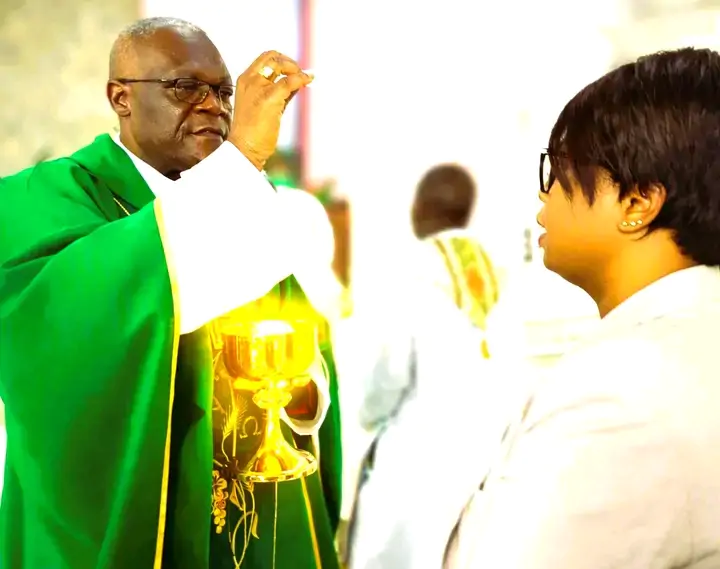
Between soft hymns, silence roared. Tears rolled down cheeks, yet His Grace administered communion with stoicism, as if arrest were not imminent. The irony dripped: a man accused of theft offering the bread of life.
The authorities were hailed for restraint, yet the question lingers: is this justice or theatre? In Zambia, arrests have become the new liturgy.
Politicians detained, bishops arraigned, citizens divided.
I note as a documentalist of history the Spanish say: “Cuando todos pierden, nadie gana.” When everyone loses, no one wins.
By law, the Archbishop remains innocent until proven guilty. May that presumption hold until a competent court decides. But the larger question is haunting: will the love between Zambia and the Catholic Church ever be rewritten?
That is a $20 million question this essay cannot answer. What is clear is that unity and dialogue are desperately needed in our nation.
Many call for the release of detained leaders, for reconciliation, for dialogue, for peace. But is that nigh? No one knows.
For now, the cathedral stands as paradox: fortress and sanctuary, courtroom and altar, Job’s ashes and David’s refuge. And in its musky silence, Zambia prays—not only for His Grace Banda, but for itself.
Anthony Mukwita, Author & Analyst
Dateline: Lusaka, September 28, 2026
Daily Nation Zambia HOT FM Zambia Millennium TV Zambia Diamond Media Zambia

Community Feedback