
RELIEF BEFORE THE VOTE, THE BILL AFTER IT- Fred M’membe

Breaking News Zambia
NewsRELIEF BEFORE THE VOTE, THE BILL AFTER IT From midnight yesterday, a litre of petrol went from K25.29 to K31.46. A litre of diesel went from K26.86 to K33.27. That is more than six kwacha on every litre, overnight, an increase of about 24 per cent. Paraffin, the fuel of the poorest homes, went from […]
RELIEF BEFORE THE VOTE, THE BILL AFTER IT
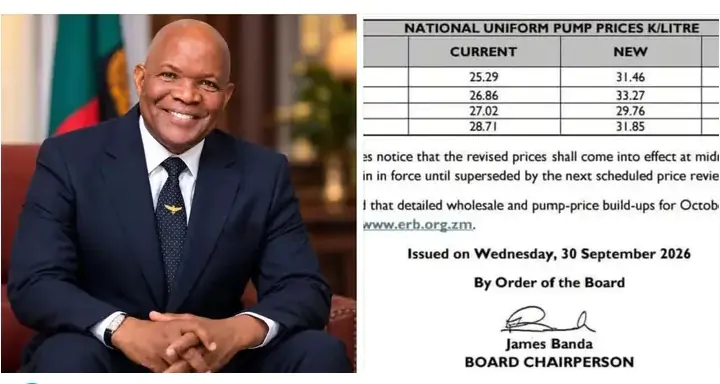
From midnight yesterday, a litre of petrol went from K25.29 to K31.46. A litre of diesel went from K26.86 to K33.27. That is more than six kwacha on every litre, overnight, an increase of about 24 per cent. Paraffin, the fuel of the poorest homes, went from K27.02 to K29.76.
These are not our figures. They are the Energy Regulation Board’s own.
Let us start with what is true because our people deserve the truth and not slogans. World oil prices have risen. The tensions in the Middle East are real. The kwacha has weakened.
But that is not the question. The question is not whether the cost of fuel should be paid. The question is how, and when, that cost is loaded onto the backs of our people. And on that question, this government made a choice.
The tax relief on fuel ran from April to September 2026. Look at those months carefully. They cover exactly the election season, the run-up to the vote of 13 August, and the inauguration that followed. In September, with world prices and the exchange rate already pushing upwards, the ERB held prices flat. Then the relief ended on 30 September, and the next morning prices jumped by a quarter.
We do not need to guess at anyone’s motives. We only need to put the dates side by side for the government to explain them. Zambians are now paying, after the vote, for the relief they received before it.
And the numbers tell us more than the dates do.
Petrol’s increase is largely explained by world prices, the kwacha, and the return of excise duty. Diesel is a different story. World diesel prices and the kwacha together moved by about 9 per cent. But the ERB’s wholesale price of diesel jumped by 27 per cent, from K20.90 to K26.51 a litre. That gap does not come from the world market. It is cost that was held back in earlier months and has now been released on our people in a single month. The ERB itself admits that its smoothing measures, together with the tax relief, kept prices down from April to September. What it has not told us is how much was held back and why all of it had to come back at once.
Why does diesel matter so much? Because diesel is what moves this country. It moves the minibus that takes the worker from Chawama to town. It moves the maize from Mkushi and Mpika, the mealie meal, the tomatoes, the kapenta, the charcoal. It runs the hammer mill and the irrigation pump. When diesel rises by K6.41 in one month, the minibus driver raises his fare, the marketeer pays more to bring her stock in, the small farmer pays more to get his crop to market, and the mother in Kanyama pays more for everything she puts on the table. Food is more than half of what an ordinary Zambian household buys. When food moves, everything moves.
We have seen this before. In August 2023, petrol rose by K3.85 and diesel by K3.52, and within a week, bus fares were up. This increase is almost twice as large.
Twenty litres of diesel cost K537.20 last month. Today, it costs K665.40.
And the worst is not over. A second shock is already scheduled. On 1 December, VAT at 16 per cent returns on fuel. On today’s prices, that is roughly another K5 on every litre. Petrol would go to about K36.49 and diesel to about K38.59. Those twenty litres of diesel would cost about K771.80. The government has offered no plan, none at all, to protect transport fares and food prices before that day arrives
There is something else our people should know. During the very months, when citizens were being told they were receiving relief, the margins of the oil marketing companies and the filling stations went up. Together, they were K3.89 a litre in March. By September; they were K4.70, a rise of 21 per cent. Today, those margins are bigger per litre than the excise duty on either petrol or diesel. Citizens got tax relief; the industry got higher margins.
This is what neoliberal management of a peripheral economy looks like. Costs are hidden when hiding them is politically useful and released when the political need has passed. The market decides the price, the politicians decide the timing, and the poor carry the bill. Relief that ends the moment the votes are counted is not care for the people. Care would have meant steady prices and a plan for December.
So we ask the government four questions, and we ask for public answers.
How much diesel cost did the ERB’s price smoothing defer between April and September, and why was it all recovered in one month?
Why did oil marketing company and dealer margins rise by 21 per cent during the relief period?
What will the government do before 1 December, when VAT adds roughly K5 a litre more?
What did the six months of relief cost the Treasury, and who is paying for it now?
Criticism without an alternative is cheap, so here is ours.
Phase VAT back in over at least three months, not a full 16 per cent in one step on 1 December. Spread the remaining diesel catch-up over several months because diesel carries our food and our public transport and must never jump by a quarter overnight. Let the ERB publish its smoothing account: how much was deferred each month, how much remains, and how it will be recovered. Let the ERB publish the cost basis for industry margins and review them. And target relief at diesel for buses, minibuses, and food haulage, where it protects the most people, rather than spreading it equally across every fuel user, rich and poor.
The principle is simple. The pump price should follow real costs, but the path it takes should be steady, public, and designed to protect the poorest.
But we must be honest with our people about something deeper. Between 74 and 80 per cent of what you pay at the pump is the wholesale cost of imported fuel. Since October 2024, TAZAMA has carried finished diesel instead of crude, and Indeni no longer refines. We import every litre we use. Tax changes and smoothing only move costs around in time. Lasting relief will come only when we buy, move and store fuel more cheaply: transparent, competitive procurement with the landed cost of every cargo published; a stabilisation fund that runs on published rules, not on the political calendar; real strategic reserves for the levy our people already pay; and freight moved off our roads and onto TAZARA and Zambia Railways.
And beyond that, the only permanent protection against fuel shocks is to need less imported fuel. Locally produced ethanol and biodiesel. Solar power for our pumps, mills, and rural enterprises. Electric buses on the routes of Lusaka and the Copperbelt. Every litre we do not import is a litre whose price no longer depends on the Middle East or the kwacha, and it is a Zambian job instead of a foreign bill.
Our economic sovereignty begins with things as ordinary as a litre of diesel. A nation that can not control what it pays to move its own food is not yet free.
Today, it is K6. On 1 December, it will be another K5. The government has two months to tell our people what it will do. Never say you were never cautioned.
Fred M’membe
SP President

Community Feedback