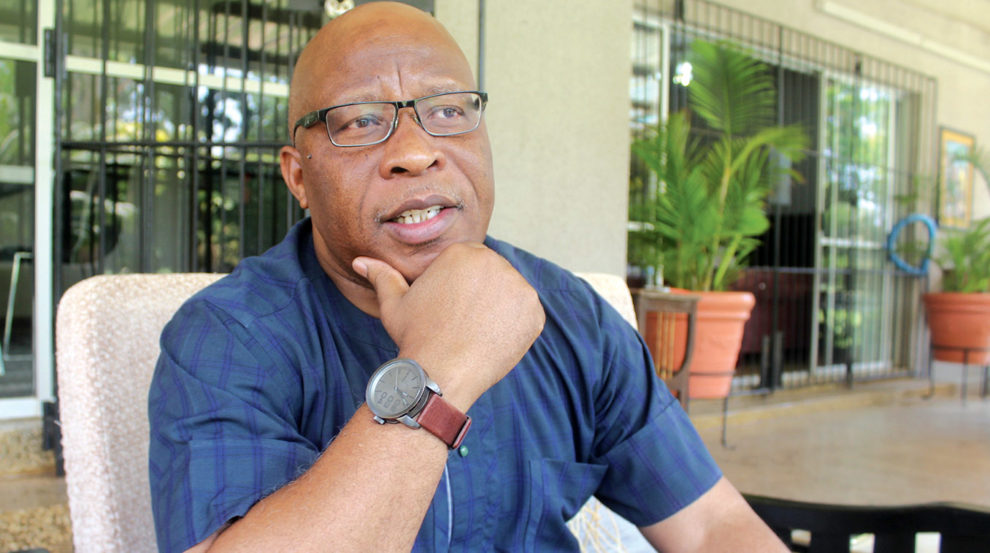
Nevers Mumba quits politics, but the benefits question remains

Breaking News Zambia
NewsFormer Vice-President Nevers Mumba has stepped away from active partisan politics and resigned as president of the New Nation Party. But as Dr Mumba begins what he describes as a new chapter as a statesman, an uncomfortable question remains over the retirement benefits attached to his former office. Mumba announced his decision on Tuesday, saying […]
Dr. Nevers Mumba
Former Vice-President Nevers Mumba has stepped away from active partisan politics and resigned as president of the New Nation Party.
But as Dr Mumba begins what he describes as a new chapter as a statesman, an uncomfortable question remains over the retirement benefits attached to his former office.
Mumba announced his decision on Tuesday, saying his departure from partisan politics was not a retirement from public service but a decision to redefine his role in national affairs. He also withdrew from the UPND Alliance Council of Presidents.
The timing has drawn renewed attention to concerns recently raised by former Ambassador Emmanuel Mwamba over whether Mumba was entitled to continue receiving former Vice-President benefits while serving as president of the New Nation Party.
Mwamba publicly argued that Mumba’s continued active role in partisan politics was inconsistent with the law governing benefits for former Vice-Presidents.
The issue is not without a legal basis.
The Benefits of Former Presidents and Former Vice-Presidents Act, 2026, which came into force on June 12, provides that retirement benefits for a former Vice-President shall not be paid or provided if the former Vice-President is engaged in active politics. The Act expressly defines active politics to include holding a position in a political party.
The same law provides that the benefits become payable when the former Vice-President ceases to be engaged in active politics.
That makes Mumba’s announcement more than a political development.
It also brings the benefits question into sharper focus.
If Mumba is no longer president of a political party and has genuinely withdrawn from active partisan politics, he would appear to have removed the statutory obstacle to receiving the benefits going forward.
But what about the period before his resignation?
That is where the argument raised by journalist and former diplomat Kellys Kaunda becomes significant.
Kaunda says Mwamba’s warning should not simply be dismissed and argues that, if he were in Mumba’s position, he would begin calculating what he had received during the period in question and consider paying it back.
His argument is that a future government could revisit the matter and seek recovery of money that was not lawfully due.
Kaunda points to the wider principle that public officials can eventually be held accountable for benefits or payments received contrary to statutory requirements, even where the issue was not immediately acted upon.
His argument is therefore less about Mumba’s decision to leave politics and more about what happens to the money, if it is subsequently established that benefits were paid during a period when the law prohibited them.
There is, however, an important distinction.
Mwamba has alleged that Government continued paying Mumba while he was active in partisan politics. That allegation has not, at this stage, been independently established by official records made public.
Neither has there been a publicly announced determination that Mumba must refund a specific amount.
What is clear is what the law says.
What remains to be established is whether the law was complied with in Mumba’s particular case.
That distinction matters because the question now facing the public is not simply whether Nevers Mumba has left politics.
It is whether his departure closes the benefits controversy — or whether it has only moved the controversy into a different phase.
The episode also raises a broader question about the purpose of retirement benefits for former leaders.
Are such benefits intended to support former Vice-Presidents after leaving public office, while requiring them to step away from active partisan politics?
If so, what should happen when a former Vice-President chooses to return to party politics?
And when the law is not followed, who is responsible — the recipient, the officials who authorise the payments, or both?
Mumba has now chosen the statesman route.
The question of the benefits, however, may not disappear simply because the political career has been put aside.
The law may have been clear. The outstanding question is whether it was followed.
Zambian Eye — Reporting Zambia. Explaining Zambia.

Community Feedback