If the Army rigs elections, how did Lungu lose?

Breaking News Zambia
News🇿🇲 INSIGHT | If the Army rigs elections, how did Lungu lose? Zambia is never short of people with selective political memory. Following the Monday Zambia Army’s statement that it will not be drawn into partisan politics, some opposition supporters have responded with a familiar argument: if the Army is politically neutral, why was it […]
🇿🇲 INSIGHT | If the Army rigs elections, how did Lungu lose?
Zambia is never short of people with selective political memory. Following the Monday Zambia Army’s statement that it will not be drawn into partisan politics, some opposition supporters have responded with a familiar argument: if the Army is politically neutral, why was it deployed during the August 2026 elections? It is a legitimate question. But once it is asked, another must follow. If the presence of soldiers during an election is itself evidence of rigging, how did Edgar Lungu lose the 2021 election after his own government deployed the military?
The record is not hidden. In August 2021, President Lungu authorised the Zambia Army, Zambia Air Force and Zambia National Service to assist police ahead of the August 12 election following political violence. “In order to curb the political violence we have witnessed in the past two days, I have allowed the Zambia Army, Zambia Air Force and Zambia National Service to help the Zambia Police in dealing with the security situation,” he said. He added: “I have taken this step in order to ensure that the electoral process, the work of the Electoral Commission of Zambia, is not interfered with.” Soldiers subsequently appeared in several parts of the country during the election period, including around sensitive electoral locations.
The PF was government. Lungu was Commander-in-Chief. The military was deployed under his authority. He still lost. Hakainde Hichilema, then the opposition candidate, defeated him with 2,852,348 votes against Lungu’s 1,870,780. So what exactly is the argument in 2026? Did the Army refuse to manufacture an election for the government which deployed it in 2021, only to suddenly acquire the ability and willingness to manufacture one for another government five years later? Political suspicion can raise a question. It cannot answer it. Evidence must do that.
This does not place the Army beyond scrutiny. The 2026 election produced legitimate questions about security deployments, particularly around constituency totalling centres. Election observers raised concerns about the intimidating effect of a heavy military presence during parts of the tabulation process, alongside broader questions about transparency. Those concerns deserve answers. But there remains a substantial difference between saying soldiers were present, saying their presence intimidated people, and proving soldiers altered an election result. A uniform at a totalling centre is not a ballot. A deployment order is not a result sheet. Presence is not proof of rigging.
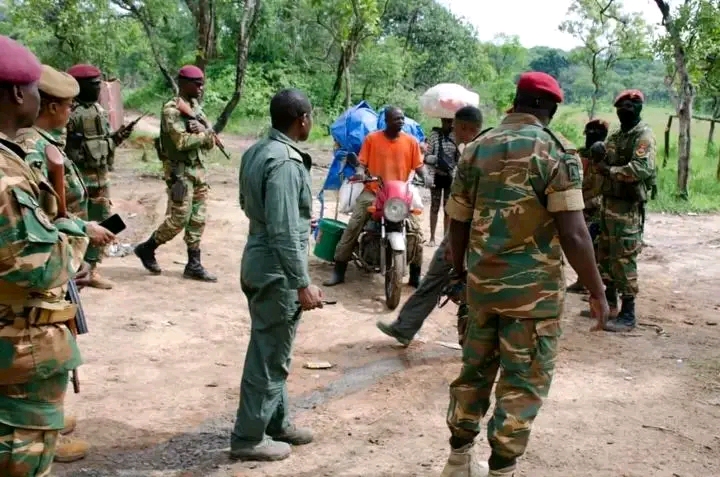
The argument circulating online, however, has expanded beyond elections. Critics are also pointing to military operations in the gold areas of North-Western Province as evidence of an Army they say has become brutal under the current government. The political connection is important. During the campaign, Brian Mundubile promised greater access to economic opportunities around mining, including returning mining dump sites to youths. For supporters who saw the gold rush as ordinary Zambians trying to survive difficult economic conditions, the sight of soldiers clearing people from mining areas reinforced an existing political grievance.
But memory cannot begin with the soldiers arriving. It must also remember what preceded them. The gold rush was not simply a gathering of unemployed Zambians carrying picks and shovels in search of survival. Authorities reported tens of thousands converging on some gold areas, attacks on police officers, offensive weapons and increasingly uncontrolled trading activity. Concerns were also raised about makeshift markets and networks involving Zambians and foreign nationals, including people from Tanzania and other countries. Once weapons, unregulated mineral trading and organised networks enter the picture, the matter stops being only about poverty. It becomes a question of law, minerals and national security.
None of this gives soldiers permission to brutalise civilians. If military personnel assaulted people unlawfully or used excessive force, such conduct deserves investigation. But there is a difference between questioning how an operation was conducted and arguing that the State had no reason to restore order. Economic hardship can explain why people rush towards newly discovered gold. It does not create a mining licence. Political leaders can legitimately promise young people greater participation in mineral wealth, but such participation still requires licences, cooperatives, designated mining areas, safety standards and rules governing who buys and sells the minerals.
This is also where Mundubile’s campaign promise deserves to be remembered accurately rather than romantically. Giving mining opportunities to Zambian youths is a legitimate policy proposition. Indeed, a mineral-rich country should constantly ask why communities sitting near valuable resources remain poor. But allowing citizens to participate in mining is different from allowing uncontrolled occupation of mineral areas where parallel markets and security problems can emerge. A gold rush is not empowerment. Lawlessness is not youth policy. The real policy challenge is turning informal miners into lawful economic participants.
The Zambia Army’s statement should therefore be read against this wider political argument. “The Zambia Army will not be drawn into partisan political discourse,” spokesperson Colonel Sydney Mwewa said. Crucially, the Army also acknowledged the democratic boundary: “Legitimate criticism and public discussion are not in themselves unlawful.” Citizens can question deployments. Journalists can investigate military conduct. Opposition politicians can challenge security decisions. But criticism of an institution and an allegation that the institution rigged an election are not the same thing. The latter requires evidence.
Zambians should remember 2021 before rewriting 2026, and remember what happened before the military entered the gold areas before reducing those operations to a political slogan. Governments change. Opposition parties change. The uniform remains. The PF deployed soldiers and still surrendered power after losing an election. The Army must remain accountable for how it exercises power, but political disappointment cannot become evidence of partisanship. If deployment alone could manufacture presidents, Edgar Lungu would never have left State House. And if every security operation against illegal mining were political persecution, the State would eventually have no law left to enforce.
– The People’s Brief | Ollus R. Ndomu

Community Feedback