East Livestock sector set for transformation

Breaking News Zambia
NewsBy Abigail Kashweka and Iris Mwale The International Livestock Research Institute (ILRI) is implementing an ambitious initiative known as the “Scaling for Impact” program, designed to transform the livestock sector in Zambia. By targeting the production and strategic preservation of high-quality forage stock feed, the program aims to cushion livestock against the devastating effects of […]
By Abigail Kashweka and Iris Mwale
The International Livestock Research Institute (ILRI) is implementing an ambitious initiative known as the “Scaling for Impact” program, designed to transform the livestock sector in Zambia. By targeting the production and strategic preservation of high-quality forage stock feed, the program aims to cushion livestock against the devastating effects of climate-induced shocks, with a target of serving at least 100,000 head of livestock across the country by 2030.
Explaining the vision behind the initiative, ILRI Research Associate Thembinkosi Baleni highlighted that climate change continues to pose severe risks to rural livelihoods, particularly through recurrent droughts that deplete natural pastures and water sources. He noted that the program targets to develop ten (10) livestock forages cooperatives, of which two (2) have so far been formulated and have been equipped with sustainable livestock management practices.
According to Mr Baleni, growing forages will improve resilience of farmers by protecting their livestock (economic assets) from climate change shocks such as drought, while allowing for diversification of farmers’ incomes through fattening, feed production hubs and forage seed/ grain seed trading. This will in turn provide crucial economic stability by allowing households maintain steady streams of income.
To achieve maximum reach and long-term sustainability, the project adopted a peer-to-peer “lead farmer” extension model, where it is currently developing twenty (20) farmer forage production and livestock feeding field schools across ten (10) districts in Eastern province. Under this structure, select agricultural producers receive comprehensive training in forage production, crop-residue mixing, and feed storage, which they are then expected to step down to “follower farmers” in their respective communities.
Crucial to the implementation of this model in the region is the active partnership between the project and local government departments.
Maybin Banda, a Livestock Technician based in Chipata, with the Department of Livestock Development under the Ministry of Fisheries and Livestock, explained how the collaborative framework operates.
“This project is basically collaborating with us as Government, and as a department, in a way that we provide human resource, while the project provides key resources such as fuel and allowances to enable our officers to move about during sensitizations,” he explained.
He detailed that Heads of Departments like himself are first trained on pasture and forage production. Afterwards, they train camp staff who are extension officers working directly in the camps, on how to harvest forage, bale feed, and properly feed livestock. These camp staff then go into the field to identify farmers and continuously teach them.
Mr Banda noted that the initiative directly addresses a critical seasonal challenge faced by local farmers, who traditionally rely on natural grazing pastures. As land for grazing is increasingly cut off for crop production and climatic challenges, pasture resources become severely depleted during the hot season, causing animals to lose weight.
“In our district, vendors look at the body condition score when setting prices,” Banda said. “If animals are not fed well during the hot season, their market value drops drastically. Our camp staff go into the fields to sensitize farmers not to burn crop residues after harvesting maize. Instead of burning stover or leaving groundnut haulms in the field, we teach farmers to collect and bale them as supplementary feed for when resources go down, he elaborated”
In addition to crop residue management, the project distributes forage seeds including velvet beans, pigeon peas, and Rhodes grass for farmers to plant, harvest, and bale.
“When drying the forage, farmers are instructed not to leave it completely in the sun, but to dry it in the shade so it retains its greenish color and starch content,” Banda added. “To enhance the taste for animals, farmers are advised to sprinkle a bit of salt or molasses, the byproduct of sugar extraction, onto the dry feed before serving it as a supplement when livestock return from grazing.”
Mr Banda indicated that the program is relating to the Ukama Ustawi concept to achieve its goal by fostering collaborations and alignment among stakeholders, including farmer cooperatives, the Ministry of Fisheries and Livestock and ILRI, among other strategic partners.
“So, you find that as this program came in, it just got embedded into already existing structures, already existing women groups, already existing youth groups. So that’s how we’ve been able to work with the program,” Mr Banda elaborated.
Early reports from lead farmers across several districts in Eastern Province indicate that the approach is already yielding remarkable results in animal health, herd management, and rural economic empowerment.
In Katete District, Janet Banda, a lead farmer from Chingaipe Village in the Kafumbwe Ward, described the project as a total turnaround for her community. She observed that prior to the training, farmers faced frequent livestock losses due to disease and poor nutrition.
“We have seen a significant reduction in diseases because, through this initiative, we now understand the correct medications and accurate dosages required to keep our livestock healthy. Furthermore, our animals are no longer getting stolen because they are no longer wandering too far in search of pastures like it was in the past, and resulted in livestock missing or being stolen. Having forages or supplementary feeding saves animals,” she shared.
Ms. Banda emphasized that the shift to deliberate forage feeding has enhanced the physical condition of her herd, making the animals noticeably healthier and heavier, which directly translates to higher market returns.
“My animals are fetching much higher prices on the market compared to before I learned this program,” she explained. “I was able to sell four cattle at K7,000 each, whereas in the past, I could only sell a single animal for between K2,000 and K3,000. Goat prices have also jumped from K300–K400 to around K800–K900 each because they look attractive and well-nourished.”
In the neighbouring Sinda District, Moffat Banda from Sivwa Village highlighted how the ILRI intervention changed his entire approach to agricultural economics. After completing his training alongside other lead farmers in Eastern Province, he received specialized seeds to plant dedicated forage crops and was instructed on how to properly blend forages with feed processing equipment.
“We were trained to keep our animals in designated enclosures and follow a structured feeding procedure,” he said.
“If you follow the guidelines properly, the livestock become fat and healthy within just 90 days. It was after seeing these results that I realized livestock farming can actually be more profitable and reliable than traditional crop farming,” he added.
As a lead farmer in a cooperative of 70 people, that was equipped with processing machinery, Mr Banda now stores his processed forage in secure locations to feed his 13 cattle.
The financial benefits were immediate; selling a portion of his herd at K6,000 per animal, up from his previous selling price of K3,000 to K4,000. This has allowed him to fend for his family, including sorting out his school -going children’ school needs.
Since receiving training in 2024, Mr Banda has set an ambitious goal to reach 500 farmers in Sinda District, with plans underway among local farmers to organize resources and construct a permanent training shed.
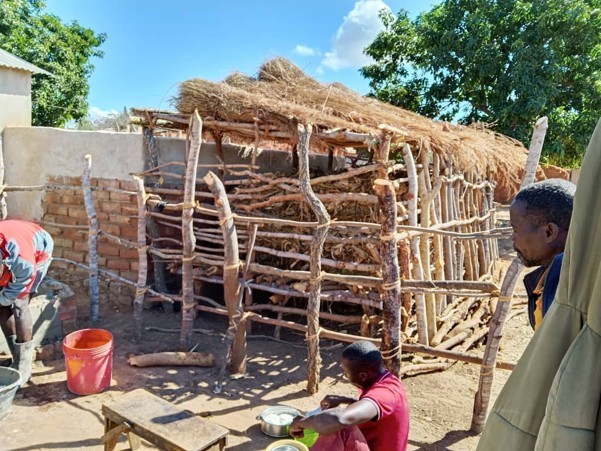
Similar successes are being recorded in Lundazi District, where lead farmer Mapopa Nkhata reported rapid progress just twelve months after adopting the program. To protect his feed supply, Mr Nkhata constructed a secure, thatched-roof shelter to store his processed forage.
“I have seven cattle and 15 goats, and although I was trained just one year ago, the benefits are already huge,” Mr Nkhata said. “I meet with local farmers twice a month to refresh their skills and ensure they are executing the feeding methods correctly.”
Having already trained 500 farmers, Mr Nkhata aims to expand his reach to another 700 next year, while working with his community to secure a central shelter to house processing machinery for public use.
In Petauke District, Allan Zulu of Zyambo Village in the Kalindawalo area highlighted the nutritional quality of the forage mixtures, which combine locally available materials including maize bran, groundnut residue, lablab legumes, and grass chaff to provide a balanced diet.
“Because so many farmers see the benefits and want to join, I have already trained 500 people and am targeting 1,000 by next year,” he narrated.
To sustain these gains, Mr Zulu and his fellow farmers are establishing a formal cooperative where members will contribute one cow each to pool capital, with the immediate goal of building a permanent structure to house their processing equipment.
As climate unpredictability continues to challenge standard farming practices across Zambia, the ILRI Scaling for Impact program is demonstrating that simple, community-driven forage production and preservation can safeguard livestock, raise rural incomes, and build a climate-resilient agricultural sector.



Community Feedback