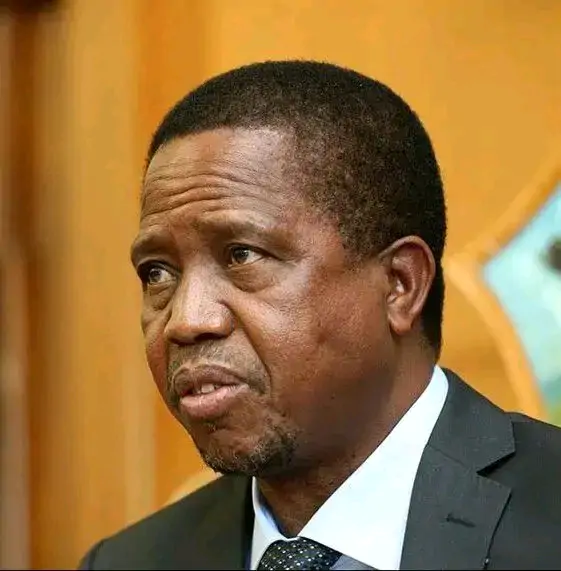
Zambia has quietly passed a law that hands government the final say over where a former president is buried

Breaking News Zambia
NewsBy Hopewell Chin’ono Zambia has quietly passed a law that hands government the final say over where a former president is buried, and it lands just months after the country’s institutions fought an actual court battle in South Africa over exactly that question after former president Edgar Lungu’s family refused to have the Zambian dictator […]
By Hopewell Chin’ono
Zambia has quietly passed a law that hands government the final say over where a former president is buried, and it lands just months after the country’s institutions fought an actual court battle in South Africa over exactly that question after former president Edgar Lungu’s family refused to have the Zambian dictator Hakainde Hichilema preside over his funeral
The Benefits of Former Presidents and Former Vice-Presidents Act, 2026, assented to on 4th June and enacted on 12th June, repeals and replaces the 1993 Act. On the surface it reads as routine housekeeping about retirement packages, pensions, and residences for former heads of state and their deputies.
But buried in Part III, Section 8, is a clause that deserves far more scrutiny than it has received. It states that a former President or former Vice-President who dies in, or after vacating, office “shall be buried at a burial site designated by the Government within the Republic,” and that the funeral “shall be conducted in accordance with State protocols, as may be prescribed.”
In other words, the state now has statutory authority to decide where a former leader’s body goes, regardless of what that person’s family wants.
This is not an abstract hypothetical.
In 2025, Zambia was consumed by precisely this dispute. When former President Edgar Lungu died, his family wanted him buried in South Africa, while the Zambian government insisted he be laid to rest at home with full state honours.
The disagreement escalated all the way to litigation, with a South African court ordering a suspension of the burial amid the fight between the Lungu family and the state. It was a messy, drawn-out and very public constitutional grey area. Now, rather than leaving that grey area for families and courts to work through case by case, Parliament has written the government’s preferred outcome directly into law.
There is a second layer worth noting too. The Act extends benefits to former Vice-Presidents for the first time, a change some, such as Emmanuel Mumba, have defended as correcting a long-standing unfairness and treating former leaders with dignity.
Others have pushed back hard, arguing that a country grappling with debt and poverty should not be expanding pensions, housing and funeral entitlements for a small circle of retired politicians, some of whom, critics point out, are already wealthy.
Taken together, the law does two things at once. It formalises comfortable retirement terms for a handful of people at the top of Zambian politics, and it grants the state permanent legal control over how, and where, those same people are finally put to rest.
For a country that just lived through a very public tug-of-war between a grieving family and the government over a coffin, writing the government’s authority into statute rather than resolving the underlying tension feels less like closure and more like Parliament betting it will need this power again.





Community Feedback