
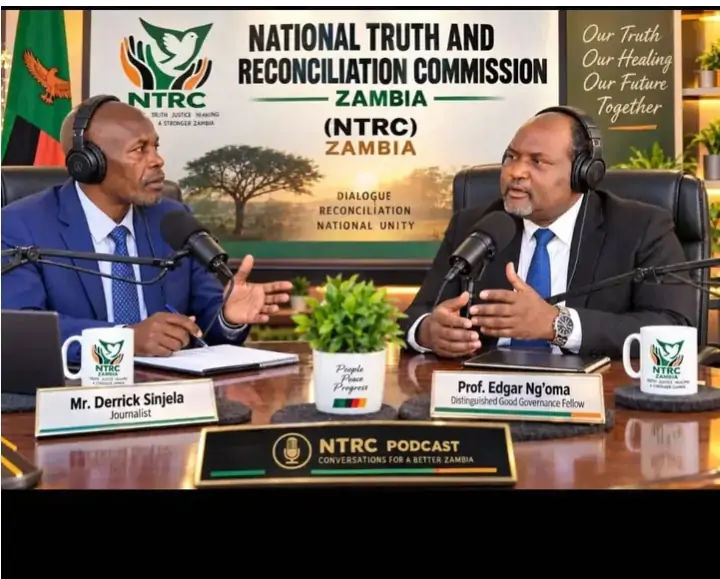
Why Zambia Needs Truth and Reconciliation – Prof. Edgar Ng’oma

Breaking News Zambia
NewsWhy Zambia Needs Truth and Reconciliation – Prof. Edgar Ng’oma _By Derrick Sinjela_ Sunday 27th September 2026. Distinguished Good Governance expert, Prof. Edgar Ng’oma, has proposed the establishment of a *National Truth and Reconciliation Commission for Zambia (NTRCZ)* — a historic and healing initiative designed to confront painful historical wounds, restore national trust, and secure […]
Why Zambia Needs Truth and Reconciliation – Prof. Edgar Ng’oma
_By Derrick Sinjela_
Sunday 27th September 2026.
Distinguished Good Governance expert, Prof. Edgar Ng’oma, has proposed the establishment of a *National Truth and Reconciliation Commission for Zambia (NTRCZ)* — a historic and healing initiative designed to confront painful historical wounds, restore national trust, and secure Zambia’s future.
In an exclusive interview on Wednesday, 23rd September 2026, Prof. Ng’oma told this author that the time has come for Zambia to transcend the politics of transition and build a truly united community.
He observed that while Zambia has earned continental respect for peacefully changing governments through the ballot, it has yet to master the more profound art of healing peacefully after those changes.
> “My proposal is simple. Zambia has learned how to change governments peacefully. We have not yet learned how to heal peacefully after those changes. This National Truth and Reconciliation Commission is not about dwelling on past transgressions. It is about securing our future,” Prof. Ng’oma explained.
*Not About One Regime, But About Our Nation: 1964 to 2026*
Prof. Ng’oma was emphatic that the proposed NTRCZ is not a witch-hunt targeting any single administration. Rather, it is a comprehensive, inclusive national audit covering Zambia’s journey from Independence in 1964 to 2026.
> “I want to allay any fear that my proposed NTRCZ is targeting a previous regime. Not at all. And that is why it is necessary. This is not about 2011 or 2021. It is about 1964 to 2026. Every era has victims who have never been heard. If we make it about one regime, we miss the point,” he said.
“This is about ending the vicious cycle where every new government investigates the old one. Let us have one truth process that protects everyone, whether you are in the ruling party or in the opposition.”
In essence, it is a commission for all Zambians — a platform where no pain is too old to be acknowledged and no voice is too small to be heard.
Reconciliation is Economic Policy
Responding to those who argue that Zambia’s priority is jobs, not dialogue, Prof. Ng’oma offered a powerful economic rebuttal: unity is the foundation upon which sustainable development is built.
“I agree we need jobs. But jobs do not come to a divided house. When investors see tribal hate speech, political revenge, and instability on social media, they go elsewhere. Reconciliation is economic policy,” he quipped.
“Rwanda did not become stable because it forgot. It became stable because it confronted its truth. Truth first, then trust, then investment.”
He argued that without social cohesion and political stability, even the most ambitious economic blueprints will falter.
*Restorative, Not Retributive: Healing, Not Punishing*
Prof. Ng’oma drew a clear and crucial distinction between a court of law and a truth commission.
“A court asks: Who is guilty and how do we punish them? A Truth Commission asks: What happened, why did it happen, and how do we ensure it never happens again?”
Unlike a court, the NTRCZ will not possess prosecutorial powers. It will not jail or sentence. Its power lies in something far deeper — truth-telling, acknowledgment, apology, and forgiveness.
“It is a platform for a mother who lost her market stall for political reasons, a youth who was beaten as a cadre, a civil servant who was retired in national interest. It allows truth-telling, apology, and forgiveness. It is restorative,” he explained.
You Cannot Heal a Wound in Darkness
To those who say “let bygones be bygones,” Prof. Ng’oma responded with both cultural wisdom and moral clarity.
“Bygones are not bygones when the wound is still bleeding. You cannot build One Zambia, One Nation in silence. Our Christian faith and our Zambian tradition teach us that for forgiveness to happen, truth must be told first. We must bring the wound into the light to clean it, so it can heal.”
True reconciliation, he insisted, demands courage — the courage to listen, to confess, and to forgive publicly.
A Passionate National Appeal
In a deeply moving conclusion, Prof. Ng’oma made an impassioned appeal to the conscience of the nation — to every Zambian, to the media, to the Church, to our Traditional Leaders, and to the Head of State, His Excellency President Hakainde Hichilema, who has himself championed reconciliation.
“From the bottom of my heart, I am on my knee, passionately appealing to all Zambians, to the media, to the Church, to our Chiefs, and to His Excellency President Hichilema, who himself called for reconciliation, to spearhead the proposed NTRCZ. Let us support this. I am not asking for a position. I am asking for a process that will heal our country. Zambia is bigger than all of us,” he prayed.
If convened with sincerity and goodwill, the National Truth and Reconciliation Commission will not be a moment of division, but a milestone of maturity — a decisive step to secure Zambia’s future for generations ofvi
young people, in the enduring and cherished spirit of *One Zambia, One Nation*.
*Ends*
Community Feedback