
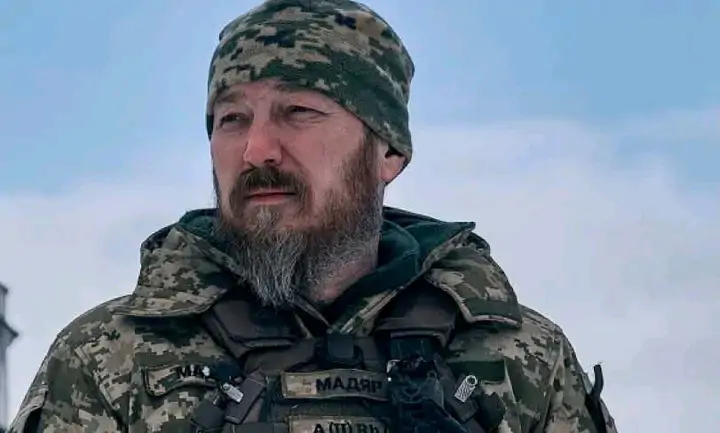
WHY WOULD RUSSIA REPORTEDLY PAY $20 MILLION FOR INFORMATION ON UKRAINIAN DRONE COMMANDER ROBERT “MADYAR” BROVDI?

Breaking News Zambia
NewsWHY WOULD RUSSIA REPORTEDLY PAY $20 MILLION FOR INFORMATION ON UKRAINIAN DRONE COMMANDER ROBERT “MADYAR” BROVDI? Robert Brovdi, better known by his call sign “Madyar,” is not just another Ukrainian commander. He leads Ukraine’s Unmanned Systems Forces (USF) and has become one of the most closely protected figures in the Ukrainian military. According to a […]
WHY WOULD RUSSIA REPORTEDLY PAY $20 MILLION FOR INFORMATION ON UKRAINIAN DRONE COMMANDER ROBERT “MADYAR” BROVDI?
Robert Brovdi, better known by his call sign “Madyar,” is not just another Ukrainian commander.
He leads Ukraine’s Unmanned Systems Forces (USF) and has become one of the most closely protected figures in the Ukrainian military.
According to a report by The Wall Street Journal, Ukraine’s Unmanned Systems Forces say the Kremlin is offering $20 million for information that could help locate Brovdi, with the alleged bounty circulating through criminal networks across the former Soviet space.
So why would one commander be worth so much?
The answer lies in how modern warfare has changed.
For decades, destroying a tank, artillery battery, air-defense system or military facility hundreds of kilometers from the front could require an aircraft, an expensive missile or a complex military operation.
Drones have changed that equation.
Brovdi has become one of the most visible figures in that transformation.
Before Russia’s full-scale invasion, he was not a career military officer. He was a businessman who later became a commander of Ukrainian drone units and eventually took charge of the country’s specialized unmanned-systems branch.
His importance is therefore not simply that he operates drones.
It is that he has helped turn them into an industrial-scale system of warfare.
Units under his command use different types of unmanned vehicles for reconnaissance, attacks on troops and equipment, logistical interdiction and strikes against targets far beyond the front lines.
Brovdi has claimed that Ukraine’s Unmanned Systems Forces account for roughly 2.5% of the Ukrainian military’s personnel, while being responsible for approximately one-third of Russian casualties over the previous year.
That is a claim made by the Ukrainian commander himself and should be treated as such. However, it helps explain why Moscow could have a strong interest in locating him.
Madyar represents the type of warfare that is making Russian advances increasingly costly.
The issue is not simply how many drones Ukraine possesses.
It is the organization behind them.
Operators, intelligence personnel, communications networks, weapons production, target selection, reconnaissance, image analysis and the coordination of thousands of missions form a vast technological chain.
Eliminating one commander would not automatically destroy that structure, but targeting its leadership could potentially disrupt coordination, command and the ability to adapt.
There is also a psychological dimension.
If a $20 million bounty is indeed being offered, it would not only send a message to Brovdi.
It would send one to everyone around him.
Anyone who knows his location could potentially become a source of information.
That is why the security surrounding the commander reportedly resembles something from a spy movie.
When a Wall Street Journal journalist was taken to the secret location where Brovdi was staying, she was reportedly required to disable her phone’s location and communications functions and place it inside a Faraday bag, designed to block cellular, Wi-Fi, Bluetooth and GPS signals.
She was then transported in a vehicle with tinted windows.
The objective was straightforward:
even a visitor’s phone could not accidentally reveal the commander’s location.
In modern warfare, a smartphone can unintentionally become a tracking beacon.
A connection to a cell tower, a GPS-enabled application, photographs containing metadata or other electronic transmissions can potentially provide clues about a person’s whereabouts.
When drones and missiles can strike shortly after a target is located, physically hiding a commander is no longer enough.
His digital footprint must also be hidden.
Brovdi has also been sentenced in absentia by Russian courts to lengthy prison terms under terrorism-related accusations connected to Ukrainian military operations.
But the reported $20 million bounty, if accurately described by the Journal, highlights something broader:
The war in Ukraine is demonstrating how valuable a single individual can become when that person helps command an organization capable of multiplying the battlefield impact of thousands of relatively inexpensive machines.
For much of the 20th century, the symbols of military power were battleships, bombers, tanks and missiles.
Ukraine is revealing another reality.
One small drone carrying explosives can pursue a vehicle.
Another can observe territory kilometers away.
Another can serve as a communications relay.
Another can strike infrastructure far behind the front.
And behind all of them are people designing procedures, analyzing intelligence and deciding how to deploy the network.
That is why Robert “Madyar” Brovdi has become such a high-value target.
Not because he is a weapon himself.
But because he leads one of the structures helping define how warfare may be conducted in the future.
If the reported $20 million bounty is genuine, it illustrates how strategic value on the modern battlefield increasingly depends not only on the size of an army, but also on its ability to connect technology, intelligence, production and personnel.
The war in Ukraine began with massive columns of tanks.
Four years later, some of the conflict’s most closely targeted commanders are those capable of directing armies of machines small enough to fit in the trunk of a car.
The nature of war has changed and “Madyar” has become one of the figures most closely associated with that transformation.

Community Feedback