
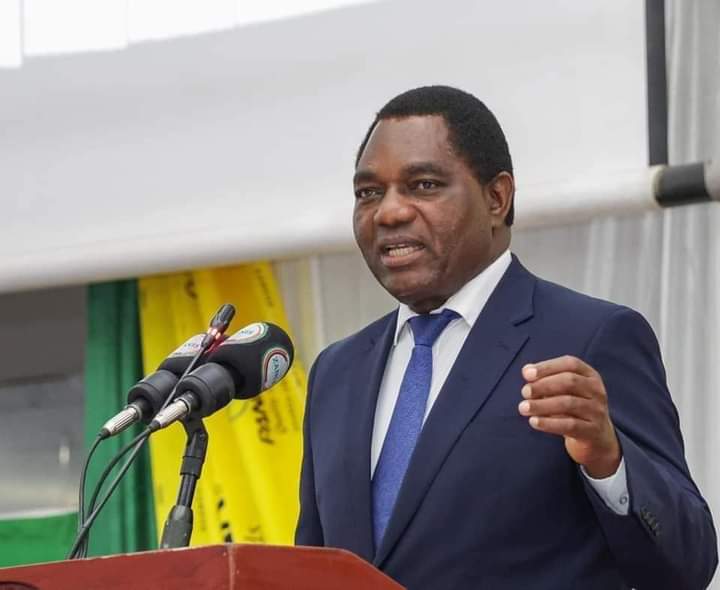
“There is no crisis, we move on” — Hichilema tells Zambians

Breaking News Zambia
NewsLUSAKA – President Hakainde Hichilema has told Zambians to move on from the August 13 election, rejecting claims that the country is facing a post-election crisis and warning that political messaging on social media could undermine investor confidence. Speaking at State House during the swearing-in of newly appointed Deputy Auditor General Patricia Malaila on Friday, […]
LUSAKA – President Hakainde Hichilema has told Zambians to move on from the August 13 election, rejecting claims that the country is facing a post-election crisis and warning that political messaging on social media could undermine investor confidence.
Speaking at State House during the swearing-in of newly appointed Deputy Auditor General Patricia Malaila on Friday, Hichilema said the election had been decided and the country should now concentrate on development.
“There’s no issue in this country. We have had an election. Zambians voted. Decisions are made by Zambians. We move on,” he said.
The remarks come more than a month after the August election, whose outcome remains disputed by some opposition figures. President Hichilema was declared the winner by the Electoral Commission of Zambia with 2,965,326 votes, ahead of Brian Mundubile, who polled 1,856,217.
But while the Government has maintained that the election produced a clear result, opposition figures and other critics have continued to raise concerns about the conduct and aftermath of the election.
It is against that background that Hichilema used the swearing-in ceremony to make a broader appeal for citizens to stop presenting Zambia as a country in crisis.
“If it is not me, nobody should be in that office”
The President said some of the continued political dispute was being driven by people who were unhappy that their preferred candidate was not in State House.
“What is this creating? A crisis where there’s none. What is it about? Selfish interests. ‘If it is not me, nobody should be in that office’. Let us not have that mentality,” he said.
He also warned that citizens who break the law should expect the legal process to take its course regardless of their status or age.
“The law applies equally to all citizens regardless of status or age,” he said.
The comments come as several opposition figures remain involved in criminal proceedings following the election, including Mundubile and his running mate Makebi Zulu, who are facing treason and sedition-related cases.
The President’s remarks did not address those individual cases.
Hichilema warns social media could scare investors
Another major part of the President’s message was directed at what Zambians publish on social media.
Hichilema said he regularly monitors social media and warned that posts portraying Zambia negatively could affect efforts to attract investment.
“I scan social media. I look at the kind of stuff that is thrown in there. You don’t realize what you are doing. You are scaring off an investor who we have worked so hard to attract,” he said.
He appealed to Zambians living outside the country to also consider the consequences of how they portray Zambia internationally.
“The fact that you are not physically here does not entitle you to damage your country. If you really love Zambia, why would you damage your country?” he asked.
The comments come as the post-election dispute has increasingly moved beyond Zambia’s borders, with demonstrations held by some Zambians in the diaspora and criticism of the Government raised in international forums.
Hichilema’s argument is that such activity risks affecting the country’s economic interests, particularly investor confidence.
Why Hichilema stayed away from UNGA
The President also offered an explanation for his decision not to travel to New York for the 81st United Nations General Assembly, where Foreign Affairs Minister Mulambo Haimbe has represented Zambia.
Hichilema said the decision was part of a deliberate effort to reduce the cost of foreign travel by government officials.
He said his administration had reduced both the size of official delegations and the length of overseas trips, contrasting this with previous practices where some officials allegedly stayed in New York for as long as a month.
“I have reduced both the size of official delegations and the duration of foreign trips to save public resources,” he said.
The President said his decision to remain in Zambia also meant that people who would normally have travelled with him remained at home, generating further savings.
He joked that some members of his presidential team were unhappy with the decision because they had expected to travel and had already made plans around the trip.
He said leadership had to start with the President and Vice-President setting an example in controlling public expenditure.
“State House is not for parties”
Hichilema also used the occasion to describe changes he says have taken place in the use of State House.
He said State House should primarily be a place for official government business rather than entertainment.
The President recalled comments from someone who had observed that State House had become “dull” because there were no longer Friday parties and alcohol.
“State House is not for tumoba but serious work,” he said, according to reporting from the event.
Hichilema said alcohol and entertainment at State House involved public resources and argued that government money should instead be directed towards national priorities.
He said State House was now being used as a working environment and that people who wanted to hold parties could do so using their own money.
The remarks fit into a broader message Hichilema has repeatedly delivered since the start of his second term: that public office should be accompanied by financial discipline, accountability and a focus on delivering services.
Hichilema points to the economy
The President also argued that Zambia’s economy had remained resilient despite the political contestation surrounding the election.
He pointed to falling inflation and economic growth as indicators that the country was continuing to move forward.
According to figures cited by Hichilema, inflation had fallen from 6.2 percent around the election period to 6.1 percent in September, while the economy recorded growth of 7.2 percent in the second quarter of 2026.
The Central Statistical Office and other economic data will ultimately provide the fuller picture of how those indicators are translating into household conditions and business activity.
But for the President, the figures are evidence that Zambia’s economic programme has remained on course despite the political environment.
“Grow Zambia” becomes the focus
Hichilema linked the economic discussion to his second-term Grow Zambia agenda.
The agenda, which was introduced around his inauguration for a second five-year term, is intended to shift the Government’s focus from economic stabilisation towards broader wealth creation and growth.
The President’s message at State House was therefore broader than an appeal to simply accept the election outcome.
He connected political stability, responsible public communication, prudent government spending and economic growth as parts of the same national project.
His argument was that Zambia cannot attract investment or concentrate on economic development if citizens and political actors continue to portray the country as being in permanent crisis.
But that position exists alongside continuing debate over the election itself, the treatment of opposition figures and questions about institutions raised by opposition parties and some international observers.
For Hichilema, however, the emphasis now is on what comes after the election.
The message from State House was clear: the campaign is over, the Government is in place, and the next phase is supposed to be about growing Zambia.
Whether that call for moving on will resolve the political disagreements that remain after the election is another question.
Zambian Eye will continue to follow both sides of that conversation — what the Government says Zambia should now focus on, and the issues opposition parties and other stakeholders say remain unresolved.


Community Feedback