
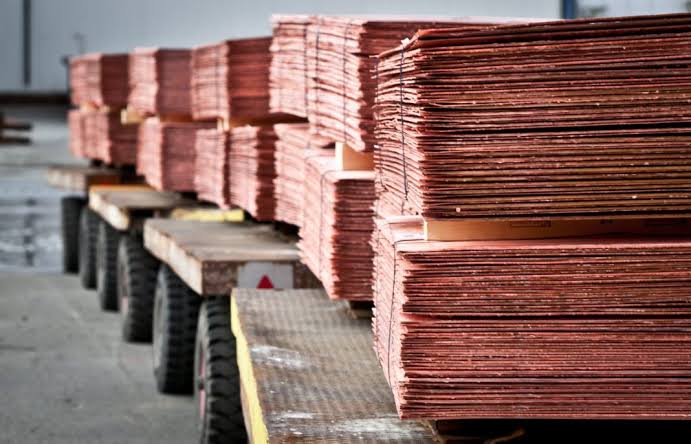
Copper prices booms to above $14,600/ton, why is the Kwacha not coming down to below K15/Dollar?

Breaking News Zambia
NewsAn economic analyst has raised concerns over […]
An economic analyst has raised concerns over the disconnect between record-high copper prices, now hovering at $14,600 per ton, and the continued weakness of the Kwacha, which remains high at K19 to the US dollar.
Copper prices have recently surged past $14,600 per ton, raising questions about why Zambia’s currency, the Kwacha, remains weak at around K19 per US dollar instead of strengthening, as many would expect given the country’s dependence on copper exports.
Speaking in an exclusive interview with the Zambian Business Times – ZBT, Economic Analyst Yusuf Dodia, who is also Chairperson for the Private Sector Development Association – PSDA, highlighted that despite government measures to ensure export earnings are repatriated, the expected strengthening of the local currency has not materialized, prompting calls for greater transparency and accountability in the handling of export proceeds.
Dodia explained that the export proceeds tracking framework, introduced by the Ministry of Finance in January 2024, was intended to ensure all export earnings from commodities like copper are remitted to Zambia.
Dodia expressed surprise that despite copper prices reaching $14,600 per ton, Zambia is not seeing a greater inflow of export earnings that would help strengthen the Kwacha.
He noted that, beginning in May 2025, increased export proceeds led to a marked appreciation of the currency, from K30 to $1, down to K17 to $1 by March 2026. With current copper prices, he argued, the Kwacha should have gained even more value and could reasonably be trading at around K12 to $1.
However, Dodia expressed concern that these anticipated inflows are not materializing as expected. He suggested that either there are delays in remitting export earnings, or there may be administrative or regulatory hiccups that are preventing the full benefit from reaching the Zambian economy. Dodia called on the Ministry of Finance and the Bank of Zambia to clarify the situation, stating, “Given these high copper prices, the Kwacha should be appreciating every day.”
He further emphasized that the global demand for copper is likely to persist, driven by the growth of electric vehicles and renewable energy installations. This should, in principle, continue supporting high prices and increased export revenues. Dodia highlighted the crucial role of the Zambia Revenue Authority (ZRA) in ensuring that declared copper exports match actual shipments, reinforcing transparency and accountability in the export sector.
While copper remains Zambia’s largest export, Dodia pointed out that other sectors, such as cut flowers, wheat, and beef, also contribute to export earnings. Yet, he observed, the full value of these inflows is not reflected in the Kwacha’s performance.
When asked about the potential impact of copper trading above $14,600 per ton, Dodia projected that the Kwacha could reasonably strengthen to between K10 and K12 to the dollar. He explained that beyond the immediate benefit of increased foreign exchange inflows, higher copper prices also boost government revenue through mineral royalty taxes, currently set at around 8%.
However, Dodia noted some uncertainty about whether these royalties are calculated based on international copper prices or the quantity of ore extracted, suggesting that rising prices should indeed lead to higher tax collections.
Despite this, Dodia emphasized that mineral royalties represent only a small fraction of copper’s true economic value. The greater benefit, he argued, comes when export proceeds are repatriated to Zambia, strengthening the Kwacha, increasing liquidity in local banks, and providing capital to spur growth across other sectors such as tourism and manufacturing. He underscored the importance of ensuring that the gains from copper exports translate into broader economic development for the country.
For ordinary Zambians to truly benefit, Dodia advocated for continued enforcement of the export proceeds tracking framework. A stronger Kwacha, he explained, would lower the cost of imported goods, ranging from electronics to clothing and hardware, thereby improving purchasing power for consumers. “When banks have more liquidity, they can lend more to small businesses, spurring job creation and expanding the domestic tax base. This, in turn, allows the government to finance development and service external debt.”
Dodia concluded by emphasizing the importance of ensuring that Zambia’s mineral wealth translates into tangible benefits for the wider population, calling for ongoing vigilance and transparency in the management of export proceeds and foreign currency inflows.




Community Feedback