
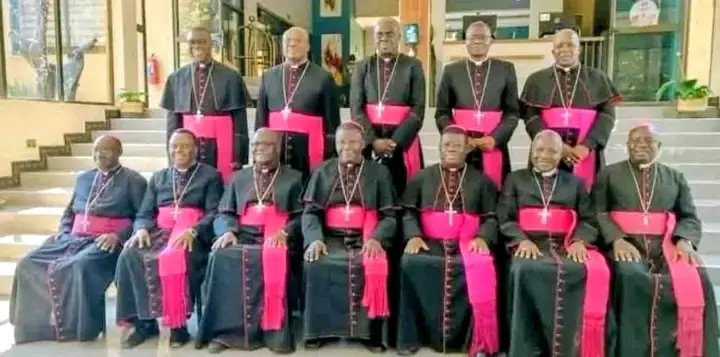
Catholic bishops warn of political polarisation, fear and shrinking civic space in Zambia

Breaking News Zambia
NewsCatholic bishops warn of political polarisation, fear and shrinking civic space in Zambia THE Catholic Church has raised concern over increasing political polarisation, restrictions on freedom of expression, electoral credibility and reports of arbitrary arrests and political violence in Zambia. In a serious pastoral appeal to Zambians and people of goodwill, the Church says the […]
Catholic bishops warn of political polarisation, fear and shrinking civic space in Zambia
THE Catholic Church has raised concern over increasing political polarisation, restrictions on freedom of expression, electoral credibility and reports of arbitrary arrests and political violence in Zambia.
In a serious pastoral appeal to Zambians and people of goodwill, the Church says the country is facing a number of developments that require urgent attention, warning that they risk weakening trust between citizens and institutions and deepening divisions in society.
The Church says it is particularly concerned about “increasing political polarisation”, which it says is weakening dialogue and cooperation while making it more difficult for citizens to place the common good above partisan interests.
It has also raised concern over what it describes as the manipulation of ethnic identities and tribal sentiments for political purposes, warning that such tendencies risk creating divisions and mistrust among citizens and threaten the spirit of “One Zambia, One Nation.”
The Church further says many citizens are experiencing fear relating to personal security, freedom of expression, employment and the consequences of expressing political opinions.
On media freedom and civic participation, the bishops express concern about what they describe as “the narrowing of the space for freedom of expression,” including concerns over the treatment of independent media, civil society and dissenting voices.
“A healthy democracy requires room for responsible disagreement, scrutiny and peaceful participation,” the statement says.
The Church also questions public confidence in the electoral process, expressing concern about the credibility and transparency of electoral processes, including concerns raised regarding the conduct and management of the 2026 General Elections.
It says public confidence in elections is essential to the legitimacy and stability of democratic institutions.
The pastoral statement further raises concerns over restrictions affecting access to justice and perceptions that the independence of governance institutions and the rule of law are being weakened.
The Church says it is concerned about difficulties faced by opposition parties and political actors, including reports of harassment, restrictions and arrests.
“Democracy requires space for alternative political voices and peaceful political participation,” it says.
It also expresses concern over intimidation, political violence and cadreism, saying these discourage citizens from participating freely and peacefully in public life.
The Church additionally highlights debates surrounding constitutional provisions on presidential terms of office, saying these have generated anxiety about constitutional safeguards and democratic continuity.
It further cites reports of arbitrary arrests and detention, the presence of military personnel in civilian spaces, and reports of excessive or unlawful use of force, including the loss of civilian lives.
“Every human life is sacred and must be protected,” the statement says.
Church calls for dialogue and rule of law
Drawing on Catholic social teaching and Scripture, the Church says political authority has a moral purpose and must serve the dignity and welfare of the people within the framework of justice, truth and the rule of law.
It calls for the protection and strengthening of constitutionalism, the rule of law and the independence of institutions, saying public institutions must be instruments of justice and service rather than sources of fear.
The Church is also calling for genuine dialogue, saying political, social and ethnic tensions should be addressed through honest conversation, listening, reconciliation and peaceful engagement rather than intimidation or violence.
It says Christian faith calls on citizens to reject hatred, violence, revenge, tribalism and political intolerance, while embracing forgiveness, dialogue, solidarity and the courage to seek truth.
The statement concludes that the current moment requires “not silence or resignation, but responsible action directed towards peace, justice, reconciliation and the common good.”
TV Yatu | Noel Iyombwa | September 30, 2026.


Community Feedback