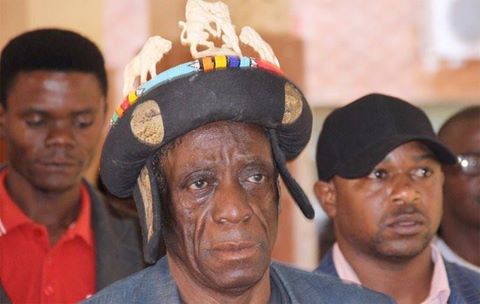
Know Your Constitution Moment ― How Does a Chief Become Paramount? The Mukuni Case and Royalty Perking Order in Zambia

Breaking News Zambia
News50 ViewsBy Dr Tarcisius Mukuka Introduction Recent reports indicate that the Mukuni Royal Dynasty has petitioned the Constitutional Court seeking recognition of Chief Mukuni XIX as a Paramount Chief, with powers and perks associated with that status. Three existing Paramount Chiefs — the Litunga, Chitimukulu and Kalonga Gawa Undi — sought to participate in the […]
50 ViewsAI-generated image of Paramount Chiefs and a Senior Chief overlooking the Musi-o-Tunya Falls
Dr Tarcisius Mukuka
By Dr Tarcisius Mukuka
Introduction
Recent reports indicate that the Mukuni Royal Dynasty has petitioned the Constitutional Court seeking recognition of Chief Mukuni XIX as a Paramount Chief, with powers and perks associated with that status. Three existing Paramount Chiefs — the Litunga, Chitimukulu and Kalonga Gawa Undi — sought to participate in the case but the Constitutional Court declined. This petition is not unprecedented in Zambia. I use the Mukuni case as a Know Your Constitution Moment exploring two questions: Does the government have any authority to confer paramountcy in Zambia? What grounds has the Mukuni royalty presented for the petition?
Current Status of the Mukuni Case
The Mukuni case is now identifiable as 2026/CCZ/0011, Jonas Shakafuswa (suing as Director General of the Bene Mukuni Royal Dynasty Committee) v The Attorney General and Others, and on 10 September 2026 the Constitutional Court dismissed the application by three Paramount Chiefs to join the proceedings.
The Tonga Paramountcy Precedent
The Mukuni question is not without precedent. Chief Monze’s claim to Paramountcy among the Tonga dates back at least to the colonial period. In 1953, his representatives sought recognition from the Provincial Commissioner, partly invoking his traditional authority as a rainmaker. The request was rejected, not only by the colonial administration but also within the Plateau Tonga Native Authority, where other Tonga chiefs did not accept the necessity of placing one chief above the others. There is, however, a Cambridge-published historical study which refers to “the Paramount Chief on the Tonga plateau, Mugodi Monze” and records that he was deposed in 1959.
The claim resurfaced after independence, increasingly framed as a question of Tonga unity. The claim has again surfaced alongside the Mukuni Paramountcy controversy. In July 2026, reports described supporters of both Chief Monze and Chief Mukuni pressing for Paramount status. This raises the question: who defines Paramountcy — the tradition itself, the other traditional authorities, the State, or some combination of all three?
Chief Monze was not rejected through a single formal decision on the merits of a Paramountcy claim. Rather, successive governments continued to treat him as a chief/senior chief and did not formally recognise him as Paramount. The Tonga political system was historically relatively decentralised. The colonial authorities themselves found it difficult to impose a Paramount Chief because the recognised Tonga chiefs did not regard one chief as naturally superior to the others. A recent UNZA study records that when the matter was considered by the Plateau Tonga Native Authority, the Tonga chiefs rejected the idea that there needed to be one chief above the others.
Beyond the Politics of the Day
It would be easy to approach this matter through contemporary politics. Traditional authority should not become a reward for political friendship, influence or proximity to power. Equally, opposition to a particular claim should not become an excuse for diminishing the history and dignity of the people who make it. The proper constitutional question is much more enduring: Would the same criteria applied to Mukuni, if effected, be available to any other traditional establishment?
The Constitution itself gives us an important starting point. Article 165 provides that the institution of chieftaincy and traditional institutions shall exist in accordance with the culture, customs and traditions of the people to whom they apply. It also places an important limitation on Parliament: legislation cannot confer on a person or authority the power to recognise or withdraw recognition of a chief. Article 167 further protects the privileges and benefits attached to the office through culture, custom and tradition. In other words, Zambia’s Constitution does not treat traditional authority as something concocted by Government. The history of Chief Monze offers a cautionary lesson for the Mukuni case. Paramountcy cannot rest simply on the prominence of a traditional ruler, the size of his establishment, his spiritual authority, or the political desire for a unifying figure. It must be grounded in demonstrable customary legitimacy and in an identifiable traditional structure of authority. The State’s role should be to recognise such an institution, not to manufacture one.
The Intriguing Case of Mukuni
Here we must tread carefully. There are different accounts of the origins and migrations of the ruling houses associated with the Toka-Leya and Mukuni traditions. One historical account records the Mukuni tradition of Lenje origins and migration towards the Victoria Falls area. Other research emphasises the diverse origins of the three Toka-Leya chiefdoms — Mukuni, Musokotwane and Sekute. The uncertainty itself is instructive. We should not turn contested or incomplete historical traditions into convenient political weapons. A dynasty’s migration from one region does not, by itself, invalidate or validate its subsequent customary legitimacy. African political history is full of migrations, settlements, alliances, marriages, conquests and incorporations through which new political orders emerged.
The Toka-Leya Complication
History is even more complicated because the Toka-Leya are not simply one undifferentiated traditional institution under one chief. Research describes three Toka-Leya chiefdoms —Mukuni, Musokotwane and Sekute — with their own histories and institutions. Research has also shown that the chief historically occupied an important apex in the political, judicial and ritual order of a chiefdom, while authority could also be shared with other traditional offices, including important female ritual authorities, such as the Bedyango or High Priestess of the tribe, showing traditional institutions may be much more complex than their modern administrative labels suggest. Historical records contain an intriguing possibility that some of the distinctions by which traditional leaders are classified today may reflect the ways colonial administrations organised and recognised chiefs rather than perfectly reproducing pre-colonial political structures. The Victoria Falls area has specifically suggested that formalised systems of chiefs and headmen were influenced by government recognition. But that does not settle the Mukuni case. It makes it much more complex.
The Danger of Politicising Paramountcy
That is why the Mukuni case needs to be approached carefully. If elevation to Paramountcy becomes dependent upon political whims, every government will inherit the temptation to create or reward traditional royal allies. Traditional authority must survive changes of government. The test therefore has to be government-neutral. If the present government were to leave office tomorrow, would the criteria used to recognise Paramountcy still appear fair? If another community presented an equivalent historical and customary case, would it receive the same consideration?
A Know Your Constitution Moment
This is precisely why the Mukuni case belongs in a Know Your Constitution conversation. The Constitution does not ask us to choose between modern Zambia and traditional Zambia. It attempts to accommodate both. The challenge is to understand how customary authority fits within a constitutional republic. We therefore need a national conversation about the meaning of Paramountcy or abolish it. Such a conversation should examine customary law, historical evidence, genealogy, territorial authority, relations among chiefs, continuity of the institution and the traditional constitutional structure of each community. It should not begin with the question: Who deserves the title? It should begin with: What makes a Paramount Chief paramount?
Conclusion
Perhaps the deepest lesson is this: Zambia should not concoct tradition through politics. Neither should it allow politics to erase legitimate tradition. The task of constitutionalism is to provide a fair framework within which both history and custom can be heard. The Mukuni case therefore deserves neither applause nor dismissal simply because of the person at its centre. It deserves something more valuable: a constitutional, historical and genuinely national conversation about who we are, where our traditional institutions come from, and how they should live within the Zambia we are becoming. The Mukuni case may be a missed opportunity for this conversation. That is why this case is a Know Your Constitution moment.
About the Author
Dr Tarcisius Mukuka is a Zambian scholar, educator, theologian, writer, politics and governance commentator whose interdisciplinary work brings together education, theology, biblical studies, ethics, governance, democracy, Traditional Authority, customary legitimacy and Constitutionalism in Zambia, human and spiritual maturity. His academic formation includes Biblical Studies, Zambian history, theology, philosophy, social sciences and Classics.


Community Feedback