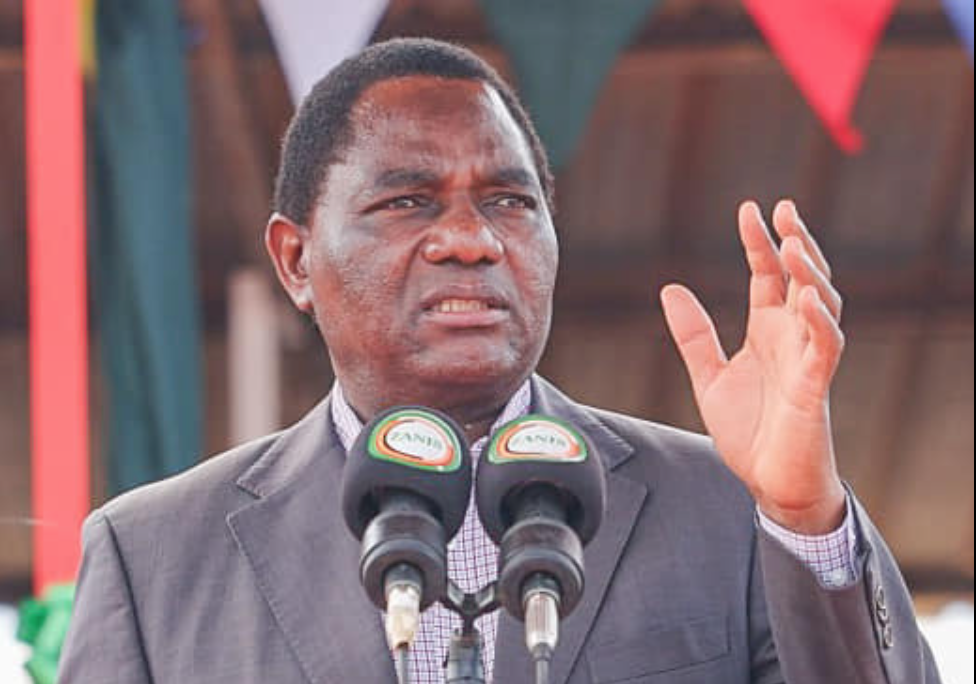
HH is not perfect, but it is in Zambia’s interest to retain him

Breaking News Zambia
NewsPRESIDENT Hakainde Hichilema and the United Party for National Development are not perfect. They have made mistakes, failed to meet some public expectations and, in certain areas, performed far below the standard they set for themselves while in opposition. There is no honest way of assessing the UPND’s first five years without acknowledging this reality. […]
PRESIDENT Hakainde Hichilema and the United Party for National Development are not perfect. They have made mistakes, failed to meet some public expectations and, in certain areas, performed far below the standard they set for themselves while in opposition.
There is no honest way of assessing the UPND’s first five years without acknowledging this reality. The frustration among many citizens is not imaginary. It is rooted in the promises that the party made before assuming office. The UPND presented itself as a government that would lower the cost of living, create employment, reduce the price of fuel, stabilise the exchange rate, end load-shedding and generally make life easier for ordinary citizens.
Some of those promises have been fulfilled or partially achieved. Others remain outstanding. In some cases, the government underestimated the size of the problems it would encounter. In others, it simply overpromised.
The cost of living remains one of the strongest complaints against the UPND. But this matter must be properly understood. Almost every political party that seeks power promises to lower the cost of living. In its literal sense, however, reducing the general price level is rarely practical. Prices ordinarily rise over time. What responsible governments can do is slow down the rate at which prices increase, improve productivity, create employment and raise household incomes.
When people earn enough to pay rent, buy mealie-meal, settle school expenses, access healthcare and still save something at the end of the month, the cost of living has effectively been brought within their reach. Therefore, the true test is not merely whether the price of bread has returned to what it was five years ago. It is whether citizens’ earnings are growing faster than the cost of their basic needs.
This is where the UPND must direct its attention should it receive another mandate. Economic stability means very little to a citizen who cannot afford food. Debt restructuring means very little to an unemployed graduate. Improved foreign reserves mean very little to a small trader whose business has been destroyed by prolonged power cuts. The government must translate the improvements recorded in economic statistics into household income, jobs and affordable services.
At the same time, it would be dishonest to assess President Hichilema as though he inherited a normal and functioning economy. He did not. The UPND inherited a country in economic distress. Zambia had defaulted on its external debt. Government arrears had accumulated. Investor confidence had deteriorated. Public resources were being consumed by debt obligations, while the country had limited access to international financing. The debt mountain appeared almost impossible to climb.
That position has changed substantially. By May 2026, the International Monetary Fund reported that Zambia’s debt restructuring agreements covered approximately 94 per cent of the restructuring perimeter. The IMF also said Zambia had made substantial progress in restoring macroeconomic stability, with international reserves rising to US$6.4 billion, representing about 4.4 months of import cover. Inflation had declined to 6.8 per cent in April 2026, returning to the Bank of Zambia’s target range.
The clearest illustration of the burden that this government continues to carry can be found in the Treasury expenditure for June 2026. In that month, the government released K49.1 billion to finance public services, debt obligations, social protection and infrastructure. Out of this amount, an extraordinary K34.9 billion went towards servicing debt and dismantling domestic arrears. That included K7.4 billion for domestic debt, K26 billion for external obligations and K1.5 billion for accumulated arrears.
That means more than 70 per cent of the money released in that month was swallowed by debt and unpaid obligations accumulated over the years. Yet, from the remaining resources, government still had to pay public servants, finance social cash transfers, fund CDF projects, operate ministries and support roads, schools, hospitals and water infrastructure. This should force every fair-minded Zambian to ask one question: what more could this government have achieved if it had not inherited such a crushing debt burden?
This is not to absolve the UPND of its failures. President Hichilema voluntarily applied for the job knowing that the country was in trouble. He cannot permanently use the previous administration as an excuse. Five years is long enough for a government to take responsibility for both its achievements and failures.
But context matters. The same way we cannot praise a government for cleaning a house without mentioning who made the mess, we cannot condemn it for failing to complete every repair without considering the condition in which it found that house.
The question before voters is therefore not whether President Hichilema is perfect. He is not. The question is whether Zambia is safer continuing with a government that has stabilised the foundation or gambling on a return to economic experimentation, uncontrolled borrowing and political recklessness.
A second mandate should not be treated as a reward. It should be understood as an opportunity to convert economic stabilisation into employment, higher household incomes, reliable electricity, better healthcare and sustainable growth. The UPND must be made to understand that the next five years cannot be another period of explaining inherited problems. They must be years of delivering visible prosperity.
It is on that premise that we say President Hichilema and his UPND are not perfect, but it is in Zambia’s best interest to give them another mandate so that the country can see what they could achieve from a more stable position than the one they inherited.


Community Feedback