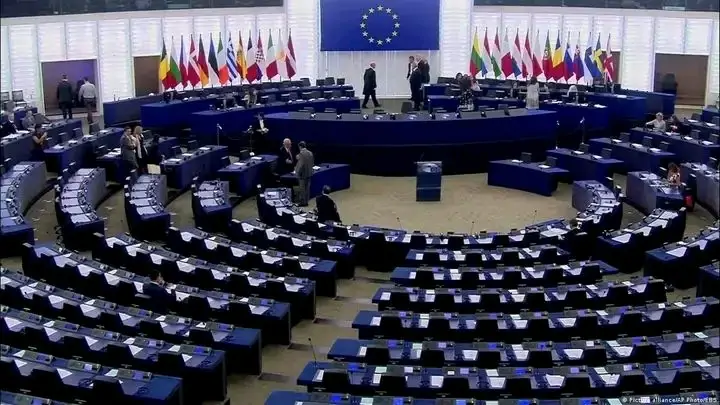
EU Parliament resolution: What are the implications for Zambia?

Breaking News Zambia
News🇿🇲 INSIGHT | EU Parliament resolution: What are the implications for Zambia? A European Parliament resolution on Zambia has become the latest exhibit in the country’s post-election political argument. To some opposition voices, the September 17 vote confirms Europe has turned against President Hakainde Hichilema, Zambia is becoming isolated and Western recognition of his Government […]
🇿🇲 INSIGHT | EU Parliament resolution: What are the implications for Zambia?
A European Parliament resolution on Zambia has become the latest exhibit in the country’s post-election political argument. To some opposition voices, the September 17 vote confirms Europe has turned against President Hakainde Hichilema, Zambia is becoming isolated and Western recognition of his Government is weakening. To some Government supporters, it is merely noise from politicians thousands of kilometres away. Both readings are convenient. Neither is sufficient.
The resolution is serious. It was adopted by 562 votes to one, with 33 abstentions. Parliament “condemns the killing of Mutotwe Kafwaya and the increase in political repression since the elections” and urges Zambian authorities to conduct “independent and transparent investigations” into allegations of unlawful force, arbitrary arrest and intimidation. It calls for detainees to have access to lawyers, family and medical care, demands fair trials, and asks authorities to refrain from abuses of national security laws and the criminal justice system.
Those are strong words. They place Zambia’s post-election conduct under European political scrutiny. They can influence conversations in Brussels, strengthen the hand of European officials raising governance concerns with Lusaka and affect how Zambia is discussed within European institutions. A resolution supported by 562 legislators is therefore not something Government should dismiss simply because it is non-binding.
But this is where Zambia’s confirmation-bias problem begins.
People frequently read international documents looking for the sentence which confirms what they already believe. Government supporters search for vindication. Opposition supporters search for condemnation. A document containing seven operative paragraphs becomes one screenshot, one headline and one political conclusion.
Read the entire resolution.
The European Parliament does not sanction Zambia. It does not call for sanctions. It does not withdraw recognition from Hichilema. It does not suspend diplomatic relations. It does not declare the August presidential result invalid. It does not recognise Brian Mundubile as President. It does not order European companies out of Zambia or terminate European development cooperation.
Instead, the resolution itself records that “the EU has deepened its partnership with Zambia through Global Gateway and the Critical Raw Materials Partnership and has provided substantial development assistance”.
Then comes perhaps the most important sentence for understanding what Europe is actually saying. Parliament “recalls the close EU-Zambia partnership”.
Read those words again: close EU-Zambia partnership.
The same institution condemning aspects of Zambia’s post-election conduct is simultaneously acknowledging a close relationship with Zambia. This is not a contradiction. It is how international relations work.
The resolution goes further. It calls for the EU and its member states to raise the alleged violations “at the highest political level”, closely monitor human rights and judicial proceedings, support Zambian civil society and follow up recommendations from the EU Election Observation Mission.
There is a useful question here. If Europe has supposedly stopped recognising the Government, who exactly is it supposed to engage “at the highest political level”?
This is where readers need to separate political criticism from diplomatic action. The European Parliament is an important EU institution. Its views matter. Its resolutions can create pressure and influence European political debate. But this resolution is not an EU sanctions instrument. It does not, by itself, terminate agreements or downgrade diplomatic relations. Political pressure and diplomatic isolation are different conditions.
Look beyond Strasbourg and the distinction becomes even clearer.
President Hichilema has just received Letters of Credence from eight newly accredited envoys representing Canada, Sweden, Finland, the Netherlands, the United Arab Emirates, Spain, Guinea and Nigeria. Four of those countries, Sweden, Finland, the Netherlands and Spain, belong to the European Union whose Parliament has just criticised Zambia.
This should not surprise anyone familiar with diplomacy.
An ambassador does not present credentials because his government agrees with everything happening in the receiving country. Neither is a credentials ceremony a medal for good governance. Countries exchange ambassadors because they recognise governments as the authorities through which official state relations are conducted.
A Swedish ambassador can present credentials to Hichilema on Thursday and Stockholm can criticise his Government on Friday. Finland can seek investment opportunities in Zambia while questioning an arrest. The Netherlands can cooperate on trade while demanding respect for civil liberties. Spain can vote through European institutions on matters critical of Zambia while maintaining normal diplomatic relations in Lusaka.
The world does not operate like a Zambian political WhatsApp group where criticism means you have crossed to the other camp.
States have interests. They maintain relationships. They negotiate. They disagree. They apply pressure. They cooperate again.
Washington provides another example. At almost the same time Zambia was being described in some political circles as increasingly isolated from the West, senior US defence official Eugene Park was at the Ministry of Defence.
“Zambia is a priority country for the United States,” he said. “We have had over 60 years of bilateral relations.”
Then came something tangible.
“We are ready to work with you and support the modernisation of the Zambian military.”
Such is defence cooperation, not diplomatic isolation.
Again, it would be equally foolish for Government supporters to interpret Park’s words as proof Washington approves of everything Lusaka does. It does not follow. The United States can describe Zambia as a priority partner while challenging its Government over human rights, health policy, corruption, elections or any other matter where American interests and values are engaged.
Recognition is not approval. Criticism is not isolation.
This distinction becomes even more important when discussing the European Union because “the EU” is not a single politician sitting behind one desk in Brussels. Its Parliament has particular powers. The Commission has its functions. Member-state governments have their own foreign policies and exercise power through European institutions. Sweden remains Sweden. Spain remains Spain. France remains France. Their interests can overlap without every institution speaking with precisely the same emphasis at every moment.
International relations are therefore read through actions as much as statements.
If Zambia were moving into genuine diplomatic isolation, the evidence would eventually become visible. Governments could recall ambassadors or downgrade relations. Cooperation agreements could be suspended. Sanctions could be imposed. Financing could be restricted. Senior political engagement could decline. International partners could begin coordinating measures against Lusaka.
This is considerably different from what is presently before us.
What we have is a European Parliament demanding accountability while explicitly recalling a “close EU-Zambia partnership”. We have European ambassadors presenting credentials to Hichilema. We have Canada, the UAE, Guinea and Nigeria doing the same. We have a senior American defence official describing Zambia as a “priority country” and discussing military modernisation.
And we have serious international concern over Kafwaya’s death, opposition arrests and the conduct of State institutions.
All of these facts can exist together.
This is where confirmation bias becomes dangerous. Once people decide Hichilema is internationally rejected, every critical foreign statement becomes evidence of isolation. Once others decide Government can do no wrong, every handshake at State House becomes evidence that international criticism does not matter.
Neither approach informs the public. Kafwaya was killed during a security operation. The European Parliament is entitled to ask questions about the circumstances. Zambia itself has an interest in establishing a credible record of what happened. Mundubile, Makebi Zulu and others face serious allegations. The State is entitled to prosecute where it believes offences occurred, but those accused remain entitled to due process and fair treatment.
These questions do not disappear because ambassadors are arriving at State House. But neither do diplomatic relations disappear because 562 European parliamentarians passed a critical resolution.
The mistake is treating international politics as an extension of Zambia’s domestic political camps. Europe is not UPND. America is not Tonse. An ambassador is not a cadre. A European Parliament resolution is not an electoral petition. International institutions act according to their mandates, while governments pursue interests which can include security, minerals, trade, investment, democracy and human rights at the same time.
So what are the implications of the September 17 resolution?
There is now stronger political pressure on Lusaka to account for Kafwaya’s death, demonstrate due process in opposition cases and answer concerns surrounding civil liberties. The resolution gives those issues greater visibility in Europe and provides a formal parliamentary position which European officials can reference in future engagement with Zambia.
What it has not done is sanction Zambia, isolate Zambia or withdraw recognition from its Government. The most revealing sentence may therefore be the one attracting the least political attention.
The European Parliament criticised Zambia and, in the same document, “recalls the close EU-Zambia partnership”.
-The People’s Brief | Ollus R. Ndomu





Community Feedback