
ECHOES OF KULTURKAMPF….how HH’s clash with Catholic Church resonates in modern Zambia

Breaking News Zambia
NewsECHOES OF KULTURKAMPF….how HH’s clash with Catholic Church resonates in modern Zambia By DAVID KANDUZATHE September 2026 arrest of Lusaka Archbishop Alick Banda by Zambia’s Drug Enforcement Commission (DEC) has escalated political friction to levels unseen in the country’s democratic era. Ostensibly centered on a contested Toyota Hilux allegedly gifted by late former President Edgar […]
ECHOES OF KULTURKAMPF
….how HH’s clash with Catholic Church resonates in modern Zambia
By DAVID KANDUZA
THE September 2026 arrest of Lusaka Archbishop Alick Banda by Zambia’s Drug Enforcement Commission (DEC) has escalated political friction to levels unseen in the country’s democratic era.
Ostensibly centered on a contested Toyota Hilux allegedly gifted by late former President Edgar Lungu, the State’s legal maneuver is widely interpreted by observers and the clergy as a targeted campaign to muzzle a powerful Government critic.
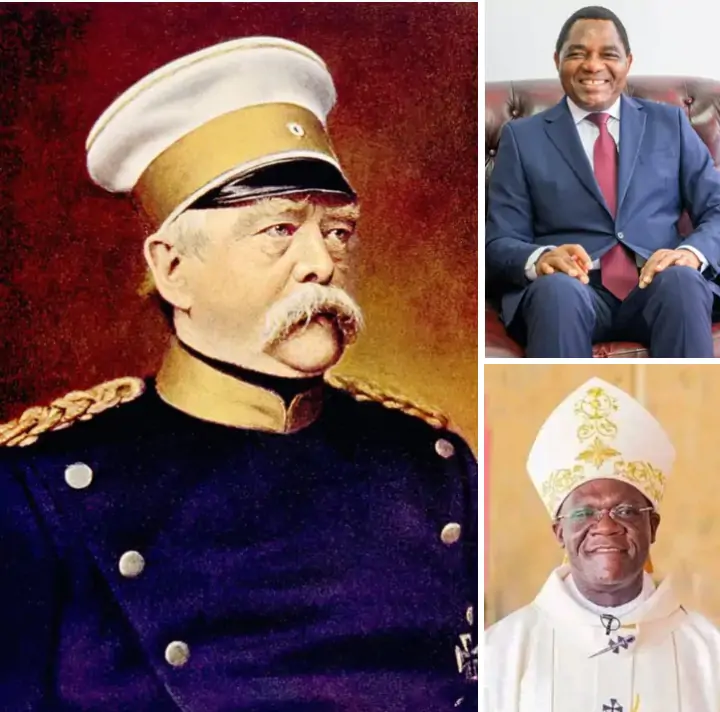
This escalating confrontation between President Hakainde Hichilema and the Zambia Conference of Catholic Bishops (ZCCB) deeply echoes a famous historical script: Otto von Bismarck’s 19th-century Kulturkampf (culture struggle) against the Roman Catholic Church.
In the 1870s, German Chancellor Otto von Bismarck launched the Kulturkampf out of fear that the Catholic Church—bolstered by the 1870 declaration of papal infallibility—constituted a ‘State within a State’ whose true loyalties lay outside the newly unified German Empire.
Backed by secular liberals, Chancellor Bismarck deployed the full apparatus of the State: passing laws to control the training of priests, shuttering monasteries and imprisoning or exiling defiant bishops.
However, the Iron Chancellor’s aggressive overreach backfired.
Instead of breaking the Church, the persecution unified Germany’s fractured Catholic minority.
It galvanised lay Catholics, triggered a massive surge in parliamentary seats for the Catholic Centre Party and ultimately forced a humiliated Bismarck into a slow, political retreat.
The parallels in modern Zambia are striking.
For decades, the Catholic Church has served as the ultimate barometer of national conscience.
Its pastoral letters historically shook the regimes of Kenneth Kaunda, Frederick Chiluba and Edgar Lungu.
Ironically, while in opposition, President Hichilema and his United Party for National Development (UPND) regularly leaned on the Church’s unwavering stance on human rights and justice as a protective shield.
However, following a highly contentious August 2026 general election that handed Mr Hichilema a second term amid accusations of institutional manipulation and the sudden closure of courts during the election petition window, the relationship has turned hostile
When the ZCCB issued a blistering pastoral statement questioning the transparency of the electoral process and decrying shrinking civic spaces, the administration’s posture shifted from collaboration to defensive combativeness.
By deploying anti-money laundering units to interrogate and subsequently arrest Archbishop Banda, Mr Hichilema’s administration is walking a path reminiscent of Bismarck’s: utilising State institutions to legally dismantle the credibility of clerical critics.
If history serves as a guide, the State’s efforts to isolate or silence dissenting bishops are bound to fail.
Archbishop Ignatius Chama of Kasama recently echoed this resilience, urging the Catholic faithful to remain steadfast against modern efforts to weaken the Church’s voice, noting that the institution will continue to rely on ‘prayer, truth and peaceful resistance.’
Already, Archbishop Banda’s arrest has sparked a powerful counter-response, drawing masses of everyday citizens to the Cathedral of the Child Jesus for solidarity prayers, signaling that the State’s aggressive posture is only serving to unify and energise the Catholic base.
Zambia’s current political tension demonstrates that when a democratic Government begins viewing an independent moral partner as an existential political rival, it risks triggering an unwinnable ‘culture struggle’,
Just as Chancellor Bismarck eventually learned that faith and institutional conviction could not be broken by executive overreach, the current administration may soon realise that the political cost of fighting the pulpit far outweighs any temporary tactical advantage.
To de-escalate the friction between State House and the Catholic Church, both entities must step back from ideological and legal warfare.
They must find an equilibrium where the rule of law is upheld without infringing upon the moral oversight of the pulpit.
What President Hichilema and the Government should do, we suggest he establish a direct and private dialogue.
Instead of relying on aggressive public pronouncements from State House or party spokespersons, President Hichilema should directly engage the Bishops.
De-escalating tensions requires moving conversations from contentious media briefs to institutional, face-to-face engagements.
The State must guarantee that the prosecution of any citizen—including the clergy—is driven transparently by the judiciary and not used as a tool for political intimidation.
Demanding that investigations remain clear of partisan interference will restore public trust.
The administration needs to re-adopt its previous stance of viewing the Church as a necessary partner in governance rather than an opposition rival.
Constructive criticism regarding democratic processes should be addressed with policy actions rather than defensive clampdowns.
What the Catholic Church and the clergy should do, we encourage that they maintain non-partisan moral authority: To safeguard its reputation as an objective arbiter of justice.
The Church must ensure its platform is not perceived as aligned with any specific political faction.
Prophesying truth to power means holding both the current administration and the opposition to the exact same moral standards.
Rather than framing legal standard procedures entirely as existential threats, the Church can model institutional accountability by allowing the legal process to run its course cleanly in the courts.
Archbishop Banda should apologise to the nation depending entirely on the outcome of the impartial judicial process.
The Archbishop has pleaded not guilty to the charge of possessing property reasonably suspected to be proceeds of crime.
Legally, he maintains his innocence regarding the Toyota Hilux linked to the Zambia Revenue Authority (ZRA).
An apology before the court hears the evidence and delivers a verdict would be premature and an implicit admission of guilt under political pressure.
If the court discovers that the vehicle was acquired through improper or corrupt public channels, an apology to the nation would be necessary to restore the moral standing expected of his office.
Conversely, if the court clears him of wrongdoing, it is the State agencies that will owe an explanation for bringing highly destabilising charges against a prominent religious leader.
The current standoff between State House and the Catholic Church represents a critical crossroad for Zambia’s democracy.
Left unchecked, a prolonged political conflict risks deeply fracturing the nation along institutional, religious and political lines.
For the sake of national harmony, the presidency and the pulpit must shift from a posture of confrontation to one of constructive engagement.



Community Feedback