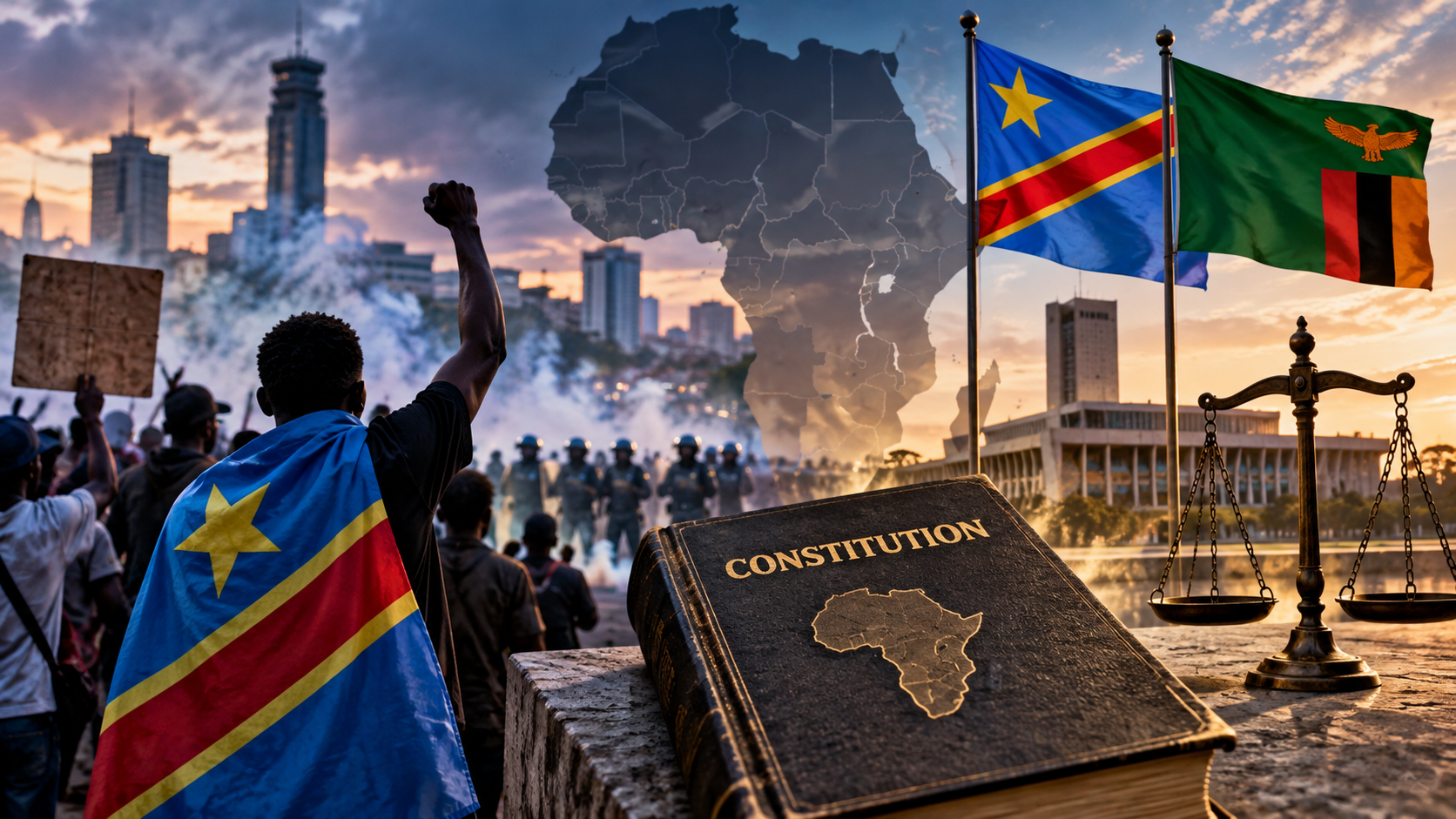
DRC protests raise a question Zambia cannot ignore: What happens when term limits become negotiable?

Breaking News Zambia
NewsThe streets of Kinshasa have once again become the stage for a familiar African political question: how far should a sitting President go in changing the rules that limit presidential power? Protests erupted in the Democratic Republic of Congo on Tuesday as opposition supporters demonstrated against proposed constitutional changes that critics say could open the […]
The streets of Kinshasa have once again become the stage for a familiar African political question: how far should a sitting President go in changing the rules that limit presidential power?
Protests erupted in the Democratic Republic of Congo on Tuesday as opposition supporters demonstrated against proposed constitutional changes that critics say could open the way for President Félix Tshisekedi to seek a third term.
Reuters footage seen by Zambian Eye showed protesters confronting security forces, throwing stones as police fired tear gas and warning shots to disperse them.
The demonstrations, organised by the opposition C64 coalition, took place in Kinshasa and other cities. Reuters reported that clashes broke out as police moved to disperse protesters.
Tshisekedi, who was first elected in 2019 and re-elected in 2023, has said he would accept a third term if the Congolese people wanted it.
But that argument has done little to calm opponents who see the proposed constitutional changes as a potential route to extending his stay in power.
The DRC Senate adopted a bill in June that could pave the way for a referendum on a new constitution. Reuters reported that the proposed changes could allow Tshisekedi to seek a third term by treating it as a first term under the new constitutional framework.
The latest protests therefore represent more than opposition to one constitutional proposal.
They touch on one of Africa’s most persistent political questions: when does constitutional reform become constitutional manipulation?
The African problem of the third term
Across the continent, presidential term limits have repeatedly become a source of political confrontation.
The argument usually begins with a constitutional amendment, a referendum or a proposal for a new constitution.
Supporters may argue that the people should decide, that a popular President should not be prevented from continuing in office or that constitutional reform is necessary to modernise the political system.
Opponents see something different: the gradual removal of institutional safeguards designed to prevent the concentration of political power.
The distinction is important.
A constitution can be amended through lawful procedures. The deeper democratic question is whether those procedures are being used to strengthen institutions or to remove obstacles facing an incumbent.
That is the question now confronting the DRC.
And it is a question that extends beyond the Congo.
The Zambia question
Zambia has its own history with presidential term limits.
The Constitution currently provides that a person who has twice held the office of President is not eligible for election as President.
President Hakainde Hichilema has now secured a second term following the August 13, 2026 election.
That makes the constitutional position particularly relevant.
There have already been calls and political discussions in Zambia around the possibility of Hichilema going beyond the two-term limit.
Whether those calls come from supporters, political actors or other groups, they raise a question that is larger than Hichilema himself:
Should constitutional term limits remain firm even when a sitting President retains political support, or should citizens be able to change the rules to allow a President to remain in office beyond the existing limit?
The answer ultimately belongs to Zambians through the constitutional and democratic processes established by the country.
But the experience of other countries provides the context in which that debate takes place.
Who protects the limits?
Zimbabwean UK-based journalist Hopewell Chin’ono has argued that Tshisekedi may find little external resistance within the region because other Southern African governments have faced their own controversies over term extensions and disputed elections.
His argument is essentially that regional credibility matters.
If neighbouring governments are unwilling or unable to consistently defend constitutional term limits and credible elections at home, their ability to challenge similar developments elsewhere becomes weaker.
That argument deserves attention, but the individual cases cited by Chin’ono should also be examined on their own evidence rather than treated as identical situations.
The broader issue, however, remains.
Regional organisations such as SADC formally identify democratic governance, constitutionalism and credible elections as important principles. SADC’s 2026 election observation mission to Zambia, for example, described its role as supporting democratic governance and credible electoral processes.
The question is what happens when those principles come under pressure after elections — particularly when the pressure comes from governments themselves.
The danger is not only the third term
The debate over term limits is sometimes reduced to a simple question: Is the President popular enough to continue?
But that may be the wrong question.
Term limits exist precisely because popularity can change the relationship between an individual and the institutions of the state.
A President who is popular today may be unpopular tomorrow.
A ruling party that commands a parliamentary majority today may lose it in the next election.
Institutions therefore need rules that do not depend entirely on the goodwill or popularity of whoever occupies the presidency.
The danger of removing term limits is not necessarily that every President who stays longer will become authoritarian.
The danger is that the political system becomes increasingly dependent on the individual at the centre of power.
Once that happens, changing leaders becomes more difficult and constitutional institutions can begin to revolve around personalities rather than principles.
What should Zambia learn?
The DRC protests should therefore not simply be watched from across the border as another Congolese political confrontation.
They offer Zambia an opportunity to think ahead.
The country has just completed a presidential election and entered a new five-year political cycle. Hichilema’s second term has only begun.
The debate about what comes after that should not be about personalities alone.
It should be about what rules Zambia wants to live under — and whether those rules should remain bigger than the individual President.
If Zambia’s constitutional framework says two terms, the question is not whether today’s President is good enough to deserve a third.
The more fundamental question is whether constitutional limits mean what they say.
And that is precisely why the images coming out of Kinshasa matter beyond the DRC.
Today it is Tshisekedi. Tomorrow it could be another President, in another country, facing another constitutional limit.
The strength of a democracy may ultimately be measured not by how easily it allows popular leaders to stay in power, but by how firmly its institutions can say the rules apply to everyone.
Zambian Eye — Reporting Zambia. Explaining Zambia.

Community Feedback