
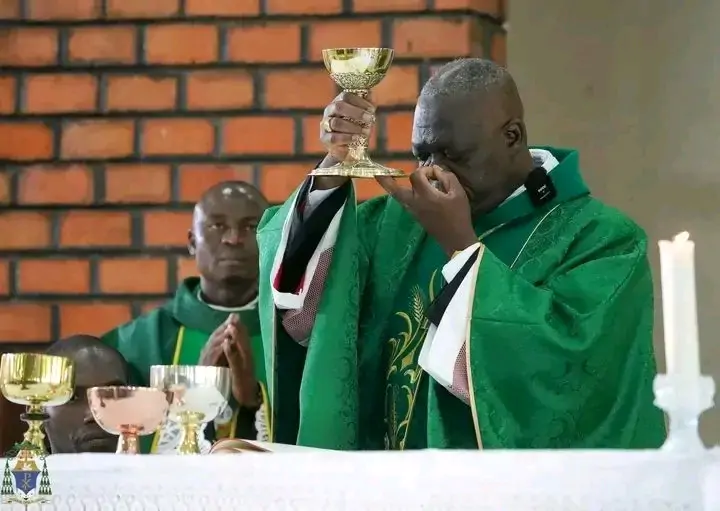
Archbishop Banda: When the Pulpit Meets Politics and the Law

Breaking News Zambia
News🇿🇲 INSIGHT | Archbishop Banda: When the Pulpit Meets Politics and the Law Monday placed three powerful Zambian institutions in the same story: the Catholic Church, the criminal justice system and politics. Archbishop Alick Banda began the day surrounded by the faithful at a solidarity Mass. He later appeared before the Drug Enforcement Commission, was […]
🇿🇲 INSIGHT | Archbishop Banda: When the Pulpit Meets Politics and the Law
Monday placed three powerful Zambian institutions in the same story: the Catholic Church, the criminal justice system and politics. Archbishop Alick Banda began the day surrounded by the faithful at a solidarity Mass. He later appeared before the Drug Enforcement Commission, was arrested and taken to court over a Toyota Hilux linked to the Zambia Revenue Authority. He pleaded not guilty and was granted bail. By evening, the question was no longer simply about a vehicle. It was also about how Zambia separates law from politics, and politics from the pulpit.
The legal issue must remain precise. DEC alleges Archbishop Banda possessed a blue Toyota Hilux, registration ALF 7734, reasonably suspected to have been unlawfully obtained from ZRA. Investigators say it forms part of a wider inquiry involving approximately 22 ZRA vehicles allegedly improperly disposed of. The Archbishop denies the charge. He is presumed innocent. His political views cannot prove the offence, just as his ecclesiastical office cannot answer questions about how the vehicle came into his possession. The prosecution carries the burden of proving its case before a competent court.
There is, however, an evidential history which makes it difficult to dismiss the vehicle issue as something invented yesterday. In September 2024, the Economic and Financial Crimes Court heard evidence concerning the disposal process. A former ZRA Board Secretary testified about breaches in the procedure through which vehicles were supposed to be sold.
Court evidence also dealt specifically with how the Hilux changed ownership before reaching Archbishop Banda. Those proceedings concerned other accused persons, not a conviction of the Archbishop, but they establish an important point: the disputed vehicle and questions surrounding its disposal were already matters of judicial record well before the latest arrest.
There is another uncomfortable fact. Mulopa Kaunda, the ZRA employee whose name featured in the purported transaction, publicly denied buying and selling the vehicle to Archbishop Banda. In an interview published by News Diggers in January, Kaunda said: “I have never seen or touched the vehicle that ZRA claimed I bought from the institution and sold to Archbishop Alick Banda.”
He alleged documents and receipts had been generated in his name. Those are serious claims, and the court must determine what weight they carry. But they make arguments suggesting the Archbishop should simply be left alone because the matter concerns “one car” legally beside the point. The question is not how many vehicles the President or anyone else owns. The question is whether this particular vehicle was lawfully disposed of and lawfully acquired
The Zambia Conference of Catholic Bishops has approached the matter differently. In its September 28 statement, the ZCCB expressed “fraternal solidarity” with Archbishop Banda and praised his pastoral service. But the bishops stopped short of declaring the criminal allegation false. Instead, they invoked a principle which should apply to every accused person: “Every person is entitled to fairness, dignity, and due process.” They called for those rights to be respected “without prejudice or intimidation.” That is a defensible institutional position. Solidarity does not determine innocence. Neither does arrest establish guilt.
The harder issue concerns the political environment surrounding the Archbishop. Banda has, over time, become one of Zambia’s most politically visible clerics. His interventions have frequently placed him in confrontation with the Hichilema administration, while opposition figures have increasingly appeared around him during moments of political controversy. When he first appeared before DEC in January, several opposition leaders accompanied him. Government interpreted their presence politically; the opposition interpreted the investigation politically.
Long before a magistrate could hear the present charge, both camps had already constructed competing narratives around the Archbishop
The same difficulty arose around the death of former President Edgar Lungu. Archbishop Banda was publicly close to Lungu and became prominent during the funeral dispute between the former president’s family and the Zambian government. His involvement could reasonably be understood as pastoral support for a grieving family. But because the burial itself had become a political and legal confrontation, his proximity to one side inevitably affected perceptions of his institutional distance. Other church figures attempted mediation. Banda was increasingly perceived, fairly or unfairly, as standing closer to one camp. Perception is not proof of motive, but for institutions built partly on moral authority, perception cannot simply be dismissed.
The 2026 election deepened the problem. Religious leaders have every right to condemn violence, injustice, abuse of power and threats to constitutional government. Zambia would be poorer if churches became silent whenever political power was involved. The Catholic Church, in particular, has a long history of speaking into national affairs.
But there is an important difference between a prophetic voice and a partisan identity. A church capable of rebuking Government must retain enough independence to rebuke the opposition. A church seeking to reconcile political opponents must be trusted sufficiently by both to enter the room.
This is why political statements surrounding Banda’s prosecution require discipline. Saying the President has many vehicles, therefore an Archbishop should not face prosecution over one, misunderstands the rule of law. Property offences are not measured against the President’s personal fleet. If public property was unlawfully disposed of, its value or quantity does not extinguish the legal question. Conversely, Government cannot reason that because Banda has associated with its political opponents, enforcement against him becomes self-justifying. Evidence remains the dividing line.
Government itself must therefore exercise unusual restraint. The state is not an ordinary participant in a political quarrel. It controls investigative agencies, police powers and prosecution machinery. Individual office-holders are human. They have political histories, loyalties, grievances and biases. Institutions exist precisely to prevent those human impulses from deciding who receives the protection of law and who experiences its force.
An investigation involving a prominent government critic consequently demands procedural cleanliness, consistency and evidence capable of surviving scrutiny in open court.
The Church faces a parallel institutional test. Political engagement carries consequences even where it is lawful. A bishop who becomes closely identified with one political constituency may discover that his pastoral actions are subsequently interpreted politically. This does not justify retaliation. It does, however, reduce the space from which the Church can convincingly act as national mediator.
Zambia needs religious leaders who can enter State House and speak uncomfortable truths, then cross town and tell opposition leaders equally uncomfortable truths. Moral authority is strongest when no political party can claim ownership of it.
None of this resolves the Hilux case. Only evidence can do so. Director of Public Prosecutions Gilbert Phiri SC has taken charge of the prosecution, while senior counsel including Bonaventure Mutale and John Sangwa are among those representing the Archbishop. The case has therefore moved from political assertion into an adversarial legal process where witnesses can be examined, documents tested and competing accounts challenged. That is where the dispute over ownership and acquisition belongs.
The ZCCB is right on one fundamental principle: Archbishop Banda deserves fairness, dignity and due process. The same principle also means DEC deserves an opportunity to present its evidence without every investigative step being predetermined as persecution. The Archbishop’s critics should not convict him through politics. His supporters should not acquit him through solidarity.
There is room here for everyone to return to their proper institutional ground. Let the court determine whether the vehicle was unlawfully obtained and whether Archbishop Banda bears criminal responsibility. Let Government enforce the law without vengeance or political theatre.
Let the Church speak to the conscience of the nation without becoming an appendage of either government or opposition.
Zambia does not need a silent Church. It needs an independent one. It does not need a timid Government. It needs a lawful one. The pulpit cannot confer immunity from accountability. The state cannot convert prosecution into political punishment.
The law must be allowed to do what politics cannot: establish facts, test evidence and reach a decision according to rules rather than loyalties.
INSIGHT | Beyond the headline. We examine the forces, choices and consequences shaping the story.
The People’s Brief | Ollus R. Ndomu



Community Feedback