
Zambia : Mwewa's Street Clearance Is A Bold Step For Lusaka, But Where Will 250,000 To 350,000 Traders Go?

Breaking News Zambia
NewsLusaka - Zambia: The Lusaka City Council (LCC) has taken a bold step to restore order to the capital's streets, clearing vendors from Simon Mwewa Lane and
Headlines 4 min.Read Mwewa’s Street Clearance Is A Bold Step For Lusaka, But Where Will 250,000 To 350,000 Traders Go? By Moses Musokotwane October 1, 2026 FacebookTwitterPinterestWhatsAppThe Lusaka City Council (LCC) has taken a bold step to restore order to the capital’s streets, clearing vendors from Simon Mwewa Lane and Kalusha Bwalya Road and moving on four more major roads, even as the Zambia Institute of Architects (ZIA) warns that the city’s informal traders, estimated at between 250,000 and 350,000, outnumber designated trading stands by more than 10 to one.
The council’s 31 main township markets have a combined capacity of just over 11,000 designated spaces, and only about 4,400 of those are reportedly occupied by registered traders. The action deserves credit. The concern is a simple one: where does everyone else go?
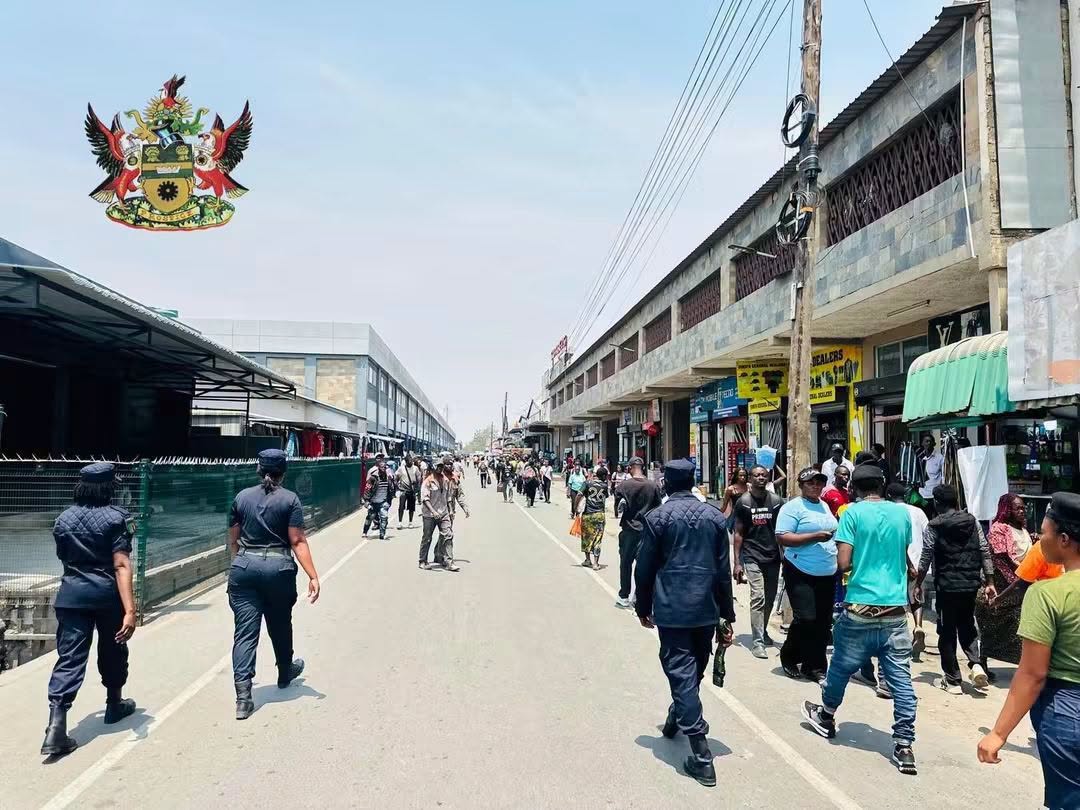
The phased removal began after the 29 September ultimatum for vendors to move into markets on their own expired. Newly elected Lusaka mayor Chitambala Mwewa followed through, leading a combined team of State police and council personnel to enforce the directive, and the usually crowded western side of Lumumba Road was free of vendors.
A day earlier, a crowd of vendors, mostly women and youths, had protested at his office in the Simson building. The mayor addressed them there and assured them that the exercise was for their own benefit and in the public interest.
He said the second phase would run through four major roads in the next 72 hours: Lumumba Road, Freedom Way, Cha Cha Cha Road and Cairo Road. Street vendors and bus operators on those roads are affected, and the aim, he said, is to restore sanitation and clear traffic jams and crowded walkways.
“We need corridors free for our people to walk on and roads to have free traffic flow, buses must operate strictly from bus stations and vendors from any of our 27 markets, and they pay rent to the council electronically,” Mr Mwewa said.
He urged vendors to start considering which of the city’s 27 public markets they would like to trade from, and said the completion of phase one meant that, with law enforcement in place, vendors would not return to the streets.
“The plan to move in through law enforcement is already in motion and has been well prepared to make sure our people are moved into the market safely,” the mayor said.
Clean walkways, free-flowing traffic and buses operating from bus stations are what many residents want from their city, and the mayor has acted on them. Other mayors would do well to show the same resolve in their own towns.
The architects’ institute accepts that something must be done, but it has a different set of numbers and a warning.
ZIA president Musunka Silungwe said the rapid growth of informal trading spaces was putting pressure on public infrastructure, sanitation and urban planning. The problem, he said, had gone beyond street vending, with traders increasingly occupying roads, railway lines, drainage spaces, walkways and emergency access routes.
“The uncontrolled use of public spaces is contributing to traffic congestion, poor sanitation and disorder in the city,” he said.
He added that systematic solutions were needed before the situation grew into a wider national problem that might be too hard to resolve.
Mr Silungwe put the size of Lusaka’s informal trade sector at between 250,000 and 350,000 active traders, and said 72 per cent of the city’s workforce depended directly on the informal economy. Only about 15 to 20 per cent of traders operated in registered municipal or cooperative markets, he said, leaving the majority in unregulated spaces and creating a major mismatch between traders and formal trading spaces.
The council manages 34 township markets and three major semi-autonomous trading hubs, the ZIA president said, and he returned to the 11,000-plus designated spaces in the 31 main township markets.
“Only about 4,400 of those spaces are reportedly occupied by registered traders,” he said.
Women make up between 54 and 60 per cent of informal traders, particularly in fresh produce and second-hand clothing, he said, while about 81.3 per cent of informal traders operate outside the formal tax bracket. The informal economy, in his words, remains an important distribution network for affordable household goods.
He warned that forcing all informal traders into the existing formal markets at once could create further social and economic pressure, because the available infrastructure was inadequate for so many people.
Sanitation and public health were also a worry, particularly the sale of food in undesignated areas without adequate toilets or running water. That problem, he said, was visible across Lusaka, including around major hospitals and transport hubs.
He urged authorities to consult stakeholders and experts and to develop properly researched interventions rather than quick fixes.
“As a society, we need to be systematic in seeking solutions,” Mr Silungwe said.
On the ground, vendors were already weighing their next move. A check across the city found some street vendors had begun asking for trading spaces at Simon Mwewa Lane Market and City Market, and several makeshift shops on Lumumba Road had been brought down by the people trading from them, ahead of the second phase.
Marketeers said City Market still had enough space to take in the traders who had been on the street.
Doreen Mulenga, who already trades inside City Market, urged fellow vendors to join her.
“We can all come in the market and make profits together, if we are in the market and no one is in the streets, customers will come to buy from the market,” she said.
Maxwell Mwenda, who traded from a makeshift shop on Lumumba Road for more than five years, said he did not know where to start. He pulled the shop down himself.
“I don’t even know where to start from, I have demolished my shop because it’s not legal that it remains here along the road,” he said, adding that he did not want to lose his goods “for being rigid after the authorities have spoken.”
For now, the council’s position is that phase two covers four major roads in 72 hours, with vendors expected to move into the 27 public markets and pay rent electronically. The architects’ figures on trader numbers and market capacity are on the record.
Loading read count...LEAVE A REPLY Cancel reply
Hot this week
HeadlinesHichilema Leaves Abu Dhabi After Two-Day Working Visit October 1, 2026 1 President Hakainde Hichilema has concluded his two-day working visit... Headlines
UPND Says No One Is Immune From Prosecution In Archbishop Banda Case October 1, 2026 1 The arrest of Catholic Church Archbishop Alick Banda has... Headlines
Pastoral Letter Questions Credibility Of 2026 Election Management October 1, 2026 1 The Zambia Conference of Catholic Bishops (ZCCB) has warned... Headlines
Petrol Hits K31.46, Diesel K33.27 As Tax Relief Ends, While Hichilema Pushes To Scrap Monthly Price Changes October 1, 2026 2 The Energy Regulation Board (ERB) has raised pump prices... Columns
Zambia keeps changing drivers and never fixes the car October 1, 2026 3 Zambia keeps changing drivers and never fixes the car In...
Topics
HeadlinesHichilema Leaves Abu Dhabi After Two-Day Working Visit 1 President Hakainde Hichilema has concluded his two-day working visit... Headlines
UPND Says No One Is Immune From Prosecution In Archbishop Banda Case 1 The arrest of Catholic Church Archbishop Alick Banda has... Headlines
Pastoral Letter Questions Credibility Of 2026 Election Management 1 The Zambia Conference of Catholic Bishops (ZCCB) has warned... Headlines
Petrol Hits K31.46, Diesel K33.27 As Tax Relief Ends, While Hichilema Pushes To Scrap Monthly Price Changes 2 The Energy Regulation Board (ERB) has raised pump prices... Columns
Zambia keeps changing drivers and never fixes the car 3 Zambia keeps changing drivers and never fixes the car In... General News
United Capital Fertilizer to expand capacity 0 United Capital Fertilizer Zambia Company Limited has disclosed that... General News
Chinsali to get 10 megawatts power plant 0 Arc Power has announced plans to put up a... Rural News
Nalolo farmers start redeeming inputs 0 Acting Nalolo District Agricultural Coordinator (DACO) Patience Munalula, says...
Related Articles
Hichilema Leaves Abu Dhabi After Two-Day Working Visit
Headlines October 1, 2026UPND Says No One Is Immune From Prosecution In Archbishop Banda Case Headlines October 1, 2026
Pastoral Letter Questions Credibility Of 2026 Election Management
Headlines October 1, 2026Petrol Hits K31.46, Diesel K33.27 As Tax Relief Ends, While Hichilema Pushes To Scrap Monthly Price Changes
Headlines October 1, 2026Mwanza Demands ECZ Account For Suspended Vote Count And Stolen Mandevu Ballots
Headlines October 1, 2026Popular Categories
HeadlinesGeneral NewsSportsEconomyRural NewsColumnsFeature Politics Previous articleHichilema Leaves Abu Dhabi After Two-Day Working Visit



Community Feedback