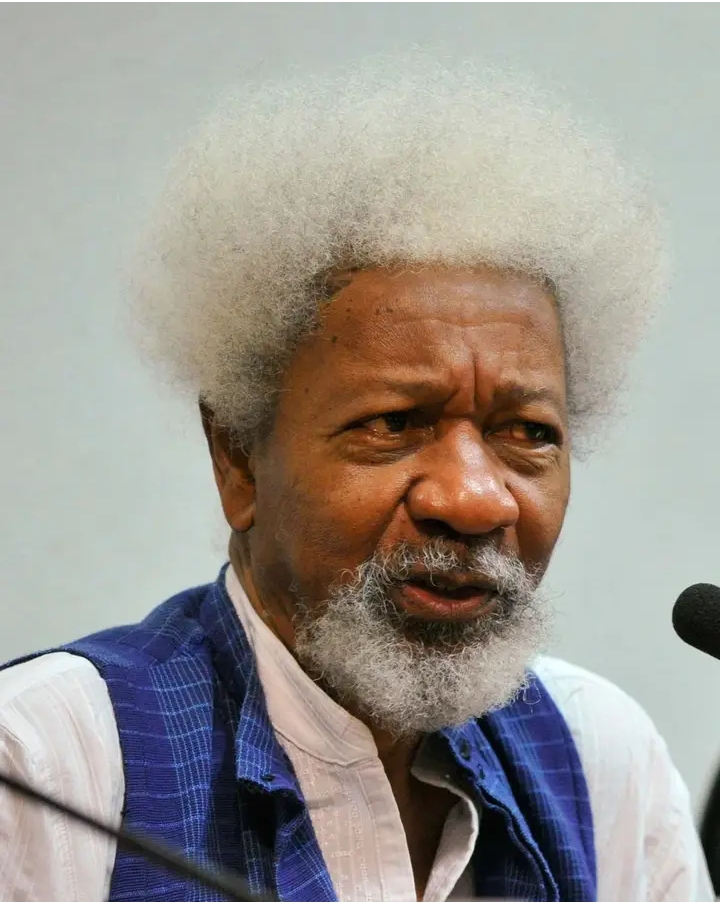
WOLE SOYINKA AT 92: THE NOBEL LAUREATE WHO REFUSED TO LET THE MAN DIE

Breaking News Zambia
NewsWOLE SOYINKA AT 92: THE NOBEL LAUREATE WHO REFUSED TO LET THE MAN DIE By Gabriel Manyati In October 1965, a masked gunman strode into the Ibadan studios of the Nigerian Broadcasting Corporation, held up the staff at gunpoint, swapped a pre-recorded tape of the regional premier’s victory speech with a broadcast detailing electoral fraud, […]
WOLE SOYINKA AT 92: THE NOBEL LAUREATE WHO REFUSED TO LET THE MAN DIE
By Gabriel Manyati
In October 1965, a masked gunman strode into the Ibadan studios of the Nigerian Broadcasting Corporation, held up the staff at gunpoint, swapped a pre-recorded tape of the regional premier’s victory speech with a broadcast detailing electoral fraud, and vanished into the night.
That gunman was Wole Soyinka.
Decades later, celebrated globally as a literary giant, he remains the same figure who haunted military juntas, survived 22 months in solitary confinement during the Nigerian Civil War, stood trial for treason, and endured repeated exile.
Soyinka has published around 25 plays, alongside numerous novels, memoirs, and essays, yet his defining signature is not his prolific bibliography but his refusal to exchange moral clarity for political convenience. His enduring declaration, “The man dies in all who keep silent in the face of tyranny,” is no mere rhetorical flourish to admire; it is the uncompromising ethical framework through which his entire life must be understood.
Soyinka fundamentally transformed the role of the African writer. While some contemporaries treated literature as a tranquil retreat from politics, Soyinka understood writing as an active instrument of resistance. His masterpieces – A Dance of the Forests, The Lion and the Jewel, Death and the King’s Horseman, Kongi’s Harvest, and Madmen and Specialists – relentlessly interrogate power, corruption, state violence, and the abuse of authority.
Crucially, his dramatagoy resists simplistic binaries that pit a romanticised African tradition against an oppressive Western modernity. Instead, Soyinka exposes the moral complexities inherent within both, warning that native tyranny is no less toxic than imperial domination.
When Soyinka became the first African to win the Nobel Prize in Literature in 1986, the committee recognised a significance that extended far beyond stylistic brilliance. Soyinka redefined the image of the African intellectual, rejecting the posture of the detached academic in favour of the engaged citizen willing to risk imprisonment and execution for truth. Contrast his trajectory with those who retreated into convenient neutrality or cozy state appointments; Soyinka consistently dismantled the illusion that thinkers could remain above the political fray.
What sets Soyinka apart across six decades of public life is his fierce ideological independence. He opposed successive Nigerian military regimes with the same fervour that he later criticised civilian governments that betrayed democratic promises. Never a partisan propagandist, his loyalty has rested firmly with principles rather than political figures.
This steadfast consistency distinguishes him in a contemporary landscape where intellectuals frequently practise selective outrage, recalibrating their indignation depending on who occupies the halls of power.
Expanding this gaze across the African continent, Soyinka’s trajectory illuminates a tragic post-colonial paradox. Many liberation movements, upon seizing state machinery, swiftly degenerated into the very authoritarian structures they fought to dismantle. Post-colonial governments have routinely celebrated writers in national museums while simultaneously persecuting living thinkers who dare to express independent thought.
Soyinka’s life exposes an uncomfortable reality: authoritarianism persists not merely through military might, but because too many intellectuals choose the comforts of political proximity over the fidelity of conscience.
This legacy holds profound urgency for contemporary Africa. Across the continent, civic spaces are visibly shrinking. The arbitrary arrest of journalists, restrictions on civil society, pervasive digital surveillance, electoral manipulation, and constitutional gymnastics designed to extend presidential terms signal a troubling democratic decline.
Authoritarianism now frequently disguises itself as constitutional governance. In this atmosphere, Soyinka’s warning against silence ceases to be a historical artifact and becomes an immediate civic imperative.
Comparing Soyinka’s generation with modern discourse reveals a stark generational shift. Does contemporary Africa still cultivate public intellectuals of comparable independence, or have social media algorithms, political patronage, and the allure of celebrity culture diluted the willingness to speak uncomfortable truths? While contemporary creators possess unprecedented platforms, many seem reluctant to bear the costs that come with uncompromising dissent.
Intellectual influence carries responsibilities that extend beyond digital engagement metrics and brand partnerships.
At the heart of Soyinka’s thought lies a rigorous philosophy of freedom, responsibility, and citizenship. His essays challenge Africans to reject the paralysis of victimhood while relentlessly confronting internal oppression. Democracy, Soyinka insists, cannot be a passive expectation delivered by benevolent leaders; it demands active, vigilant participation. His writings offer a blueprint for ordinary citizens navigating system-wide corruption and institutional decay, asserting that dignity is reclaimed only when individuals claim agency over their collective destiny.
Criticisms of Soyinka are well-documented. Scholars and readers alike have argued that his prose can be overly dense, his theatrical imagery obscure, his public interventions occasionally elitist, and his political stances contentious. These critiques deserve honest evaluation, yet complexity must not be mistaken for irrelevance.
Disagreement with Soyinka has always been a fundamental component of engaging seriously with his oeuvre. Intellectual discomfort is precisely what transformative literature ought to provoke; its purpose is to disrupt complacency, not to offer soothing platitudes.
Wole Soyinka’s supreme achievement is not that he brought the Nobel Prize to Africa, but that at 92 he remains one of the continent’s clearest moral voices. His legacy cannot be measured solely by awards or books on a shelf, but by the persistent challenge he presents to every generation: whether to seek the safety of silence or shoulder the heavy burden of truth. As democratic norms erode globally, Soyinka’s lifetime of resistance serves as a monument to human agency.
His warning reminds us that when silence becomes the default response to injustice, the individual surrenders moral life long before the physical body ceases to breathe.

Community Feedback