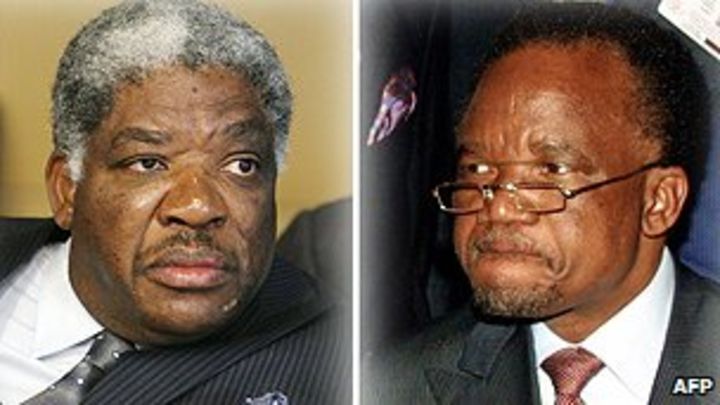
What does the Chiluba-Mwanawasa power struggle tell us about Tembo and Mundubile?

Breaking News Zambia
NewsLUSAKA – A political analysis by former Finance Minister Dr Katele Kalumba has drawn a historical parallel between Zambia’s 2001 MMD succession struggle involving Frederick Chiluba and Levy Mwanawasa and the current dispute surrounding NRPUP president Ezra Tembo, former presidential candidate Brian Mundubile and the Tonse Pamodzi Alliance. Kalumba argues that the two situations are […]
LUSAKA – A political analysis by former Finance Minister Dr Katele Kalumba has drawn a historical parallel between Zambia’s 2001 MMD succession struggle involving Frederick Chiluba and Levy Mwanawasa and the current dispute surrounding NRPUP president Ezra Tembo, former presidential candidate Brian Mundubile and the Tonse Pamodzi Alliance.
Kalumba argues that the two situations are not identical, but says the 2001 experience provides a useful historical framework for understanding what can happen when control of a political party and the electoral strength generated through that party end up being concentrated in different political actors.
His intervention comes as the post-election dispute over NRPUP’s political direction has increasingly focused on the party’s proportional representation seats.
NRPUP served as the political vehicle through which the Tonse Pamodzi Alliance fielded Mundubile as its presidential candidate in the August 13 election. After the election, however, NRPUP moved ahead with its own proportional representation list.
Tembo said the list had already been prepared and submitted by the party’s Secretary-General and maintained that the selection of nominees was a party matter rather than a decision he had made personally.
That development has prompted criticism from within the wider alliance. Tonse Alliance partner Muhabi Lungu argued that the PR seats were secured through votes obtained by Mundubile and questioned whether Tembo should determine who occupies them.
It is against this background that Kalumba’s historical comparison becomes particularly interesting.
The 2001 MMD lesson
Kalumba takes readers back to the succession struggle that followed Chiluba’s decision not to seek a third presidential term.
At the time, Chiluba remained the dominant figure within the MMD and controlled the party machinery. Mwanawasa, although already a nationally recognised politician and former Vice-President, needed the MMD political vehicle to contest the presidency.
Mwanawasa was eventually selected as the MMD presidential candidate and went on to win the 2001 presidential election.
Kalumba’s central observation is what happened after the election.
The balance of power changed.
Mwanawasa was no longer simply a presidential candidate who depended on the MMD structure. He had become Republican President, giving him an independent constitutional source of political authority.
Kalumba describes this as a movement of institutional power. His analysis points out that Chiluba’s party initially provided the route through which Mwanawasa reached State House, but the presidency subsequently became the instrument through which Mwanawasa acquired control of the MMD.
The significance, in Kalumba’s view, is not simply whether one politician was loyal or disloyal to another.
It is how political power can move from one institution or individual to another after an election.
From MMD to NRPUP
Kalumba sees a similar institutional question emerging around NRPUP.
Before the election, he describes the political arrangement broadly as Tembo controlling the party vehicle while Mundubile and Makebi Zulu brought national political visibility and the presidential campaign to that vehicle.
After the election, the question changes.
Who controls the political vehicle that has now acquired parliamentary representation through the votes generated by the presidential campaign?
Kalumba says this is the heart of the present confrontation.
The comparison, however, has an important limitation.
The MMD of 2001 was an established governing party with a substantial national organisation. NRPUP was a much smaller political party whose national relevance increased significantly after its electoral arrangement with the Tonse Pamodzi Alliance.
Kalumba therefore cautions that the two situations should not simply be treated as identical.
That distinction matters because the current NRPUP dispute revolves around the terms of the political arrangement that existed before the election and what those terms mean after the election.
Who owns the political vehicle?
This is perhaps the most important question raised by Kalumba’s analysis.
There is a difference between the legal ownership and control of a political party and the political capital generated by a presidential candidate.
Under Zambia’s proportional representation system, seats are allocated to political parties based on the valid votes obtained by their presidential candidates. The Electoral Process (Amendment) Act, 2026 provides that the Electoral Commission distributes PR seats in proportion to the total valid votes received by presidential candidates in the initial ballot.
That creates an interesting political question.
The votes are associated with the presidential candidate’s performance, but the resulting seats are allocated to the political party.
That distinction sits at the centre of the current argument.
Kalumba breaks the issue down into four questions: who controlled the political vehicle, who generated its electoral value, who can legitimately claim the electoral mandate and who controls the institution after the election.
Those questions have become particularly relevant because NRPUP has proceeded with its own PR list, while some Tonse figures argue that the alliance’s contribution to the electoral result should be reflected in the allocation of the seats.
The agreement before election day
Kalumba raises another question that could ultimately prove more important than the competing political accusations.
What exactly did the parties agree before the election?
He argues that if Tembo, Mundubile, Makebi and the wider alliance entered the arrangement without a clear written understanding governing post-election leadership and control, then the dispute may have been built into the arrangement from the beginning.
In his formulation, the parties may have solved the immediate problem of securing a political vehicle for the election without resolving what would happen to that vehicle after the election.
That is an issue that could potentially be answered by examining the original agreement between the parties, the NRPUP constitution and any other formal arrangements governing the alliance.
The argument from both sides
The dispute is not simply about personalities.
Those defending Tembo’s position can argue that NRPUP is a registered political party with its own leadership structures and that Mundubile contested the election using the party’s vehicle.
Those supporting Mundubile’s position can argue that the electoral strength that produced the party’s PR representation came from the presidential campaign and the wider Tonse Alliance effort.
Both arguments point to different forms of political legitimacy.
One is based on the institutional structure of the party.
The other is based on the political capital and electoral support generated through the campaign.
This is why the dispute has moved beyond the question of who said what to a broader question about who controls the political institution after an electoral alliance has achieved its immediate objective.
Why the 2001 comparison matters
The Chiluba-Mwanawasa experience offers an example of how political relationships can change dramatically after an election.
Before the election, the party structure was essential to the presidential candidate.
After the election, the successful candidate possessed a new source of political authority through the presidency.
The relationship between the political vehicle and the politician who benefited from it had therefore changed.
Kalumba argues that the same basic question is now worth examining in the NRPUP case: can the political actor who controls the vehicle before an election retain that control when another actor becomes the principal source of the vehicle’s electoral strength?
He describes this as a contest involving legal ownership, political authorship and electoral legitimacy.
The bigger question for NRPUP
The current dispute may ultimately be decided less by political rhetoric and more by documents and institutional rules.
Who controls the NRPUP presidency?
What does the party constitution say?
What did the Tonse Alliance agreement provide?
Who had authority to submit the PR list?
How were the eight NRPUP PR nominees selected?
And what role, if any, did the wider alliance have in that process?
Those questions are now particularly relevant because NRPUP has submitted eight PR nominees, while the party’s alliance partners have questioned both the process and the composition of the list.
The answers could determine whether the present dispute remains an internal political disagreement or develops into a broader contest over party control and representation in the new Parliament.
For Kalumba, the lesson from 2001 is that political vehicles can change hands in significance after an election.
The party may provide the vehicle.
The candidate may generate the votes.
But what happens when the election is over is ultimately a question of institutional power.
Special Comment
Dr Katele Kalumba’s full analysis, titled “Explicit and Oblique Power in Zambian Politics: Case Ezra Tembo/Mundubile and Fredrick Chiluba/Mwanawasa,” goes into greater detail on the historical comparison and the questions surrounding political power, party control and electoral legitimacy.



Community Feedback