REMEMBERING ELIAS MARKO CHISHA CHIPIMO SENIOR

Breaking News Zambia
NewsREMEMBERING ELIAS MARKO CHISHA CHIPIMO SENIOR Some politicians are remembered for the offices they occupied. Others are remembered for the things they said while occupying them. Then there was Chipimo Snr, a man who somehow managed to irritate governments without ever losing his intellectual composure. While some politicians spend their entire careers mastering the art […]
REMEMBERING ELIAS MARKO CHISHA CHIPIMO SENIOR
Some politicians are remembered for the offices they occupied. Others are remembered for the things they said while occupying them.
Then there was Chipimo Snr, a man who somehow managed to irritate governments without ever losing his intellectual composure.
While some politicians spend their entire careers mastering the art of saying absolutely nothing, Chipimo Snr seemed to believe that if something was on his mind, the nation deserved to hear it.
Born on February 23, 1931, in Mporokoso, Chipimo Snr came from a humble family. His parents, Marko and Musawa, were poor villagers raising seven children.
Education was not delivered to his doorstep.
The nearest primary school was 12 kilometres away, while the seminary where he later learned Latin was about 30 kilometres away.
So young Chipimo Sn walked.
And walked.
And walked.
Chipimo Snr’s generation apparently considered 30 kilometres on foot a reasonable commute for education.
When he was offered a scholarship, he gave it up to find employment and help his parents.
Eventually, however, the boy from Mporokoso made it to Fort Hare University in South Africa, graduating in Latin and English in 1959.
That same year he married Anna Konie, an exceptional scholar and the first Zambian woman to pass the Cambridge School Certificate.
This was not exactly a household where anyone could casually announce, “Education is not really my thing.”
Chipimo Snr taught English at Chizongwe Secondary School in Chipata between 1959 and 1963 before Zambia became independent in 1964.
And independence came with a new country desperately looking for educated Zambians to help run it.
Chipimo’s talents caught the attention of Kenneth Kaunda’s UNIP government.
There was just one problem.
Chipimo Snr wasn’t exactly a UNIP fan.
But unlike today’s political entrepreneurs who discover “principles” conveniently after being fired, Chipimo Snr was willing to serve the country even when he disagreed with the government.
In 1968, he was appointed Zambia’s High Commissioner to Britain.
His diplomatic mission was almost comical.
His predecessor had apparently described Britain as a “toothless bulldog,” leaving Chipimo Snr with the rather unenviable diplomatic task of repairing relations between Zambia and its former colonial ruler.
Imagine being told:
“Your colleague has just insulted the British. Please go there and explain that we still love them.”
Diplomacy, Zambian edition:
Your predecessor has insulted them. Please go and make peace.
Chipimo Snr survived the diplomatic assignment and served in London until 1969.
He later became the first African chairman of Standard Chartered Bank Zambia.
But clearly, the board had hired the wrong man if they were looking for somebody who would simply smile, nod and collect a salary.
Chipimo Snr had opinions.
And worse, he was prepared to express them publicly.
In 1980, he delivered a speech in which he observed that in Africa, leadership change often came through “death in the saddle” or “an assassin’s bullet.”
President Kaunda who had been in office for 16 years, was reportedly furious.
Chipimo Snr subsequently resigned from the bank.
There are people who spend their careers avoiding controversy.
Chipimo Snr apparently walked towards it, shook its hand and asked what was for lunch.
Then came 1991.
Multiparty democracy returned and Chipimo Snr resurfaced under the MMD.
He was nominated to Parliament and appointed Lusaka Province Minister.
Because apparently after surviving UNIP, diplomacy, banking and Kaunda’s displeasure, retirement was too boring.
He later served as Zambia’s ambassador to Germany from 1997 to 2000 and Japan from 2000 to 2001.
But diplomatic postings did not cure him of his greatest weakness:
telling the truth exactly as he saw it.
In 2003, at the age of 72, Chipimo Snr told journalist Amos Malupenga that he was leaving Lusaka and returning to Mporokoso because of the “scandals” and “madness” in the capital.
At 72, the man had apparently looked at Lusaka politics and concluded:
“You people can keep this nonsense. I am going home.”
Then came the entertaining part.
He was asked about Zambia’s presidents.
Chipimo Snr did not suddenly develop diplomatic amnesia.
On Kaunda, he said Kaunda had unjustifiably denounced him and made him unemployable for 11 years.
On Frederick Chiluba, he described him as a nuisance to the country, referring to Chiluba’s own description of himself as a political engineer and allegations of bribery.
And on Levy Mwanawasa, Chipimo Snr said the President was his own enemy because whenever he opened his mouth, he put his foot in it.
Three presidents.
Three opinions.
Zero sugar-coating.
Then tragedy struck.
In 2008, Chipimo Snr and his wife Anna were travelling to Mporokoso to vote in the presidential by-election when they were involved in a road accident.
Anna died at the scene.
Chipimo Snr was evacuated to UTH with fractured ribs, a fractured forearm and a head injury.
The tragedy profoundly affected their family.
Their son, Elias Chipimo Junior, later revealed that the accident and loss of his mother inspired him to enter politics.
In March 2010, he launched the National Restoration Party (NAREP).
Chipimo Snr died on January 18, 2015, in a South African hospital after being diagnosed with stomach cancer in December 2014.
He was 83, just weeks away from his 84th birthday.
He left behind four sons, three daughters and 17 grandchildren.
Among them were two prominent names: Elias Chipimo Junior and Dr Francis Chipimo, the Deputy Governor of the Bank of Zambia responsible for operations.
The government, under Acting President Guy Scott, accorded Chipimo Snr a state funeral, with a day of national mourning observed on the day he was buried at his farm off Leopards Hill Road on January 26, 2015.
Looking back, Chipimo Senior was a rather inconvenient character for Zambian politics.
He could work for a government without becoming its cheerleader.
He could serve as an ambassador without forgetting how to disagree.
And when he eventually became tired of Lusaka’s political circus, he simply packed his bags and went back to Mporokoso.
No Facebook announcement. No press conference. No “I remain available for national service.”
Just:
“Enough of this madness. I am going home.”
Perhaps the most fitting way to remember him is this:
Chipimo Snr did not suffer from a shortage of opinions.
His problem was that he had the audacity to express them while the people he was talking about were still alive, still powerful and still in office.
That was Chipimo Snr.
A scholar. A diplomat. A politician. A banker. A patriot. And, above all, a man who apparently never received the Zambian political handbook titled: “Know When to Keep Quiet.”
And judging from the things he said, he probably would have returned the book unread.
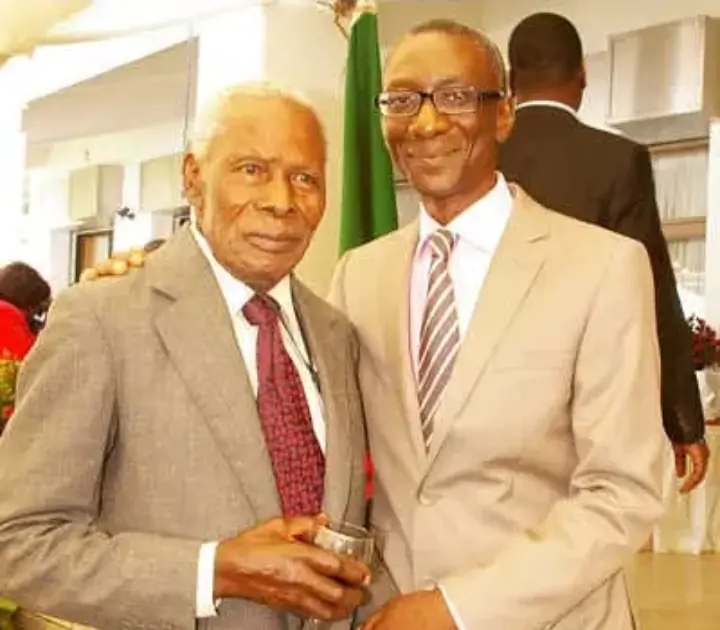
In the picture, Chipimo Snr & Junior.


Community Feedback