
Petition Or No Petition, Zambia’s Courts Hold The Real Verdict

Breaking News Zambia
Local NewsZambia’s transition of power now rests on an unresolved legal question with a fixed deadline attached: does the Constitutional Court have a valid petition in front of it, and can it rule before Hakainde Hichilema is sworn in on September 1. The Constitution gives the court 14…
Zambia’s transition of power now rests on an unresolved legal question with a fixed deadline attached: does the Constitutional Court have a valid petition in front of it, and can it rule before Hakainde Hichilema is sworn in on September 1. The Constitution gives the court 14 days from a properly filed petition to decide. Nobody, not the Judiciary, not State House, not the lawyers involved, agrees on whether that clock has even started.
The stakes go beyond procedure. A government bond auction closed this week with demand exceeding its K6.3 billion target by 37 percent, a sign investors are pricing in political continuity after the election. That confidence assumes the transition holds. An unresolved petition, or a Constitutional Court ruling that reopens the result, would test it directly.
The Judiciary’s official account is simple. Chief administrator Nalishebo Imataa told Secretary to Cabinet Patrick Kangwa that no petition had reached the Constitutional Court Registry by 18:00 hours on August 24, the seventh and final day allowed under Article 103 of the Constitution. Kangwa announced the September 1 swearing-in on that basis. Lawyer Linda Kasonde disputes the premise entirely. She says she attempted to file electronically through the Registry before the deadline and the submission bounced, so she forwarded the documents instead to Chief Justice Mumba Malila’s private email address. Malila has confirmed receiving them, called the method “highly irregular,” and referred them to the Constitutional Court regardless of the irregularity, meaning the question of whether the filing counts sits with the court itself rather than settled by administrative rejection.
Neither side has produced a timestamped record resolving the dispute. The Judiciary has not released logs showing the Registry submission failed or when. Kasonde has not published proof of the attempted filing time. That gap is the actual story: not who is lying, but that nobody has yet shown their work.
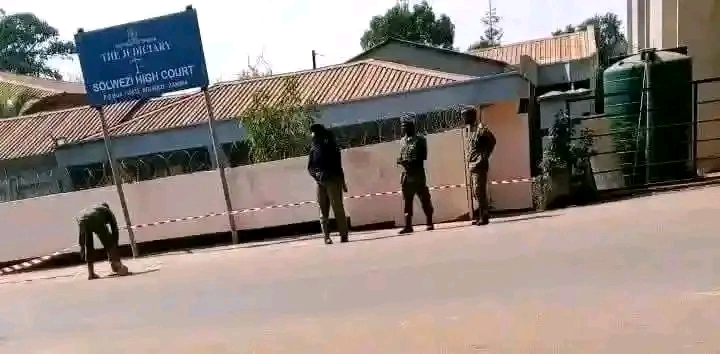
What sharpens the doubt is what was happening at the courts during the window Kasonde says she was trying to use. The Law Association of Zambia has confirmed court premises in Lusaka and Ndola were sealed off with tape marked “Crime Scene,” with no public explanation released at the time. LAZ president Lloyd Kaluba says the association still has no formal word on the legal basis for the closure, its scope or its duration, and has demanded both reopening and clarification.
State House rejects any link to the petition. Chief communications specialist Clayson Hamasaka says the August 24 measures covered the Ministry of Justice, the National Prosecution Authority and the Attorney General’s Chambers as well as the Judiciary, calling them intelligence-led precautions rather than action against a single litigant. His position is that the filing window opened on August 18, when the Electoral Commission declared the result, and that courts operated normally on the working days before the closure, with no petition lodged in that stretch. He has challenged anyone claiming a prepared petition was blocked to produce evidence of when and how they tried to lodge it. The Judicial Workers Union offers a third, unrelated explanation, with president Peter Mwale saying the closure followed the arrest of a Judiciary security officer over a detected threat and had nothing to do with any petition.
Constitutional lawyers are split on what happens if the Court finds the filing came late. Mehluli Batakathi says the seven-day window is absolute and no avenue remains once it closes. Tresford Chali argues the Court can extend the deadline where circumstances beyond a petitioner’s control, court closures among them, justify it, and that the Constitution should not be read so rigidly that the facts on the ground are ignored. Which interpretation prevails will likely determine whether the Court even reaches the merits of the case.
A second, separate legal challenge adds further pressure regardless of how the filing dispute resolves. Activist Brebner Changala and Kasonde have petitioned the Constitutional Court citing Christian Churches Monitoring Group data placing Hichilema’s vote share at 56 percent against the Electoral Commission’s declared 60.5 percent, and alleging vote figures were altered between polling stations and constituency tally centres.
The petitioners also cite the killing of former Lunte Member of Parliament Mutotwe Kafwaya and the deployment of the Zambia Defence Force to polling stations as evidence the election environment fell short of constitutional standards. Kafwaya’s death has kept NRPUP’s presidential candidate, Brian Mundubile, and running mate Makebi Zulu, out of public view; both say they remain in a secure location over safety concerns, a decision that has split their own party. NRPUP’s registered president, Ezra Tembo, has broken with his party’s candidates to congratulate Hichilema and accept the result.
The Drug Enforcement Commission’s parallel case has not slowed the legal standoff but has added to the week’s uncertainty. The agency says 79 people of nine nationalities, arrested at Evana Estates in New Kasama, ran a digital laboratory targeting government systems linked to the Electoral Commission, with computers, hard drives and foreign currency seized. Spokesperson Allan Tamba says all suspects will be processed under normal constitutional protections.
What happens next has a clock on it. If the Constitutional Court accepts either petition as validly filed, Article 103(2) gives it 14 days to rule, a window that would run past the scheduled September 1 inauguration. Whether the ceremony proceeds as planned, is delayed, or goes ahead under legal challenge is now the single fact markets, diplomats and Zambians themselves are waiting on the Court, not the politicians, to settle.







Community Feedback