
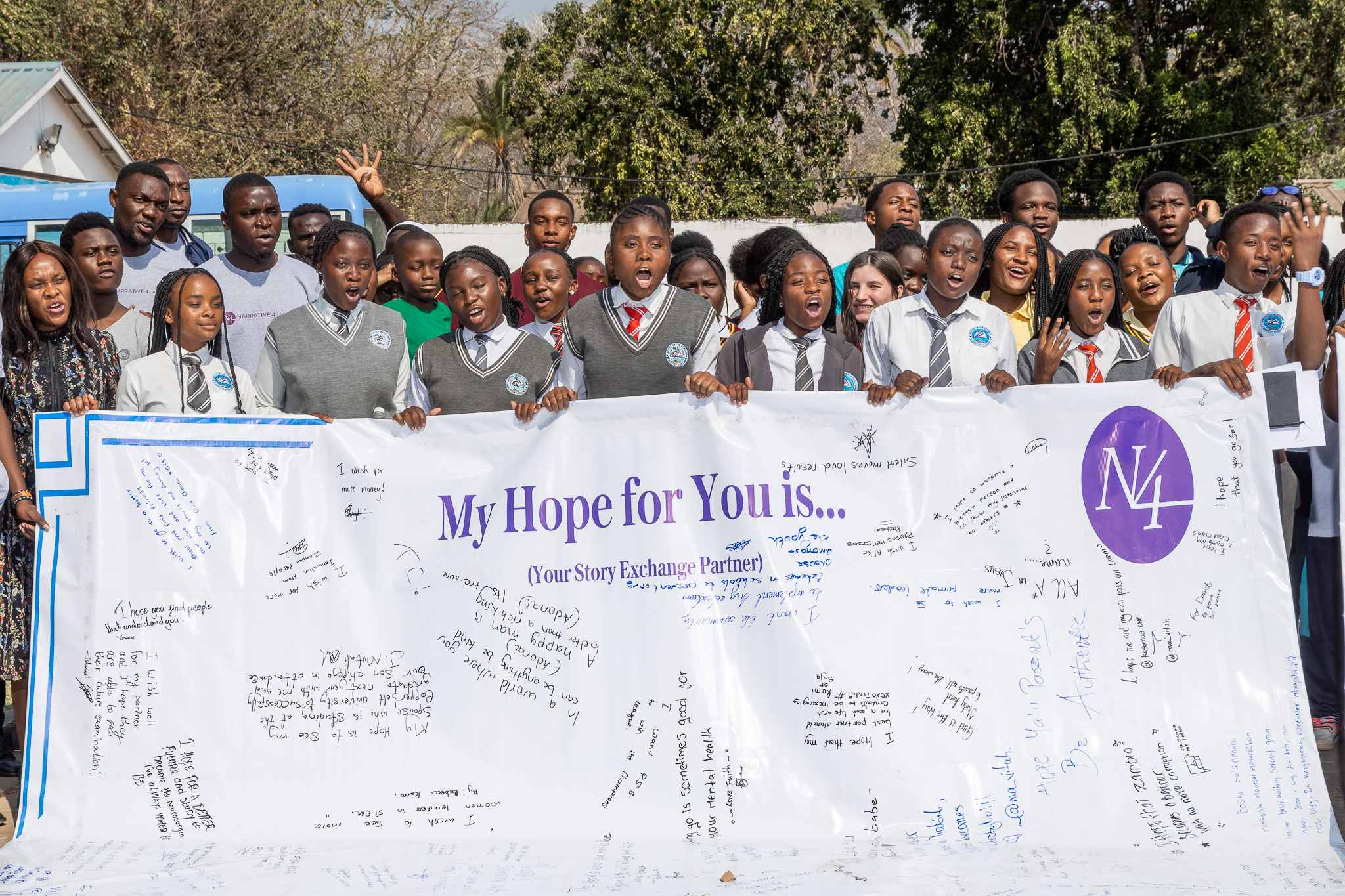
Lusaka Pupils turn community problems into ideas for change

Breaking News Zambia
NewsLUSAKA – For six months, secondary school students from Lusaka have been looking beyond the classroom to identify problems affecting their communities — and work out what they could do about them. This week, about 200 Pupils from 10 secondary schools will bring those ideas together at Crested Crane Academy, where they will showcase creative […]
LUSAKA – For six months, secondary school students from Lusaka have been looking beyond the classroom to identify problems affecting their communities — and work out what they could do about them.
This week, about 200 Pupils from 10 secondary schools will bring those ideas together at Crested Crane Academy, where they will showcase creative work, exchange stories and pitch proposed community projects to a panel of judges.
The event marks the conclusion of the Cities School Programme, run in Zambia by global non-profit Narrative 4.
For the students, the programme has been about more than producing school projects.
It has involved learning how to listen to other people’s experiences, understand different perspectives and turn concerns about their communities into practical ideas.
And there is a tangible incentive for the school whose idea stands out.
The winning school will receive a US$1,300 grant, approximately K25,200, to help put its proposed community project into action.
From identifying problems to finding solutions
Over the past six months, students participating in the programme have examined their local environments and identified challenges affecting their schools and surrounding communities.
They have then worked collaboratively to develop possible responses.
The final gathering gives them an opportunity to present those ideas publicly through project pitches, while also showcasing drama, dance and visual artwork.
It is this combination of storytelling, creativity and civic engagement that sits at the centre of Narrative 4’s approach.
The organisation describes its work as using stories to build connection and community, while encouraging young people to become active participants in addressing issues around them.
Narrative 4’s Zambia programme has been running since 2022, with the organisation reporting more than 20 Story Exchanges, over 500 participants and 262 facilitators trained in the country.
Why storytelling is part of the programme
One of the distinctive elements of the programme is the Story Exchange.
Rather than simply asking students to discuss community problems, participants are encouraged to share personal experiences and listen to the experiences of others.
The idea is that understanding another person’s story can change how young people see issues, identities and communities.
At this week’s gathering, students will therefore not only pitch solutions but also exchange stories and engage with perspectives that may differ from their own.
Narrative 4’s Director of Africa Operations, Buchi Onyegbule, says the programme is intended to give young people the emotional, creative and practical skills required to turn ideas into projects.
“These young people are using storytelling to understand one another, celebrate their identities and build stronger communities,” Onyegbule said.
Teachers are part of the equation
The programme has also involved teachers.
Participating teachers were trained as Narrative 4 facilitators and subsequently guided students through Story Exchanges and community-building activities.
That means the programme is not designed to end when the final event is over.
Students from the winning school are expected to begin implementing their community project with support from Narrative 4, while participating schools retain a framework that can be used for continued student engagement.
This creates a second layer to the programme: building the capacity of teachers to continue facilitating activities after the formal six-month programme.
A wider African programme
The Lusaka programme forms part of a broader Cities School Programme also being implemented in Nigeria, Rwanda, Tanzania and Kenya.
Narrative 4 says it works in six African countries and that 42,808 students participated in its programmes across Africa in 2025.
The organisation operates in 12 countries globally across Africa, Asia, Europe and North America and says more than one million stories have been shared through its programmes.
For Zambia, however, the immediate focus is much closer to home: giving young people an opportunity to look at the communities in which they live and ask a practical question — what can we do about the problems we see?
That is perhaps the most interesting part of the Lusaka gathering.
The students are not being presented simply as beneficiaries of a youth programme.
They are being asked to identify problems, listen to one another, develop solutions and compete for resources to actually implement one of those solutions.
And when the winning school receives its US$1,300 grant, the success of the programme will ultimately be measured not by the presentation on the day, but by what the students manage to change afterwards.
Zambian Eye will be watching what happens when these ideas move from the classroom and presentation stage into the communities they are intended to serve.


Community Feedback