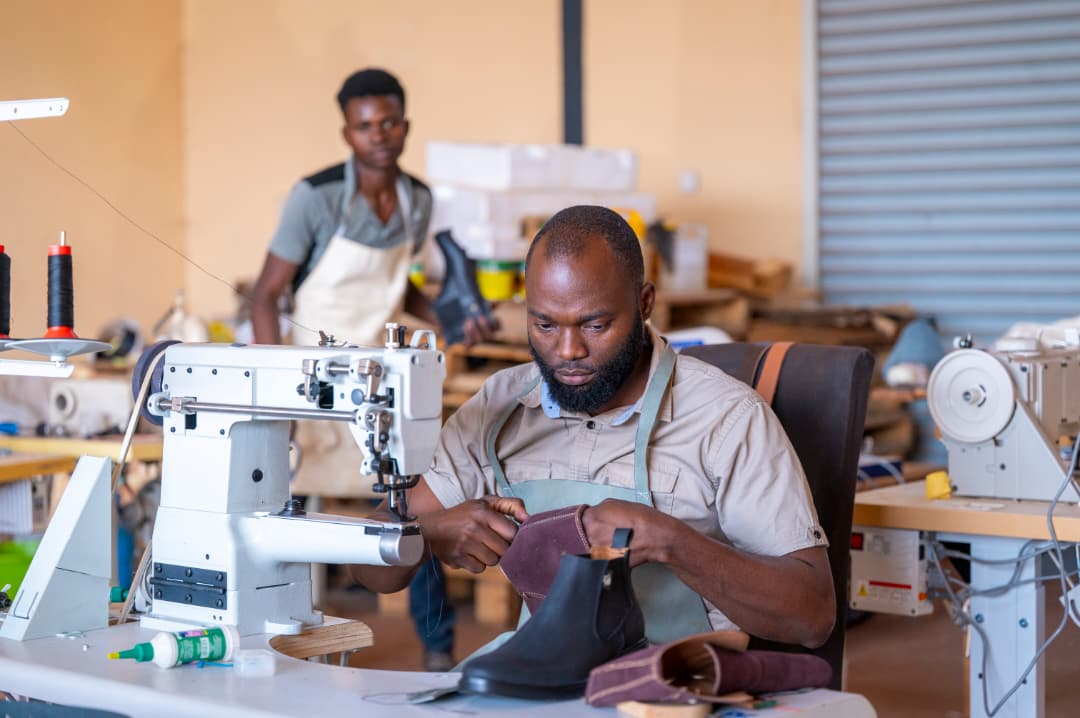
Kansanshi mine empowers local leather shoemaking company with equipment to boost productio

Breaking News Zambia
NewsA locally owned company, EB Stitch Leather […]
A locally owned company, EB Stitch Leather Limited, based in Solwezi District of North Western Province, is poised to significantly boost its leather shoe manufacturing operations locally following a vital handover of equipment supported by Kansanshi Mining PLC. EB Stitch is a locally owned company that specializes in crafting genuine leather products, including safety footwear, casual shoes, and school shoes.
According to EB Stitch Leather Limited, Founder, Evans Bwalya, the turning point came when Bwalya’s workshop caught the attention of Kansanshi Mining PLC through their accelerator program. “I didn’t know Kansanshi supported local businesses until a content creation team visited my workshop,” Bwalya explains.
“They introduced me to the Kansanshi accelerator program, which included 10 months of mentorship.” Bwalya’s journey into shoe manufacturing began as a personal challenge: unable to find his preferred style of shoes locally, he turned to online resources and self-learning.
“I started by watching YouTube videos on shoe making,” Bwalya recalls. “From there, my interest grew, and today we are able to make our own shoes.”
As his skills developed, Bwalya sought mentorship from experienced shoemakers, even connecting with an expert in Nigeria via video calls to refine his techniques. This dedication led to the establishment of EB Stitch Leather, which now produces high-quality leather footwear. He notes that the Kansanshi accelerator program has provided more than just equipment; it offered critical business training, such as financial management and formalization.
“We learned to separate personal and business finances, and the importance of formalizing our operations,” Bwalya says.
As a result, EB Stitch Leather has now achieved certification from the Zambia Bureau of Standards for its safety footwear, enabling the company to supply not only the general public but also larger clients such as mines and contractors. With the new machinery now handed over by Kansanshi mine, Bwalya projects a dramatic increase in production capacity.
“Previously, with just one electric sewing machine, we could only make 100 pairs of shoes a month. Now, with five machines and additional equipment coming, we’re targeting 300 pairs per month,” he stated.
He further added that the expanded operation will also create local employment, as more staff will be trained and hired to meet growing demand. Bwalya believes that formalization and visibility are key for local businesses seeking support.
“You don’t need special connections. Formalize your business, get known, and start now. If you demonstrate initiative, people will want to help,” he advises.
Looking ahead, Bwalya envisions EB Stitch Leather becoming a leading supplier of safety footwear across Zambia, serving mines and contractors nationwide with locally produced, high-quality products.
The partnership with Kansanshi Mining PLC, he said is more than an investment in equipment, but a catalyst for sustainable growth and market access for local SMEs.
Meanwhile, Kansanshi Mining PLC, reiterated its commitments to actively fostering sustainable economic growth in Solwezi by empowering value-adding local businesses through its innovative Business Accelerator Program.
Kansanshi Mining PLC, Corporate Affairs Manager, Ryan Ellis, explained that the program’s core mission is to identify and support enterprises that create genuine value, such as manufacturing or offering valuable services, rather than merely trading goods.
“For a business to access the mining value chain, it must be creating or adding value,” Ellis states.
“Simply purchasing items and reselling them doesn’t drive lasting impact. Our approach is to empower businesses that manufacture products or provide vital services, ensuring their longevity and impact in the community.”
One such beneficiary is EB Stitch Leather Limited, a small but ambitious operation that manufactures safety and casual footwear. Ellis points out that while traders may experience quick, short-lived success, value-adding companies like EB Stitch have the potential for longterm growth.
“Even after Kansanshi closes, Zambia’s millions of citizens will continue to need shoes. This is a business with real longevity beyond our immediate needs.” Ellis emphasized that the Business Accelerator Program is a deliberate, long-term strategy. The goal is to help local enterprises reach the quality and scale necessary to supply to Kansanshi and, eventually, the broader market.
“We will favorably consider tenders from local companies that meet our quality standards at competitive prices,” he says. “Safety is paramount, especially for products used in demanding environments like mining pits and smelters.
Our support is not just about opportunity, but also about ensuring products meet rigorous standards so our employees are not put at risk.” The Accelerator Program operates on an annual cohort system, with fresh intakes each year.
Through mentorship, equipment provision, and certification support, such as the Zambia Bureau of Standards (ZABS) accreditation for EB Stitch—participants receive the push they need to become independent and competitive.
“It’s like teaching a child to ride a bike,” Ellis remarks. “We give them the initial push, then let them pedal on their own while we help new businesses.” Currently, 66 businesses are enrolled in the program. Ellis notes that growth rates vary by sector and circumstance. “At year’s end, we reassess, do they stay in the program, or are they ready to move on independently?
The real challenge is to identify and nurture those businesses that can make a lasting impact in Solwezi’s rapidly expanding economy, now home to nearly 400,000 people.” Ellis envisions that by 2027, select businesses will begin supplying administrative and foundation needs, gradually building revenue and paving the way for broader supply opportunities.
“The hope is that these businesses become genuine, independent competitors, contributing to Solwezi’s dynamic economy long after Kansanshi’s involvement.” Concluded Ellis
Article by Tyndale Muchiya


Community Feedback