How Hichilema stole Zambia’s election- Sishuwa Sishuwa

Breaking News Zambia
NewsHow Hichilema stole Zambia’s election By Sishuwa Sishuwa The 2026 election was the first competitive election that Hakainde Hichilema has ever managed. The 2006 internal party election that brought him to the helm of the then main opposition United Party for National Development (UPND) and the 2021 poll that secured him the Zambian presidency were […]
How Hichilema stole Zambia’s election
By Sishuwa Sishuwa
The 2026 election was the first competitive election that Hakainde Hichilema has ever managed. The 2006 internal party election that brought him to the helm of the then main opposition United Party for National Development (UPND) and the 2021 poll that secured him the Zambian presidency were both organised by his opponents, Sakwiba Sikota and Edgar Lungu, respectively. Precisely because those polls were credible, Hichilema won.
Between 2006 and 2021, he never once held a competitive democratic election in his party, perhaps fearful that an open contest might lead to his ousting in the wake of repeated electoral failures in 2006, 2008, 2011, 2015 and 2016.
As a result of this demonstrated lack of commitment to democratic politics, I was not surprised that Hichilema, once in power, weakened oversight bodies, tilted the playing field, entrenched his advantage over time, and generally presided over an undemocratic administration which, as recently noted by Amnesty International, employed authoritarian tendencies to arrest freedoms and undermine political competition.
This record explains why I repeatedly invited Hichilema, ahead of the 13 August election, to pledge that he would peacefully concede defeat and hand over power were he to lose. My apprehension that Hichilema might refuse to accept defeat and spare the country from possible civil strife arose from the absence of safeguards that had previously helped to secure peaceful transitions whenever an incumbent president lost to an opposition challenger and attempted to manipulate the outcome.
The first is the absence of a former president who, in the event of loss, would advise the president that there is life after State House. Kenneth Kaunda helped ease a transition in 2011 when Rupiah Banda lost and tried to resist conceding. In 2021, it was Banda who helped to ease Lungu out. Lungu may well have done the same if he had not died and had not been a candidate in this election, were Hichilema to lose and resist leaving.
The second safeguard was the presence of several Western diplomats who, coming from countries that then boasted having presidents or prime ministers who supported democracy across the world, encouraged affected incumbent presidents to peacefully concede defeat rather than seeking to change the election result. In 2011, then US ambassador Mark Storella combined with Kaunda to persuade Banda to accept the result. In 2021, then UK High Commissioner Nicholas Woolley and US Charge d’affaires David Young, who had both combined shuttle diplomacy with public condemnation of human rights violations and the lack of a level playing field ahead of the election, encouraged Lungu to concede after he lost the poll.
Their efforts were complemented by the role of former presidents Banda, Bai Koroma (Sierra Leone) and Jakaya Kikwete (Tanzania). It was precisely the absence of this crop of democracy-supporting individual Western diplomats that made me unease ahead of this election, in addition to the growing disinterest in promoting democracy among great powers such as the USA and the European Union, as well as regional powers including South Africa and organisations such as the African Union.
The US has had no ambassador following the departure of the highly principled Michael Gonzales who spoke out against corruption, defended democracy, and sometimes seemed to care more for Zambia than many Zambians do. The Swedish ambassador Johan Hallenborg departed Zambia on election day. In Corry van Gaal, Canada has an astute High Commissioner but she is quite new, having only arrived in Zambia on the eve of the election, in July.
The British High Commissioner Rebecca Terzeon has shown little interest in political and human rights questions since she succeeded Woolley in January 2025 and is probably the worst on that score to occupy the position since Zambia returned to multiparty democracy in 1991. Following her arrival in early 2022, United Nations Resident Coordinator Beatrice Mutali remained silent on the several human rights violations that occurred throughout the Hichilema presidency and which Amnesty International were to document later in a report that was released three days before the election. Altogether, this context left me gravely concerned especially after Hichilema declined to make a public undertaking that he would concede if he lost the election.
The third safeguard was a depoliticised military that stayed out of politics, thanks to the leadership of apolitical and professional military commanders who exercised greater restraint in deploying their institutional prerogatives for partisan goals. Ahead of this election, Hichilema ended the nonpartisan character of the Zambia Army when he sackedthe highly regarded Lieutenant General Sitali Alibuzwi from his post as army commander and hired corruption-accused Geoffrey Zyeele as his replacement.
Zyeele had been retired ‘in the national interest’ in 2016 by then President Lungu for alleged partisan conduct in favour of the UPND. After the 2021 transfer of power, Hichilema recalled his co-ethnic from retirement, promoted him to the rank of Major General, and appointed him deputy army commander. To obscure the long-term political motives behind the appointment, the President chose Alibuzwi, the then deputy army commander who had been promoted to the position by Lungu in 2019, as the head of the military.
Although it was the first time that both the army and deputy army commanders came from the same region, the appointment of Alibuzwi was widely seen as merit-based owing to his professionalism, commitment to integrity, and the respect that he commanded among soldiers. The same could not be said about Zyeele, who was soon to be implicated in a major corruption scandal, one that forced the Anti-Corruption Commission to place the deputy army chief under investigations. Like most cases of corruption involving members of Hichilema’s inner circle, the case went nowhere. This murky history explains why opposition politicians rejected Zyeele’s promotion as army commander when Hichilema elevated him. In what has become his trademark response to public concerns, the president simply ignored these objections.
When removing Alibuzwi, the president gave no reason for the decision. However, his comments in the aftermath of the changes he made to the army’s leadership, alongside the public conduct of Zyeele since then, provide a clue: preparing the army to play a partisan role in politics and especially the conduct of the forthcoming election. For instance, in April 2025, Hichilema appropriated the country’s military as his fighters, ordered them to start dealing with civilians, and, when doing so, to be in a lethal mode. “I want to see my soldiers who are polite in the communities, who know how to handle civilians but yet (sic) when duty calls for the lethal side, they mutate into that mode as well. I believe you have got my message”, the president said six months after the unexplained dismissal of Lieutenant General Alibuzwi.
Given that soldiers do not “handle civilians”, as the maintenance of law and order is the responsibility of the police, Hichilema’s remarks were generally seen as a veiled invitation for the army to get more involved in politics and deal decisively with any pre-election signs of political dissent and potential post-election unrest. Zyeele heard the message. Since his appointment, he has repeatedly threatened citizens including critics of Hichilema, made partisan speeches, and enabled the deployment of the army for what are essentially police functions – precisely the kind of things that his predecessors would not have done.
A notable example occurred in November 2025 when informal small-scale miners, whose hazardous trade Hichilema had promised to regularise when he was in opposition, pelted the president with stones at a public rally on the Copperbelt. Hichilema was forced to abandon his speech, flee to safety, and had his ego severely bruised. If this incident showed mounting public anger at the president’s failure to fulfil the campaign promises he made in the last election, it unsettled the corruption-accused Zyeele who described the disillusioned stone-throwing youths as insane, vowed to hunt them down, and promised to institute “corrective measures” to avoid a repeat.
“You cannot throw a stone at a commander-in-chief and hope to have peace”, the army commander said before adding that “All those individuals who threw stones at the commander-in-chief, we shall pick them one by one. Some of them are under custody already. Those who ran away, we will look for them and deal with them according to the law. There is no sane person who can throw a stone at a commander-in-chief.” Zyeele’s point was clear: the army had got Hichilema’s message and was now implementing it by assuming policing functions.
Although the message was directed at informal miners, the targeted audience was much wider: general civilians in whom the army commander is instilling fear that any expression of dissent against the president would be met with lethal response from ‘Hichilema’s soldiers.’Having been previously dismissed from his role for alleged partisan conduct in favour of the UPND, Zyeele knows that the only way he can secure his job is to support the man who resurrected him from retirement, even if this means undermining the long established non-partisan character of the Zambia army.
Altogether, these three factors, enabled my apprehension ahead of the election that the president might resist leaving power if he lost the election. That apprehension was made worse by what I thought was a fundamental flaw in Hichilema’s character: unconstrained, extremely dangerous and reckless in its lack of restraint, a flaw that found expression through the pursuit of policies that have deepened divisions in the country and are totally disconnected from consequence. Drunk on his own power and lost to the vanity of self-focused ambition, I feared that Hichilema was not like any other president that Zambia has had before. Kaunda, Banda, and Lungu could have sought to overturn the results after being told that they were losing, but there was something in their DNA that made them concede. Hichilema is different. He appears to have gone into the election with one goal in mind: to remain in power at all costs, regardless of the verdict of voters. His entire machinery was designed with this objective.
Hichilema had stood in the queue to becoming President of Zambia for 15 years before voters finally removed him from it in August 2021. This demonstrates how badly the man wanted this job. But it has taken him only five years in office to display his unfitness for the role. When it comes to the bigger national issues, such as safeguarding our cherished democracy, getting the best out of Zambia’s mineral wealth, respecting the constitution and the rule of law, fighting corruption beyond rhetoric, genuine promotion of national unity and equitable distribution of appointments to public service positions, creating a professional civil service, sorting out the cost-of-living crisis and the deplorable conditions of life for most Zambians, Hichilema has lamentably failed. This dismissal record in office explains why, on 21 June this year, I predicted that “Zambia’s president will lose the 2026 election, unless he rigs it on an industrial scale.” My fears came to pass this week after the 13 August vote.
Given the information at my disposal, I can now reveal, for the first time, that Hichilema has managed to steal the election, and that the Electoral Commission of Zambia (ECZ) will be announcing his victory before long. Hichilema has managed to achieve this outcome using his allies in the electoral body, the local government system and security services.
By law, the leadership of the electoral commission consists of five commissioners appointed by the president, including the chairperson and the deputy who serve on a seven-year contract, renewable once. After assuming office, Hichilema declined to renew the contracts of three of the five commissioners appointed by his predecessor and who had managed his election in the 2021. These were Esau Chulu, the chairperson, Emily Sikazwe, the deputy chair, and Ali Simwinga, a commissioner. He replaced them with his former personal lawyer Mwangala Zaloumis, who now chairs the body, and two other commissioners with known ties to the ruling United Party for National Development (UPND).
The commissioners include Zevyanji Sinkala, who joined the commission on 14 May 2026, about a week before the start of presidential nominations, and McDonald Chipenzi, whose appointment was opposed by the opposition over his previous links to the UPND. In fact, ahead of the 13 August election, Sinkala was planning to seek election to parliament on the UPND ticket and had started producing his campaign material. Plucking him from the field, Hichilema felt Sinkala could better serve the ruling party in a different capacity: as a commissioner on the national electoral body. This meant that last Thursday’s election was conducted by a commission whose impartiality was already questionable.
Well-placed sources in government who have sought anonymity disclosed that a day after the election, the president was briefed by relevant officials that things were not looking good for him. ECZ results are tallied at polling station, before they are sent to the totalling centre at district level, and finally transmitted to the ECZ national totalling centre at Mulungushi in Lusaka. Although it is only the ECZ that is legally mandated to announce results by law, organised political parties and election monitors, especially those who conduct Parallel Vote Tabulation (PVT) exercises, can easily know the national aggregate results, based on the copies of results announced at the crucial polling station stage, long before they are announced by the electoral body. Indeed, this is what happened in this election.
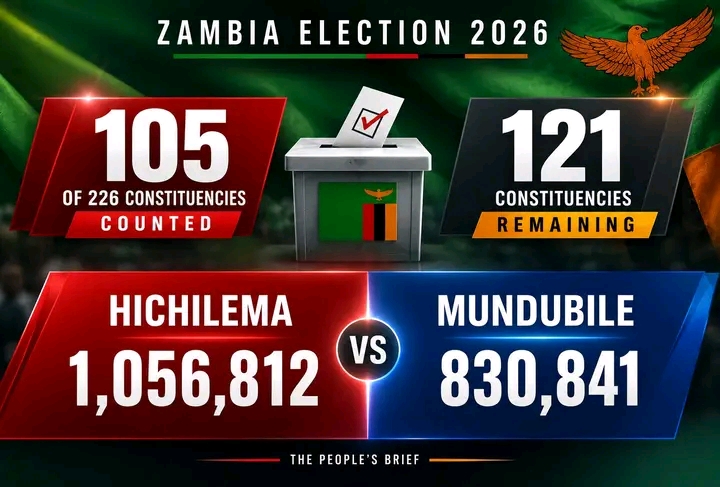
After the conclusion of vote tabulation and counting at polling station level, three independent PVT exercises separately showed that Hichilema had lost the election to his main rival Brian Mundubile. The most credible of these PVTs, conducted by broad sections of civil society, shows that Mundubile defeated Hichilema by a difference of 567, 911 votes. In response to the news that he had lost the election, the president turned to his allies in the ECZ to stop the count for the purpose of enabling him to create room for manipulating the vote in his favour. The ECZ obliged.
In a statement released around 2pm local time on 14 August, Hichilema’s former personal lawyer announced the suspension of vote counting “throughout the country” over “reports of violence during the counting and announcement of results in some districts.” Zaloumis claimed that the “violence is targeted at poll staff and in some instances has resulted in the theft of marked ballot papers in ballot boxes.” This decision was faulty for five major reasons.
First, the suspension of vote count was based on unproven or insufficient evidence. There were no reports of violence in any part of the country during the voting. Both election observers, in their preliminary statements, and Hichilema confirmed that voting had taken place peacefully. So where did the ECZ find evidence of deliberate, widespread and systematic violence to justify their decision?
Second, the decision was made without the support of the law. As noted by the Law Association of Zambia, there is currently no law that empowers the commission to suspend vote counting across the country. The existing legislation only allows the commission to suspend vote counting at each polling station level.
Third, the decision was illogical. If only some districts were affected, why did the ECZ extend the suspension to the whole country including areas that were not affected?
Fourth, the decision was vague in relation to the identity of affected districts. How is it possible that the ECZ knew that violence had occurred in some districts but could not state the names of the affected areas? Is it because the commission was afraid that the people from those areas would have disputed any claims of violence?
Fifth, the decision fatally wounds the credibility of the result itself. If ballot boxes were stolen, as alleged by ECZ and presumably after the tabulation and counting of votes at polling stations had concluded, then why should the public believe that the results being announced are accurate, not those that could have been swapped with stolen ones? How many ballot boxes were stolen and in which areas? Were the stolen ballots recovered? If yes, did the ECZ engage all the parties and their polling representatives in the affected stations to establish the validity of the recovered ballots before admitting them? If the stolen ballots have not been recovered, then where does this leave the credibility of the results being announced?
Moreover, polling stations are secured guarded by state police. How was it possible for anyone to freely walk into the stations and steal the ballot boxes? Where was the police? What makes it even worse is that the ECZ made the decision to stop the count without any prior consultation with the different stakeholders such as the competing candidates or political parties. Why? All considered, it is easy to see that the suspension of counting was intended to help one party: the UPND, as there is no real incentive for the opposition in stealing the ballots.
The ECZ caught everyone by surprise when announcing the decision. As one international election observer noted in a chat with me, ‘We were shocked by the decision to STOP THE COUNT because it has no precedence in Zambia. Before coming to Zambia, we were telling ourselves that we would be here for only a few days as elections in this country tend to go on smoothly and without major incidents. How wrong we were! What is happening here has come as a shock to many of us because this is not the Zambia that we know. The election management body of this country was widely respected internationally, and it is sad to see that solid reputation going up in flames.”
All these shortcomings and discrepancies in the statement by the ECZ were deliberate, however. What was important for Hichilema was neither the justification for the decision nor the reputation of ECZ but the creation of sufficient time in which he could manipulate the results. This is precisely what happened during the four-hour period when the suspension was in effect. Two developments are crucial here.
The first was the decision by Hichilema to order the Local Government Service Commission (LGSC), a statutory government body that provides the staff that manages the election at district level, to alter the results at polling station level by destroying the Gen 20 election forms and replacing them with new one containing entirely fabricated results. The LGSC is headed by Maurice Hichilema, the president’s younger brother who, in March 2026, was appointed as the commission’s secretary, leaving his previous role as director of human resources development at the Public Service Management Division.
The position placed the younger Hichilema in control of Town Clerks, Council Secretaries and other senior officials that run municipalities and councils. Although Zambia’s Constitution provides that the ECZ shall have offices in provinces and progressively in districts, the electoral body continues to rely on town clerks and council secretaries to serve as district electoral officers with the responsibility of administering the elections at the district level. The decision by Hichilema to transfer his sibling on the eve of the election to this crucial body, the LGSC, was therefore not accidental. It was designed to help him steal the election in case he lost. This is indeed what happened after the president learnt that he was losing the poll.
According to information provided by one of the LGSC commissioners, Hichilema ordered the alternation of the election results across the country using the infrastructure of the town clerks and council secretaries. The crucial Gen 20 election forms, on which results are entered at polling station level before the party agents append their signatures to the form, were to be destroyed and replaced with new ones complete with fake signatures of polling agents. To avoid mispresenting the commissioner’s, it is important to quote them at length to understand how Hichilema has employed industrial scale vote-rigging to subvert the will of the people:
“On 14th August, in the morning, having seen that the incumbent was losing, the Town Clerks and Council Secretaries were instructed…to collect all Gen 20 forms for Presidential election from districts. They want to alter the results and destroy what has been published so that there is no evidence during petitions since the only persons who shall prove that evidence are the DEOs/ROs….who will not have the original Gen 20 forms. Stakehokders have copies but the issue is that they want to announce the winner using fake Gen 20 forms so that once there is a petition, what form are the DEOs going to present as evidence in court since the original that was published (which stakeholders have) [would have] …been destroyed.
Take note that Gen 20 form is the actual election. The practice has always been that the Gen 20 and other materials forming part of the results announcement are submitted to Lusaka by gazzetted Returning Officers and after verification (all stakeholders come to verify results after 7 or 10days) and it is after this exercise that they take documents to Lusaka. So why should DEOs surrender these documents to someone who is not gazetteer?
In order to undertake this assignment, ECZ announced the 24-hour suspension on results announcements. There was pressure on this matter from a lot of stakeholders. Due to this pressure and having met resistance from some principled officers, instructions were modified as follows: District Electoral Officers have been given fresh instructions through Provincial Local Government officers that the District Intelligence Officers in each District should collect all the Gen 20s from Town Clerks and Council Secretaries. On the same 14th [August] afternoon, some officers were talked to directly. These include Town Clerk for Mazabuka…. who is calling all Council Secretaries and Town Clerks in Southern Province to change votes beyond the total number of voters that actually voted…telling them to modify the GEN 20. So the whole of Southern Province has now managed to modify the results.
[In] Northwestern province, all Council Secretaries have been directed to change figures of Gen 20 in all districts. [This rigging exercise is] Being coordinated by Solwezi Town Clerk…and the DPS [Deputy Permanent Secretary] for Northwestern [Province.] North-Western started [this rigging exercise] yesterday, and because time was ticking, the Zambia Army started helping [in collecting the Gen 20 for destruction before replacing them with manufactured ones] from Chavuma into Zambezi. Since the numbers are not much in Northwestern, they decided to extend [the exercise] to Lusaka yesterday afternoon, using Soldiers.
In the BM [Brian Mundubile] strongholds [of Luapula, Northern, Muchinga, Copperbelt and Lusaka provinces], the instructions were to reduce on the tally for BM. As long as there is no intervention, ECZ is determined to continue announcing fake and overstated results so that they install the incumbent and ask aggrieved parties to go to court.”
The LGSC commissioner disclosed that many of those refusing to surrender or hand over Gen 20 forms for destruction are being arrested and held in detention centres across the country. Others have been severely beaten by security services.
The second development that occurred during the four-hour period when the suspension of vote counting was in effect was the decision by Hichilema and Zyeele to unleash the military tankers onto the streets, send soldiers to the totalling centre in districts to help with the collection and destruction of Gen 20 forms, and to deploy military officials to invade polling stations in several places across the country, chase polling agents, and pave the way for the swapping of the results. This takeover of polling stations by state security agents was meant to allow the authorities to inflate turnout in places that had recorded low turnout such as Southern Province, facilitate ballot stuffing, and enable the alteration of constituency-level results in ways that could reverse the overall result.
All these dramatic developments coincided with the abduction of several opposition figures from Mundubile’s party to distract their concentration and prevent them from fighting the ongoing rigging schemes. For instance, Mundubile disclosed in a public address that spy and military officers raided his home in the evening of on 15 August, shot at his party officials, and subsequently abducted several senior members of his security and campaign team. The latter include his spokesperson George Chisanga, his party’s finance chairperson Mutotwe Kafwaya, and the well-regarded Anglican bishop Trevor Mwamba. The whereabouts of all these political figures remain unknown, joining those who were abducted earlier such as Sebastian Kopulande.
All these activities were not accidental. They were organised. The military’s raid on Mundubile’s house could not have been carried out without the approval of the army commander and Zyeele could not have given the order to attack the home of the president’s rival without instructions from Hichilema. If Alibuzwi was sacked for refusing to support the use of soldiers in electoral contests, Zyeele will keep his job for doing what none of his predecessors ever did: getting the military involved in partisan politics.
In the end, and within a period of four hours, the foundation for changing the election results in different places had been laid. What remained was to ensure that the ECZ proceeded to announce the results slowly for the purpose of enabling the completion of industrial scale rigging in places like Luapula and Northern.
Emboldened by the success of his rigging schemes, Hichilema even called on the opposition to concede defeat peacefully long before the ECZ had announced a single result.
Writing on his official Facebook on 14 August, minutes after the ECZ announced that vote counting would resume because the security services had ‘contained the violence in some districts’, the president said, “In our entire years of opposition, at no point did we encourage other people’s children to go into the streets over any grievances we had with the electoral process. We hope our colleagues in the opposition can learn from that by not sending people other people’s children in the streets…” After facing backlash over the post since no single opposition party had protested the yet-to-be-released results, Hichilema deleted it. Such was his excitement!
Seen from this perspective, the suspension of vote counting was a carefully calculated and deliberate strategy designed to infuse in the ballots that Hichilema needed to reverse the overall outcome of the election and be declared the winner. By 15 August, much of this rigging exercise had been successfully completed. What remains is for the ECZ to now find efficiency in announcing the altered results before finally declaring Hichilema President-Elect of Zambia.
In some cases, the scale of the rigging has left the ECZ exposed, with two different recorded voter turnouts in same constituencies. In Kalomo, for example, the ECZ announced results showing that voter turnout at presidential level was 70 percent and 48 percent at parliamentary level! Political opponents displeased with the results will be encouraged to approach the Constitutional Court – an institution that Hichilema packed with his loyalists on the eve of the vote – for redress.
After securing his second term, Hichilema can then proceed to do what Emmerson Mnangwa has done in Zimbabwe: change the constitution and entrench himself in power. Ahead of the election, the Attorney General disclosed Zambia will overhaul its constitution after this month. Such changes might include removing or extending the length of presidential term limits and empowering the National Assembly rather than voters to choose the president.
Until now, Zambia possessed one of Southern Africa’s most important traditions of peaceful democratic competition and transfers of political power. That record has depended upon the conduct not only of political leaders, but also electoral officials, security institutions, civil society, party representatives, independent media, citizens, and international partners. Previous Zambian electoral transitions demonstrated that timely attention of key actors can reinforce the professional independence of institutions and reduce incentives for conduct that could compromise public confidence in an election.
Against a wider pattern of democratic erosion across the SADC region, Zambia now carries unusual significance. Recent developments in several neighbouring states have demonstrated how quickly electoral competition, constitutional restraints, and institutional independence can erode when regional safeguards are absent and the attention of traditional international partners, particularly the United States and the European Union, is diverted by competing priorities.
Unfortunately, the country’s previously enviable democratic tradition that distinguished it within Southern Africa is now gone. Not that Hichilema would give a damn. What mattered to him was that he remained in power, even if it means governing without any shred of legitimacy for the next five years. In the end, Mundubile won the most votes, but Hichilema won the result, thanks to his allies in the electoral commission, the local government system, and security services!
Well, there you have it! Who will stop Hichilema?

Community Feedback