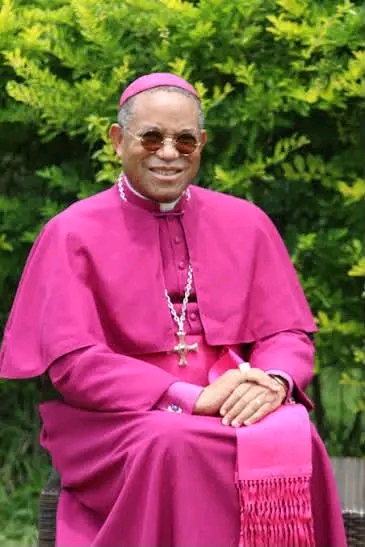
Bishop Trevor Mwamba’s arrest debate and role of the church in politics

Breaking News Zambia
News8 Views The recent arrest of Bishop Trevor Mwamba at a political meeting which took place amid alleged shootings at National Reconciliation Party for Unity and Prosperity NRPUP president Brian Mundubile’s residence has gotten citizens talking. It has generated a heated debate in social media circles, with some saying it was in bad taste for […]
8 ViewsThe recent arrest of Bishop Trevor Mwamba at a political meeting which took place amid alleged shootings at National Reconciliation Party for Unity and Prosperity NRPUP president Brian Mundubile’s residence has gotten citizens talking.
It has generated a heated debate in social media circles, with some saying it was in bad taste for the State to arrest a respected Man of God the way it did.
Others said the church leader was at the wrong place at the wrong time. Yet some questioned the role of the church in politics.
Commentator, Dr Lubinda Habazooka gives his own perspective.
He says the church, particularly Zambia’s Roman Catholic Church needs to seriously reconsider its role as a political referee, arguing the church has lost influence after being perceived to take sides in the 2026 elections.
Writing in a post-election opinion, Dr Habazooka said his comments were “not an attack on anyone, any church but an opinion based on observations made thus far.”
“The Catholic Faith in Zambia is dominated by people of various ethnic groups, race and political affiliations. This church with whom I identify has had strong influence on the development of Zambia with its network of mission schools, charities and church presence in Zambia,” he said.
He noted that historically the church has shaped public opinion through pastoral letters and coordinated messaging. “Former President Kenneth Kaunda and many others later have been victims of political losses after going in conflict with the Catholic leadership,” he said.
However, Dr Habazooka argued that for the first time the church’s influence has waned because leadership “misread the mood of the population and clearly taken sides in political battles.”
“With citizens in dire need of an independent body to counsel various political groupings, everyone was looking up to the vocal Catholic Church to reconcile people but some of its leadership allegedly influenced by certain individuals decided to clearly support one side and this led to disgust amongst a large portion of its followers and citizens in general,” he said.
He singled out the church’s decision to organise and publicise a candle mass as a key misstep. “The biggest mistake of the Catholic Church was to organise and publicise a candle mass which was criticised by the ruling party. In its wisdom, the church should have either removed the candle from the mass or even invited all political parties to attend or even cancelled the mass altogether,” he said.
According to Dr Habazooka, the mass was widely viewed as political. “There insistence to continue with the mass influenced negatively those they were perceived to support. Many people shunned the mass as they viewed it as a last political rally. Senior members of the opposition widely advertised this mass and openly associated the candle symbol with the lamp. You might argue with me but deep down you know that,” he said. “I openly advised to not do this. Zambians are weird in their judgements.”
He also pointed to changing religious demographics. Citing the Census of Population and Housing report from ZamStats, he said Christianity represents about 98% of Zambians, but no single denomination dominates.
“Roman Catholic: 17.9%, Seventh-day Adventist: 17.7%, Pentecostal: 17.5%, United Church of Zambia: 9.6%, New Apostolic Church: 8.4%,” he listed, adding that other groups include Jehovah’s Witnesses at 5.6%, Baptists at 3.6%, Islam at 0.5% to 0.94%, and those with no religion at about 1.3%.
“Clearly no church dominates this space,” he said. “There is also serious historical rivalry amongst church denominations and whenever one church takes a stance, it’s very common to find other churches take a different position.”
Dr Habazooka said the church’s pastoral letters “never carry the same weight now as in the past” and that the public now perceives the church “to be a party to the conflict and not a referee.”
“Referees never take a sides. When they issue a red card, everyone agrees with it,” he said.
He called for the church to refocus on reconciliation. “Even the issue of the burial, the church should take a lead and guide. The church is about reconciliation and not establishing who is wrong or right. Jesus accepted everyone. So we call on the church to continue guiding us its children for the betterment of all,” he said.
He concluded with an appeal for unity. “We beg for forgiveness and mercy from the Lord Jesus Christ and ask us him to show us a signal on how to move on,” he said.
“This is entirely my opinion and scholarly advice. Zambia needs a strong independent stakeholder to lead when political groupings are in disagreement,” Dr Habazooka said.

Community Feedback