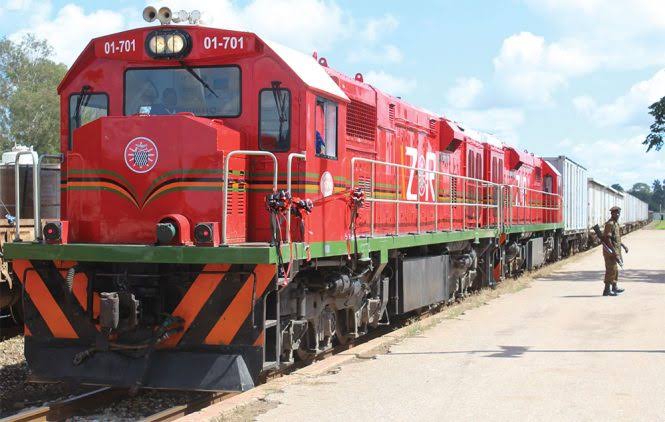
Why is Rail sector still struggling to handle more export volumes than Roads?

Breaking News Zambia
NewsDespite the Zambian government securing $1.4 billion […]
Despite the Zambian government securing $1.4 billion for the rehabilitation of the TAZARA railway and $60 million for Zambia Railways, the nation’s exports continue to be overwhelmingly dominated by road transport.
A recent government report reviewed by the Zambian Business Times (ZBT) revealed that from January to April 2026, Zambia recorded total exports of K105.2 billion across all transport modes. Road transport accounted for K101.3 billion, representing 96.3% of the total, while air transport followed with K2.3 billion. Rail transport lagged behind at just K50.4 million.
In terms of volume, 3.2 million metric tonnes of goods were exported during the same period. Road transport was responsible for 2.6 million metric tonnes (80.2%), rail accounted for only 8.7 thousand metric tonnes (0.3%), and air for 1.4 thousand metric tonnes. Jacob Makambwe, Secretary General of the Southern Africa Cross Border Traders Association (SACBTA), attributes this imbalance to poor railway infrastructure. “Zambia doesn’t have the infrastructure needed to facilitate the export of goods by rail.
Upgrading the railway system is crucial for shifting cargo from road to rail, which would ultimately reduce road maintenance costs,” he told ZBT, Makambwe noted that while significant funding has been allocated—including European Union support for the rehabilitation of the Livingstone-Copperbelt line—implementation has been slow.
“If these projects are completed, they could help transition more exports onto the railways and ease pressure on Zambia’s roads,” he said. As the government and partners work to implement these largescale projects, industry stakeholders continue to advocate for a modern, efficient rail network that can compete with road transport in moving Zambia’s exports.
Article by Justine Phiri




Community Feedback