
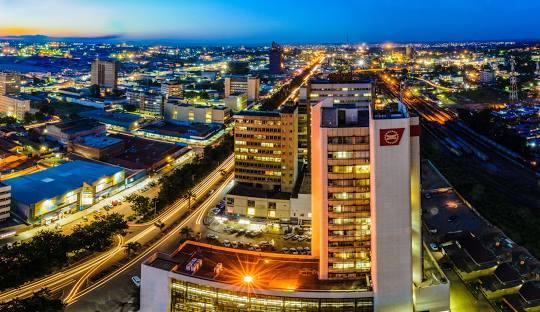
Lusaka tops provincial inflation rankings at 8.6% in April 2026

Breaking News Zambia
SportsOfficial government statistics show that Lusaka led […]
Official government statistics show that Lusaka led provincial inflation rates in April 2026, recording an 8.6% year-on-year increase, more than double Luapula Province’s 4% rate for the same period. Of the overall annual inflation rate of 6.8 percent in April 2026, Lusaka Province accounted for the highest contribution at 2.5 percentage points, followed by Copperbelt Province at 1.3 percentage points.
Central and Southern Provinces contributed 0.7 percentage points each, while Luapula and Northwestern Provinces recorded the lowest contributions at 0.2 percentage points each. Commenting on the figures in an interview with the Zambian Business Times (ZBT), economic analyst Samuel Lungu attributed the 4.6 percentage point gap to underlying structural differences between Zambia’s high-demand urban centres and its lower-demand rural economies.
Lungu explained that the inflation disparity indicates rural Zambia remains relatively insulated from price increases, while urban households, particularly in Lusaka, are bearing the full brunt of rising costs in housing, fuel, food, and essential services.
“The significant inflation gap is both demand and supply driven, and Lusaka’s high population creates stronger pressure on prices compared to provinces like Luapula,” Lungu observed.
He noted that Lusaka’s elevated consumption levels, limited housing supply, and escalating transport costs are key drivers pushing inflation well above the national average. “With limited housing and rapid urbanisation, costs such as rent, transport, and wages are significantly higher, and these feed directly into inflation in Lusaka,” he stated. According to Lungu, rural provinces are shielded by their reliance on subsistence living, where households depend less on formal markets and more on locally sourced food.
“Rural provinces have an informal buffer through peasant farming and informal trade, which dampens inflation compared to urban centres that depend on formal supply chains,” he stated. Lungu warned that if these disparities persist, Zambia risks deepening economic inequality. Urban residents would continue to face mounting living costs, while rural areas fall further behind in development—entrenching a structurally imbalanced economy increasingly driven by urban inflation.
Article by Phillip Sinkala




Community Feedback