
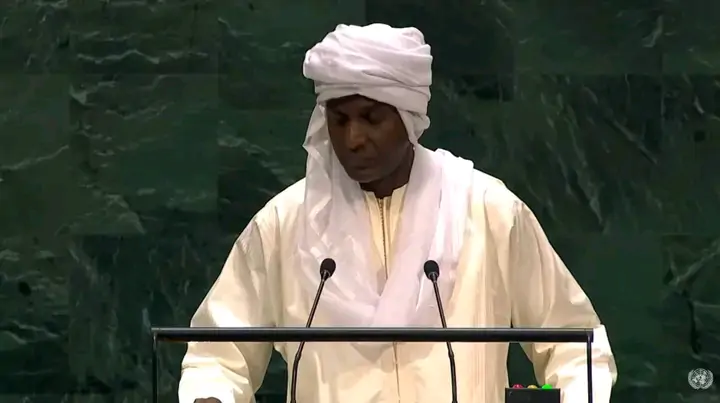
“For more than half a century… Niger’s uranium has lit the cities of Europe while our cities have remained in darkness. That injustice is now over.”- Niger’s PM at UNGA

Breaking News Zambia
NewsNiger has just delivered perhaps one of the most defiant African speeches at the United Nations General Assembly. The message was uranium, sovereignty, France, Ukraine, the Alliance of Sahel States, and a declaration that Niger will never again surrender control of its resources. The PM Ali Mahamane Lamine Zeine speaks: 1. Niger’s uranium first. Niger’s […]
Niger has just delivered perhaps one of the most defiant African speeches at the United Nations General Assembly. The message was uranium, sovereignty, France, Ukraine, the Alliance of Sahel States, and a declaration that Niger will never again surrender control of its resources.
The PM Ali Mahamane Lamine Zeine speaks:
1. Niger’s uranium first.
Niger’s representative declared:
“For more than half a century… Niger’s uranium has lit the cities of Europe while our cities have remained in darkness. That injustice is now over.”
He said Niger recovered control of SOMAIR in June 2025 and declared that the uranium currently produced and stockpiled belongs exclusively to Niger:
“The current stock belongs to our country. It does not belong to anyone, and we will sell it to all those who wish to buy.”
He said that after foreign operators left, equipment was sabotaged, but Niger invested approximately 30 billion CFA francs to restart production entirely with Nigerien workers and experts:
“Not a single foreigner was involved in that.”
2. Then came his accusation against France and Ukraine.
Niger argued that the conflict in the Sahel is not merely terrorism but part of an attempt to regain control over African resources.
His words were extraordinary:
“Niger’s uranium, Mali and Burkina Faso’s gold, lithium, gas, oil and so many other riches still make the former colonial powers salivate.”
He described terrorism in the region as:
“The cynical machinery of recolonization dressed in the trappings of extremism.”
He then directly accused France, with Ukrainian complicity, of destabilizing the central Sahel:
“This perfidious attempt to destabilize the central Sahel, conducted by France with the active complicity of Ukraine…”
3. Then came the stark warning to France, Ukraine and their alleged proxies.
Niger’s representative declared:
“The Sahel sees, the Sahel hears, the Sahel remembers, and the Sahel understands things very well.”
He alleged that armed proxies were positioned near Niger’s northeastern frontier and preparing attacks against military and petroleum installations.
Then came the warning:
“They are about to attack our military positions and our oil installations. But inshallah they will find what they deserve if they do so.”
That was not diplomatic ambiguity. That was a direct warning from the UN podium.
4. Niger says the Alliance of Sahel States is irreversible.
Speaking about Niger, Mali and Burkina Faso, he described the AES project as:
“A profound, lasting, irrepressible and irreversible change, Inshallah.”
And:
“Our resources belong to our peoples. Our future will no longer be decided elsewhere.”
He said the AES now has a 5,000-person unified force, expandable to 15,000, its own investment and development bank, biometric passport, television channel, press agency, radio and confederation parliament.
Importantly, he said their development bank:
“Finances our projects and programs using our own resources.”
5. Niger says it is financing its own transformation.
This was striking because, unlike many of the African speeches I have been following at this UNGA, Niger spent considerable time emphasizing domestic financing.
The government, he said, is financing agriculture and basic social services through:
“Voluntary contributions of Nigeriens themselves, in addition to revenues drawn from the exploitation of our mineral and oil resources.”
He said oil and uranium revenues are being directed toward security, agriculture, electrification, water, sanitation, education and healthcare.
And then:
“These are our results that we have achieved through our own means and resources.”
6. Niger says it no longer needs foreign food assistance.
The government claims its agricultural program has produced a major change:
“For the first time in decades our country has not faced food shortages or had to call upon foreign assistance.”
It now says it intends to halve grain imports by the end of 2027.
7. Niger explicitly named its “true friends.”
This was one of the most revealing geopolitical moments of the speech.
Niger’s representative named:
Togo
Türkiye
Morocco
Russian Federation
People’s Republic of China
And then said:
“[They] are among our friends, true friends.”
He expressed Niger’s “full gratitude” to them.
He separately gave particularly strong recognition to Algeria, calling it:
“A kindred and neighboring country.”
He credited Algeria with substantial investment in Niger’s natural resources, support for its defense system, and cooperation in health, education, energy, water and agriculture.
And, of course, Niger identified Mali and Burkina Faso not merely as friends but as its core partners in the Confederation of Sahel States.
So the geopolitical picture presented from the podium was remarkably clear:
Core AES family: Mali and Burkina Faso
Strategic neighbor singled out for support: Algeria
Countries explicitly called “true friends”: Togo, Türkiye, Morocco, Russia and China.
8. Palestine and Gaza.
Niger also expressed concern about Gaza and called for protection of civilians and unrestricted humanitarian access.
It reaffirmed support for:
“A two-state solution allowing the State of Palestine and the State of Israel to live side by side in peace, security and dignity.”
9. Africa must have permanent Security Council representation.
Niger reaffirmed the Ezulwini Consensus and said Africa’s exclusion from permanent Security Council membership must stop being:
“The subject of sterile debates repeated day after day.”
It demanded a concrete decision.
10. And Niger’s final message was sovereignty.
Perhaps the clearest summary came near the end:
“Niger intends to fully exercise its sovereignty over its natural resources and will never again accept any restriction imposed from outside on its sovereign right to freely choose its partners.”
And:
“That right is inalienable and it is non-negotiable.”
Whatever one thinks of Niger’s government or its allegations against France and Ukraine, this was not a speech structured around asking the international community for money.
It was structured around uranium, oil, self-financing, resource control, the AES, new geopolitical partnerships and a declaration that Niger intends to determine for itself who buys its resources and who becomes its partner.
And perhaps no sentence captured the tone better than this:
“Our resources belong to our peoples. Our future will no longer be decided elsewhere.”
Prof.
Community Feedback