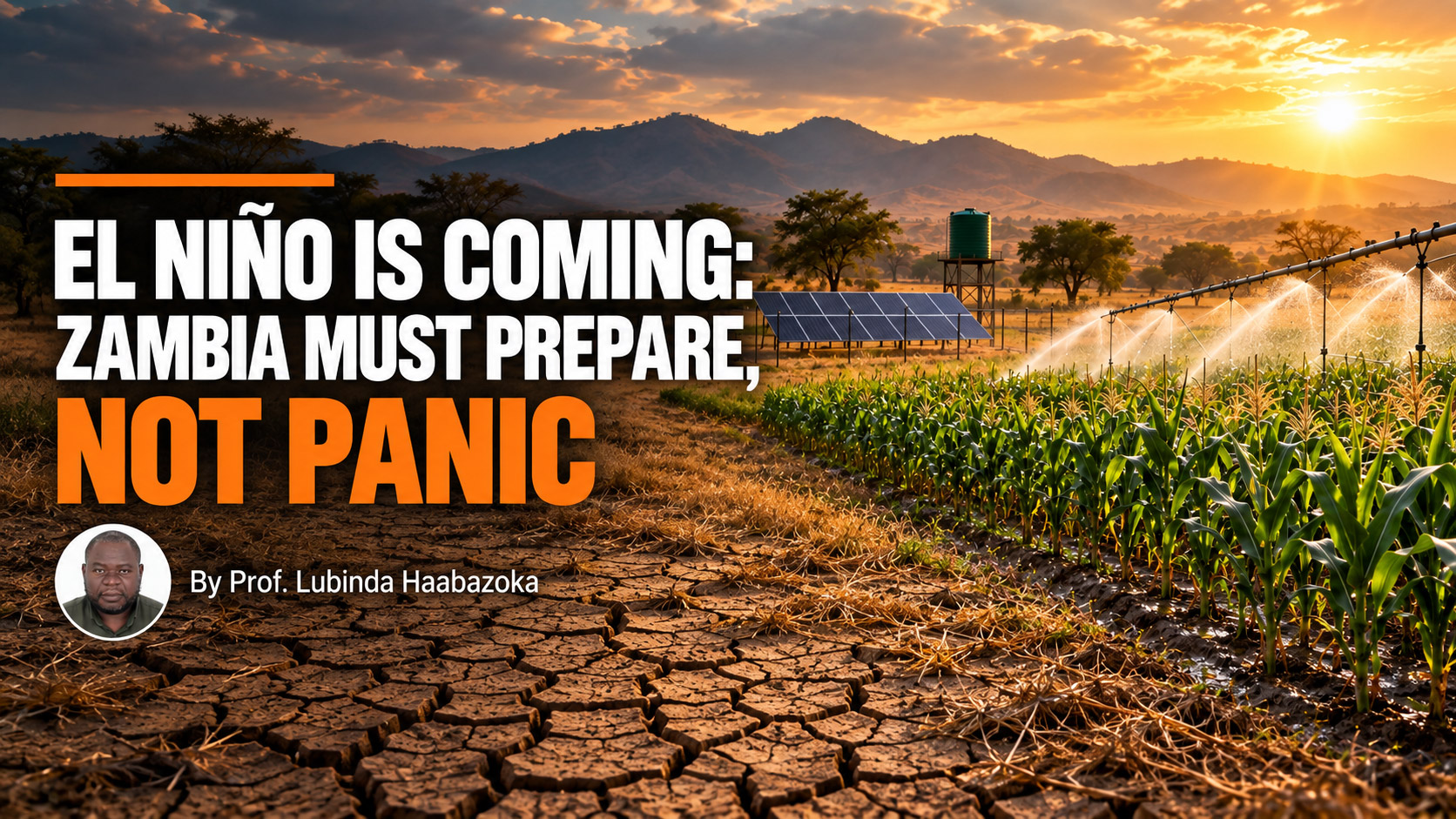
El Niño Is Coming: Zambia Must Prepare, Not Panic – Prof. Lubinda Haabazoka

Breaking News Zambia
NewsThe projected 2026/2027 El Niño presents a serious risk to Zambia’s agriculture, electricity generation and economic growth. The World Meteorological Organization reports that a strong El Niño is intensifying, while regional forecasts indicate possible delayed and below-normal rainfall in southern Zambia. Forecasts, however, are probabilities, not instructions for farmers to abandon production. Zambia must prepare,
Audio article Listen to this story Share Send this storyThe projected 2026/2027 El Niño presents a serious risk to Zambia’s agriculture, electricity generation and economic growth. The World Meteorological Organization reports that a strong El Niño is intensifying, while regional forecasts indicate possible delayed and below-normal rainfall in southern Zambia. Forecasts, however, are probabilities, not instructions for farmers to abandon production.
Zambia must prepare, but it must continue planting. Farmers should select early-maturing and drought-tolerant varieties of maize, sorghum, millet, cassava, cowpeas, groundnuts and sunflower that can produce with less water. Conservation farming, water harvesting, irrigation and timely distribution of seed and fertiliser must be accelerated. The President is a farmer. This is not the first drought he will be experiencing. From his speech at state house yesterday, its very clear he has a plan for this. Technocrats must follow. Citizens must adapt. We need to use Grow Zambia Agenda as a mitigating strategy!
Production should also be deliberately expanded in Northern, Luapula, Muchinga and other areas where normal or above-normal rainfall is projected. The country must increasingly treat agriculture as a national production system in which better-performing regions compensate for drought-affected areas. But other regions should not fold their hands.
Fortunately, Zambia is not entering the possible drought empty-handed. The country experienced a bumper maize harvest of nearly 5 million metric tonnes, compared with approximately 3.9 million tonnes in the previous season. This represents an increase of roughly one million tonnes, or about 28 percent. If properly managed through the Food Reserve Agency, controlled exports and secure storage, this surplus gives Zambia an important food-security cushion. Therefore, Zambia should not automatically be at a loss if rainfall underperforms, but the bumper harvest must be managed prudently and protected from storage losses and excessive exports.
The Grow Zambia Agenda should now function as a national drought-mitigation strategy. Its focus on expanding agricultural production, irrigation, agro-processing, energy investment, infrastructure and private-sector participation must be translated into early action before the rains begin. Irrigation schemes, water points, dams and farming blocks should be treated as economic-security infrastructure.
Energy preparedness is equally important because drought reduces water available for hydropower. Zambia has already commissioned significant solar capacity, including the 34 MW Riverside, 60 MW Itimpi, and two 100 MW Chisamba solar plants—a combined 294 MW. The existing 300 MW Maamba coal-fired power station has also provided essential non-hydro baseload power. In the pipeline is Maamba’s additional 300 MW expansion, alongside further solar projects expected to add hundreds of megawatts to the grid. These investments diversify Zambia away from excessive dependence on rainfall-sensitive hydropower.
The lesson from the 2023/2024 drought is clear: climate forecasts must trigger preparation, not paralysis. Government must secure food reserves, accelerate irrigation, diversify electricity generation and guide farmers using district-level forecasts. Farmers, meanwhile, must plant, but plant intelligently, using suitable varieties, appropriate crops and moisture-conserving methods.
El Niño may reduce rainfall, but it must not be allowed to reduce Zambia’s ambition. With a bumper harvest, expanding solar and thermal capacity, and disciplined implementation of the Grow Zambia Agenda, Zambia can protect food security, energy supply and economic growth.
Engage with this story
Comment 0Likes 0Reactions 0Comments 0Shares Be the first reader to react to this storyDiscussion
Join the Conversation
Share your thoughts. Let's keep it respectful and constructive.
Start the discussion Sort by: No comments yetBe the first to bring a thoughtful perspective to this story. Comment as a guest No account is needed. Sign in only if you want your comment tied to your profile. Sign in instead


Community Feedback