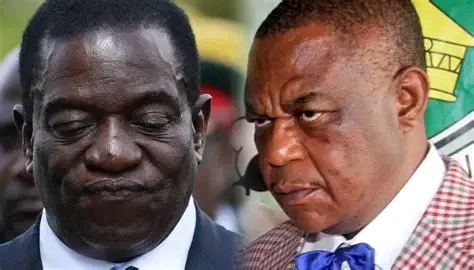
CHIWENGA’S WAITING GAME: WHAT EXACTLY IS HE WAITING FOR?

Breaking News Zambia
NewsCHIWENGA’S WAITING GAME: WHAT EXACTLY IS HE WAITING FOR? The Cold War After the Constitution By Reason Wafawarova There is a theory circulating within Zimbabwe’s political corridors that President Emmerson Mnangagwa cannot fire Vice-President Constantino Chiwenga. The argument is that dismissing Chiwenga would produce a rupture: it would convert a frustrated Vice-President into an aggrieved […]
CHIWENGA’S WAITING GAME: WHAT EXACTLY IS HE WAITING FOR?
The Cold War After the Constitution
By Reason Wafawarova
There is a theory circulating within Zimbabwe’s political corridors that President Emmerson Mnangagwa cannot fire Vice-President Constantino Chiwenga.
The argument is that dismissing Chiwenga would produce a rupture: it would convert a frustrated Vice-President into an aggrieved liberation-war figure, awaken dormant military loyalties, unite disgruntled war veterans and give Mnangagwa’s internal opponents a grievance around which to organise.
Chiwenga, according to this theory, is waiting to be fired. Mnangagwa, meanwhile, appears determined not to oblige him.
But that produces the question at the centre of Zimbabwe’s succession cold war:
What exactly is Chiwenga waiting for—and what is the waiting supposed to achieve?
Waiting is not a strategy unless time is moving in your favour. At present, time appears to be moving in Mnangagwa’s favour.
The President Who May Not Need to Fire His Rival:
Firing Chiwenga would be dramatic. Neutralising him while leaving him in office is far more sophisticated.
Mnangagwa seems to be preserving Chiwenga’s title, motorcade, security detail and ceremonial position while gradually removing the political machinery through which that title could be converted into the presidency.
That is the essential distinction. The contest is no longer simply about removing the man. It is about removing his route.
Chiwenga, unless he does something about it, can remain Vice-President while losing control of party structures. He can sit beside Mnangagwa at state functions while provincial executives are reorganised around other interests. He can retain the title of Second Secretary while parliamentary candidates, ministers, security commanders and business networks are progressively realigned.
He can remain visibly powerful while becoming institutionally stranded.
The advantage of this strategy would be that it denies Chiwenga the dramatic moment his supporters may be waiting for. There is no dismissal around which to rally. No public humiliation to avenge. No sudden break requiring military, political or factional actors to choose sides.
There is only attrition. And attrition rarely announces itself. It simply leaves the intended target weaker with every passing year.
Age Has Entered the Succession War:
Chiwenga turns 70 in August 2026. Mnangagwa turns 84 in September.
If the present constitutional architecture carries Mnangagwa to 2030, Chiwenga will be approximately 74 when Parliament is expected to determine the next President. Mnangagwa will be approximately 87.
A seven-year presidential term beginning in 2030 would run to 2037. Chiwenga would then be approximately 81, while Mnangagwa would be approximately 94.
These ages do not automatically disqualify either man. African politics has repeatedly demonstrated that political ambition rarely retires merely because the body has reached retirement age.
But age matters because Chiwenga’s strategy appears to depend upon waiting for an opening that keeps moving further away.
He was once discussed as the natural successor after 2023. Then the expectation moved to 2028. Constitutional Amendment No. 3 has moved the decisive moment to 2030, changed the length of presidential terms and removed the direct presidential vote.
What happens if 2030 produces another rearrangement? What happens if Parliament selects a younger candidate acceptable to the Mnangagwa political and commercial establishment?
What happens if Chiwenga discovers, at 74, that he has waited patiently for a succession mechanism that no longer exists?
A man can wait for his turn until the queue itself is abolished.
Chiwenga’s Actual Options:
Chiwenga’s problem is not merely that Mnangagwa remains President. His deeper problem is that the rules governing succession have been rewritten around him.
Under the original 2013 constitutional design, the running-mate system would have given a Vice-President an electoral mandate tied directly to the presidential ticket. Constitutional Amendment No. 1 removed that arrangement before it came into operation, preserving the President’s power to appoint and dismiss Vice-Presidents.
Constitutional Amendment No. 3 has gone further. It has postponed the expected 2028 election, extended political terms and transferred the selection of the President from the electorate to Parliament.
That leaves Chiwenga with several possible strategies—none of them easy.
He can continue waiting:
This is the least disruptive option, but potentially the most dangerous. Chiwenga can remain loyal in public, cultivate his remaining structures quietly and hope that age, illness, political miscalculation or internal revolt eventually creates a vacancy.
But hope is not institutional power. Mnangagwa can use every year of that waiting period to rotate commanders, retire officers, reshape party provinces, control parliamentary nominations and expand patronage networks around alternative successors.
By 2030, Chiwenga may still be Vice-President but no longer possess the machinery necessary to become President.
He can provoke his dismissal:
If Chiwenga believes that being fired would produce a rupture in his favour, he could escalate his opposition until Mnangagwa is forced to act. Like what the boys who openly booed Grace Mugabe in Bulawayo did to trigger the firing of Mnangagwa in 2017.
That would free him from collective responsibility for the government and allow him to present himself as the betrayed architect of the 2017 transition.
But this is an enormous gamble. The military of 2026 is not necessarily the military of November 2017. Command structures change. Officers retire. Loyalties migrate. Death attrition as well. Patronage creates new interests. A former commander cannot assume that yesterday’s obedience remains available on demand.
A dismissal might create a martyr. It could equally create a retired Vice-President surrounded by nostalgic supporters but lacking the institutional force to change the outcome.
He can fight for ZANU-PF itself:
Chiwenga’s most constitutionally conventional option would be to organise openly within ZANU-PF: secure provincial support, defend the party congress, influence parliamentary nominations and build a majority capable of determining the succession.
This would recognise the new reality created by Amendment No. 3. If Parliament selects the President, then parliamentary candidates become part of the presidential electorate. Control of ZANU-PF’s candidate-selection process therefore becomes potentially more valuable than the Vice-Presidency itself.
The decisive succession contest may occur long before MPs assemble to vote. It may be settled when candidates are selected, provinces are restructured and party lists are compiled.
But an open internal campaign would expose Chiwenga’s network. Mnangagwa would know whom to remove, whom to promote, whom to prosecute and whom to purchase.
He can become the constitutional dissident inside the system:
Perhaps this is the most feasible option if action was to be taken right now.
Chiwenga could align himself publicly with war veterans, retired commanders, constitutionalists and citizens opposed to the destruction of the 2013 constitutional settlement. Like Edgar Tekere did when he stood openly against the idea of a one-party state. He won the debate but lost his ZANU-PF political career.
That would Chiwenga something he has never independently possessed: a civilian political constituency extending beyond the barracks and ZANU-PF factional structures.
But to do that credibly, he would have to speak clearly. Whispers from supporters are not a programme. Strategic silence is not resistance. Private unhappiness is not a constitutional position. Encrypted church sermons might ignite excitement, but they cannot be ultimate resistance.
He would have to explain what he believes about the direct presidential vote, term extensions, executive accountability and the right of citizens to choose their leaders.
He would also have to confront an uncomfortable contradiction: Chiwenga was central to the military intervention that elevated Mnangagwa in 2017. It would take more than internal disappointment for him to reintroduce himself as the custodian of constitutional democracy.
Or he can negotiate:
Chiwenga may ultimately decide that succession is less important than institutional security, personal protection and preservation of his political network.
He could negotiate guarantees for himself and his allies in exchange for accepting another successor.
That would explain the continued public coexistence. The cold war might not be a fight to the finish. It could become a negotiation over the terms of surrender.
But if that is the game, then Zimbabweans should stop confusing Chiwenga’s silence with national resistance. A private bargain over succession is not a democratic alternative.
Enter Kudakwashe Tagwirei:
The removal of Chiwenga’s route does not mean that Mnangagwa intends to rule forever. It may mean that he intends to control who rules after him.
Kudakwashe Tagwirei’s formal entry into ZANU-PF structures in 2025 immediately attracted succession speculation. His resources, relationship with the presidency and access to patronage networks make him impossible to ignore.
Temba Mliswa has gone further, openly presenting Tagwirei as a plausible successor and dismissing Chiwenga’s chances. Mliswa even fancies his own chances as a possible VP in that arrangement.
Tagwirei himself may deny that there is presently a vacancy. That denial costs him nothing. Succession campaigns in ZANU-PF are traditionally conducted while everyone publicly insists that no succession campaign exists.
If Parliament becomes the presidential selector, money assumes even greater political importance.
Direct presidential elections require a candidate to persuade—or at least mobilise—millions of voters. A parliamentary contest requires control of a much smaller political market: party officials, parliamentary candidates, provincial leaders, financiers, factional brokers and MPs.
That is an environment in which a billionaire patron may be more competitive than a popular campaigner. CAB 3 was designed to make sure the public will not ever again be allowed to have another Chamisa moment – the headache of populists.
Tagwirei does not need to inherit Chiwenga’s military history. He needs to inherit Mnangagwa’s parliamentary and patronage architecture.
The Family-Succession Whisper:
Then there are persistent claims from Chiwenga-aligned circles and others that Mnangagwa is considering a family succession involving First Lady Auxillia Mnangagwa or one of his sons.
No conclusive evidence has been publicly produced establishing such a plan. It must therefore be treated as political speculation, not fact.
But the rumour matters because it reveals the depth of mistrust inside the ruling establishment.
Sean Mnangagwa’s military career inevitably attracts attention, but imagining a transition merely through military uniform confuses rank with command, and command with political legitimacy.
Collins Mnangagwa has recently been the subject of highly damaging media reports concerning alleged drug use, rehabilitation and family turmoil. Many of the more sensational details remain unverified and should not be treated as established fact.
Emmerson Mnangagwa Junior may appear, superficially, to be a more politically present option. But he too carries the burdens that accompany proximity to presidential power, including adverse reporting about his private life.
The mother, Auxilia is an interesting colourful option, not too different from the Grace Mugabe option was to the succession of Robert Mugabe.
The central point is not to adjudicate family gossip. Zimbabwe’s presidency should not be inherited through matrimonial proximity, biological descent or private presidential endorsement.
The country did not fight colonialism to replace white dynastic entitlement with black dynastic entitlement.
Chamisa and the Ambiguity of the “Collective Solution”:
Nelson Chamisa occupies a different but equally important part of this leadership web.
He repeatedly calls for a collective national solution involving political parties and other stakeholders. On its face, there is nothing objectionable about dialogue or national consensus. Zimbabwe is too deeply divided and institutionally damaged to dismiss cooperation as inherently treacherous.
But “collective” is not a political programme.
Who convenes this collective arrangement? What constitutional mechanism creates it? What happens to elections? What role does Chamisa expect for himself? Is he proposing a transitional authority, an electoral coalition, a government of national unity or an elite accommodation?
Vagueness allows every listener to hear what they want. More troublingly, Chamisa increasingly appears to imply that his own political ascent may emerge from some negotiated relationship involving ZANU-PF rather than from the construction of an organised opposition capable of defeating it.
If that is the implication, then Chamisa risks becoming another candidate waiting to be anointed by the system he claims to oppose.
There is a difference between negotiating democratic reform with ZANU-PF and negotiating one’s own admission into a ZANU-PF-controlled succession arrangement.
One transforms the system. The other merely changes the identity of its beneficiary.
Zimbabweans Have Been Reduced to Succession Spectators:
This is the most disturbing aspect of the entire debate. Zimbabweans are being conditioned to choose among personalities who have been preselected by power:
Mnangagwa or Chiwenga. Chiwenga or Tagwirei. Tagwirei or a Mnangagwa family member. Chamisa through election—or Chamisa through some unexplained collective settlement.
The national imagination is being confined inside an elite leadership web.
The question is no longer: Whom do Zimbabweans freely choose? It has become: Whom will the existing system permit Zimbabweans to receive?
That is how democratic space closes psychologically before it closes institutionally. Citizens are trained to discuss who is being groomed, who has received presidential endorsement, who controls the army, who controls the money and who has privately negotiated with whom.
The sovereign voter becomes a spectator at an anointing ceremony. This is precisely why the removal of the direct presidential vote is so consequential. It does more than change an electoral procedure. It changes the political culture from popular choice to elite allocation.
The Waiting Game Has an Answer:
So, what is Chiwenga’s waiting game supposed to bring?
If he is waiting to be fired, Mnangagwa may deny him that detonating moment. If he is waiting for natural succession, the constitutional path has already been removed. If he is waiting for 2030, Mnangagwa has four more years to shape the Parliament that will choose the President. If he is waiting for military loyalty to rescue his ambitions, he must first establish whether that loyalty survived the institutional recalibration since 2017.
If he is waiting for the people, he must finally speak to them—not through factional whispers, anonymous briefings or ceremonial body language, but through a clear constitutional and political programme. This is what the people themselves expect him to do, as it seems.
And if he is merely waiting to negotiate a protected retirement, then the Chiwenga succession project may already be over.
The waiting game is therefore designed to produce different outcomes for the two men.
Chiwenga waits for an opening. Mnangagwa uses the waiting period to close every opening.
That is why the passage of time is not neutral. Every additional year may weaken Chiwenga’s historical leverage while strengthening the parliamentary, financial and institutional machinery from which Mnangagwa can manufacture a preferred successor.
The ultimate danger, however, is greater than the fate of Constantino Chiwenga.
Zimbabwe is being encouraged to believe that its next President must emerge from a private catalogue containing Chiwenga, Tagwirei, Chamisa, Auxillia Mnangagwa or one of the President’s sons.
That catalogue must be rejected. Zimbabwe is a nation of millions of citizens, not a family estate, military inheritance, corporate acquisition or negotiated reward for political patience.
The presidency belongs neither to the man who staged the intervention, nor to the man who benefited from it, nor to the businessman who financed the system, nor to the opposition leader waiting for accommodation, nor to the family of the incumbent.
It belongs to the sovereign people of Zimbabwe.
The real national struggle is therefore not over which individual inherits Mnangagwa’s system.
It is over whether that system should be permitted to choose Zimbabwe’s leaders at all.
Reason Wafawarova
Voice of Reason
Community Feedback