Types of Breasts Explained: What Different Breast Shapes Mean and What’s Normal

Breaking News Zambia
NewsEvery woman’s breasts are unique. Just like faces, fingerprints and body shapes, no two pairs of breasts are exactly alike. Size, shape and appearance vary naturally from one person to another. Many women worry that their breasts are “abnormal” simply because they don’t look like those seen in advertisements or on social media. The truth […]
Every woman’s breasts are unique. Just like faces, fingerprints and body shapes, no two pairs of breasts are exactly alike. Size, shape and appearance vary naturally from one person to another.
Many women worry that their breasts are “abnormal” simply because they don’t look like those seen in advertisements or on social media. The truth is that there is a wide range of healthy, normal breast shapes.
Here’s what you need to know.
Do Breast Shapes Mean Anything?
In most cases, breast shape does not indicate personality, fertility, attractiveness or sexual ability.
The appearance of breasts is mainly influenced by:
Genetics
Age
Hormones
Pregnancy
Breastfeeding
Body weight
Natural ageing
There is no scientific evidence that one breast shape is better than another.
Common Types of Breast Shapes
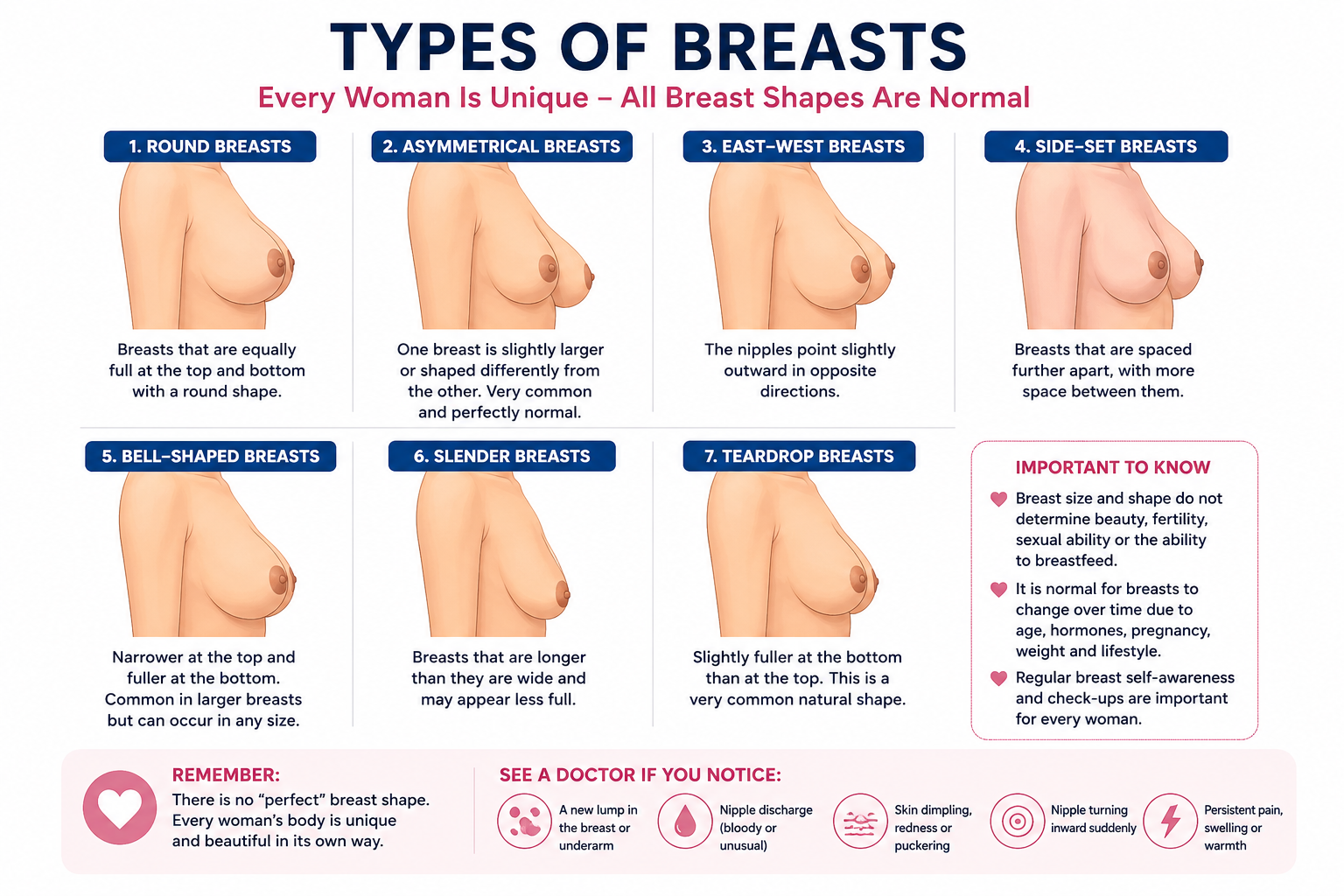
1. Round Breasts
Round breasts appear equally full at the top and bottom.
Some women naturally have this shape, while others achieve it through cosmetic surgery.
2. Asymmetrical Breasts
One breast is slightly larger than the other.
This is extremely common.
In fact, many women have noticeable differences between their left and right breasts.
3. East-West Breasts
The nipples point slightly outward in opposite directions.
This is a completely natural variation.
4. Side-Set Breasts
These breasts are spaced further apart, leaving more space between them.
Many women naturally have this shape.
5. Bell-Shaped Breasts
Bell-shaped breasts are usually narrower at the top and fuller toward the bottom.
This shape is often seen in women with larger breasts but can occur at any size.
6. Slender Breasts
These are longer than they are wide and may appear less full.
Again, this is perfectly normal.
7. Teardrop Breasts
Teardrop-shaped breasts are slightly fuller at the bottom than at the top.
Many people naturally have this shape.
Does Breast Shape Affect Breastfeeding?
No.
Most breast shapes and sizes can produce enough milk for breastfeeding.
Milk production depends mainly on the milk-producing glands rather than breast size or shape.
Does Breast Size Affect Intimacy?
Another common myth is that breast size determines sexual attraction or intimacy.
There is no medical evidence supporting this claim.
Healthy relationships are built on communication, respect, trust and emotional connection—not breast size.
Common Myths About Breasts
Myth 1: Perfectly Symmetrical Breasts Are Normal
Reality: Slight differences between breasts are very common.
Myth 2: Small Breasts Produce Less Milk
Reality: Breast size does not determine milk production.
Myth 3: Wearing a Bra Prevents Sagging
There is limited scientific evidence that wearing a bra alone prevents natural changes that occur with age, pregnancy or weight fluctuations.
Myth 4: Bigger Breasts Mean Better Health
Breast size has no connection to overall health.
When Should You See a Doctor?
While natural differences are normal, certain changes should not be ignored.
Seek medical advice if you notice:
A new lump in the breast or underarm.
Persistent breast pain.
Bloody or unusual nipple discharge.
Sudden changes in breast shape or size.
Skin dimpling or puckering.
A nipple turning inward unexpectedly.
Redness, swelling or warmth that does not improve.
Early medical assessment is important because many breast conditions are easier to treat when detected early.
Tips for Healthy Breasts
To maintain good breast health:
Perform regular breast self-awareness checks so you become familiar with how your breasts normally look and feel.
Wear supportive bras if they are comfortable for you.
Maintain a healthy lifestyle with regular exercise and balanced nutrition.
Attend recommended breast screenings based on your age and medical advice.
Consult a healthcare professional if you notice unusual changes.
Final Thoughts
Breasts come in many different shapes and sizes, and almost all natural variations are completely normal. Their appearance does not determine beauty, health, femininity or the ability to breastfeed.
Rather than comparing yourself to unrealistic images online, focus on understanding what is normal for your own body and paying attention to any new or unusual changes.




Community Feedback