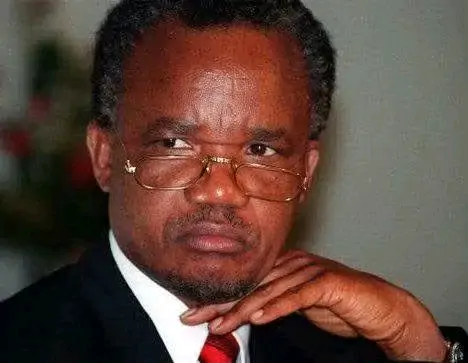
THERE MUST BE AN INQUEST INTO THE DEATH OF PRESIDENT FREDERICK TITUS JACOB CHILUBA- Saviour Chishimba

Breaking News Zambia
NewsTHERE MUST BE AN INQUEST INTO THE DEATH OF PRESIDENT FREDERICK TITUS JACOB CHILUBA Fifteen years have passed since Zambia’s Second Republican President, Dr Frederick Titus Jacob Chiluba, died at his Kabulonga home shortly after midnight on 18 June 2011. Contemporary reports indicate that he had complained of stomach pains before his death. No post […]
THERE MUST BE AN INQUEST INTO THE DEATH OF PRESIDENT FREDERICK TITUS JACOB CHILUBA
Fifteen years have passed since Zambia’s Second Republican President, Dr Frederick Titus Jacob Chiluba, died at his Kabulonga home shortly after midnight on 18 June 2011. Contemporary reports indicate that he had complained of stomach pains before his death.
No post mortem examination was conducted. It was subsequently reported that the family had resolved against a post mortem, citing President Chiluba’s Christian beliefs and tradition, but the death of a President is not merely a private family matter. It is a matter of profound national importance. The State has an interest in establishing the circumstances surrounding the death of every citizen where the law requires an investigation, how much more when the deceased is a former Head of State.
It is therefore not sufficient, fifteen years later, simply to say that “the family” did not want a post mortem. Which members of the family made that decision? Were all his children consulted? Who was present when the decision was made, and on what basis was it made? These questions demonstrate why the investigation of a death requiring lawful inquiry cannot ultimately depend upon private wishes.
There is an important principle involved here. What if, in another case, a person opposing a post mortem were himself or herself a person whose conduct required investigation? That is precisely why the law must operate independently. Where the legal requirements for investigating a death are satisfied, private wishes cannot be allowed to determine whether the State establishes the truth.
No Zambian President should ever die in circumstances that leave material questions unanswered merely because those immediately surrounding him preferred that no post mortem be conducted. The Presidency belongs institutionally to the Republic. A President may leave office, but the office he occupied remains an institution of the State. The death of a person who has occupied that office is therefore a matter in which the state may have a legitimate and compelling public interest.
Zambia must now address President Chiluba’s death institutionally and scientifically. An inquest provides the lawful mechanism through which the circumstances surrounding his death can be examined and authoritative findings made. I say this from personal experience. During some of President Chiluba’s most difficult and lonely years, when standing with him was neither fashionable nor without personal risk, I stood with him. There were occasions when he would ask everyone else to leave the room, close the door and speak to me privately. He told me things about people and circumstances around him which I have never forgotten.
During the final year of his life, I was living in Ndola. I had relocated from Lusaka partly for security reasons during a politically difficult period. Therefore, I never meet in the year of his passing although we spoke on the phone from time to time. President Chiluba had shifted his political support from Michael Sata and his PF to President Rupiah Bwezani Banda.
What happened on the afternoon preceding his death remains deeply significant to me. I was at Arcades in Lusaka having coffee with the late Bishop Chihana. At about 17:00 hours, a person who was close to President Chiluba was passing, but when he saw us he came and joined us. He found us already seated and even offered to settle our bill.
His behaviour immediately caught our attention. He was extremely restless. He would sit, move around and pace. He brought President Chiluba into the conversation and remarked that I had not been seen around him for some time. More disturbing were his words. The manner in which he spoke about President Chiluba left us with the unmistakable impression that he was anticipating something concerning the former President. His words and behaviour were sufficiently unusual that Bishop Chihana and I took particular notice.
Only four or five hours later, Bishop Chihana telephoned me with the devastating news that President Chiluba had died. We immediately remembered the encounter at Arcades. We discussed the person’s words, his extraordinary restlessness and the timing of what we had witnessed only hours earlier. Our hearts broke. We cried.
Fifteen years later, I remember that encounter clearly. The identity of that person, his relationship with President Chiluba, what he knew, his movements and communications during those crucial hours, and the meaning of what he said that afternoon are matters that should be examined under oath in a properly constituted inquest. Evidence must be gathered, witnesses heard, records examined and conclusions reached through a lawful process.
There are also matters President Chiluba personally discussed with me behind closed doors. He spoke about certain people around him, relationships and associations of which he was fully aware, and circumstances he was carefully managing as a former Head of State. I remember those conversations and their details. I am prepared to place them before the competent authorities.
Scripture recognises the importance of matters entrusted by a leader to those who remain after him. Before his death, King David left Solomon instructions concerning unfinished matters and people he was to remember. A statesman’s death does not erase what he knew or what he entrusted to those close to him. Jewish law equally recognises that the wishes of the deceased are not absolute. Rambam teaches that where an overriding legal or religious obligation exists, it can take precedence over the wishes of the deceased. That principle is relevant where the law requires the circumstances surrounding a death to be established.
Zambian law already provides the mechanism. The Inquests Act empowers a coroner, subject to the requirements of the law, to order exhumation notwithstanding contrary law or custom. It also provides mechanisms for medical examination and for persons with knowledge of the circumstances surrounding a death to give evidence under oath.
Modern forensic science also means that the passage of fifteen years does not automatically make investigation meaningless. Whether useful forensic evidence remains would be a matter for qualified forensic specialists to determine after considering the condition of the remains, the circumstances of burial and the particular substances or causes being investigated. Hair, nails, bones, teeth and surviving biological material can, depending upon the circumstances, retain information capable of forensic examination.
Even after fifteen years, modern forensic science may provide answers. If poisoning were suspected, specialists could examine the remains, surrounding soil and other material for traces of toxic substances. Where necessary, Zambia can obtain specialised forensic expertise from other countries. I now intend to consult appropriate members of President Chiluba’s family and seek legal advice on commencing the appropriate process for an inquest. Where the legal and scientific requirements are satisfied, exhumation and forensic examination should form part of that process.
An inquest can reconstruct President Chiluba’s final hours, examine the available medical evidence, establish who was with him, identify those who interacted with him during the relevant period, hear witnesses under oath and determine, on the evidence available, what happened.
If the evidence establishes death from natural causes, that finding should become part of Zambia’s authoritative historical record and put legitimate questions to rest. If evidence establishes circumstances suggesting foul play or possible criminal responsibility, that evidence must be referred to the appropriate investigative and prosecuting authorities for action according to law.
This matter is bigger than President Chiluba alone. No Zambian President should ever die in circumstances raising material unanswered questions and have the Republic simply move on without establishing what happened. The death of a President or former President is a serious national event. The country is entitled, within the framework of the law, to an authoritative account of the circumstances surrounding such a death.
The principle extends beyond Presidents. The State has a responsibility to investigate deaths falling within the circumstances prescribed by law irrespective of the status of the deceased, but when the deceased is someone who occupied the highest constitutional office in the Republic, the national and historical interest is self evident.
We must establish a precedent that protects not only the memory of those who have already served but also those who will occupy the Presidency tomorrow. A former President should never become merely a private individual for purposes of determining whether serious and legitimate questions surrounding his death deserve answers. Zambia’s institutions must be strong enough to establish the truth independently, scientifically and without fear or favour.
Fifteen years have passed, but the passage of time does not extinguish the importance of truth. President Frederick Titus Jacob Chiluba deserves the truth. His family deserves the truth. The Republic deserves the truth. Posterity deserves the truth.
Zambia Forward, TOGETHER in UNITY
Saviour Chishimba
President
United Progressive People (UPP)
UPND Alliance Partner
Community Feedback