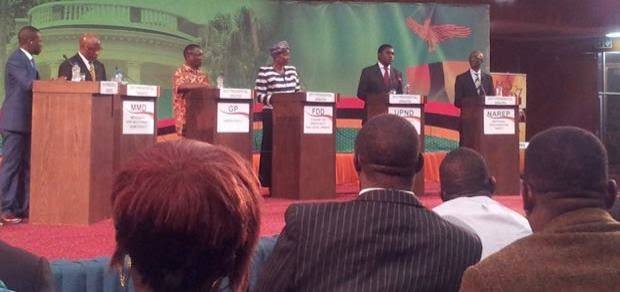
Presidential debates must be part of Zambia’s electoral process

Breaking News Zambia
NewsTHE call by the Tonse Alliance for President Hakainde Hichilema to face Mr Brian Mundubile and other presidential candidates in a televised debate may be laced with political malice, but it raises an important democratic question. Should a person who seeks to govern more than 20 million people be allowed to complete an entire election […]
THE call by the Tonse Alliance for President Hakainde Hichilema to face Mr Brian Mundubile and other presidential candidates in a televised debate may be laced with political malice, but it raises an important democratic question. Should a person who seeks to govern more than 20 million people be allowed to complete an entire election campaign without facing rivals in a structured public debate?
Tonse Pamodzi Secretary General Celestine Mukandila says the opposition wants an opportunity to expose President Hichilema’s failures and push him to apologise to Zambians. That language is plainly partisan. But that notwithstanding, a presidential debate is still important as it is expected to help voters understand the policies, temperament, knowledge and judgment of everyone seeking the highest office in the land.
We are encouraged by the enthusiasm shown by the opposition to confront the incumbent President on a public platform. Mr Mundubile says he is ready. Other candidates should state their positions. More importantly, President Hichilema should accept the challenge.
We recall that when Mr Hichilema was in opposition, he was among the political leaders who participated in presidential debates. He repeatedly sought opportunities to explain his economic programme, defend his record and challenge those in government. In those years, presidential debates were often avoided by the sitting president. The excuse was usually that the incumbent was too busy governing or that debating opposition candidates would unnecessarily elevate them.
Now that Mr Hichilema is in State House, he should not inherit the same culture that frustrated him when he was in opposition. He knows the value of an open political contest. He knows what it means to have ideas but struggle to obtain an equal platform. It should therefore be within his democratic convictions to face those seeking to replace him.
The President has a record to defend. He has spoken about debt restructuring, free education, Constituency Development Fund, mining investment, economic recovery, foreign reserves and reduced inflation. The opposition has raised questions about the cost of living, employment, agriculture, governance, civil liberties and the quality of public services. These competing claims should be tested before the voters.
A debate would compel candidates to go beyond slogans. It is easy to stand before supporters and declare that the government has failed. It is equally easy for the ruling party to claim that everything is improving. A serious debate requires candidates to explain how they will reduce the cost of living, create employment, stabilise the currency, fund free education, reform mining, improve healthcare and manage public debt.
Candidates must also be challenged on the cost of their promises. Anyone can promise cheaper fuel, lower taxes, more jobs, better salaries, free services and increased public spending. The important questions are: how will these promises be financed? Which expenditure will be reduced? What legislation will be required? What happens if copper prices fall, drought returns or international markets become unstable?
That is why presidential debates should not depend on whether candidates feel brave in a particular election. They should become an institutional part of Zambia’s electoral process. Parliament, ECZ, broadcasters, universities, civil society organisations and professional bodies should develop a recognised framework under which all qualifying presidential candidates are invited to participate in nationally televised debates.
We are not proposing a political circus. Debates should not become shouting contests where the loudest candidate is declared the winner. Neither should they be reduced to rehearsed insults. Their purpose must be to test the candidate’s understanding of Zambia’s problems and the practicality of the solutions being offered.
A legal or regulatory framework would also prevent incumbents from avoiding debates simply because they enjoy the advantages of office. It would ensure that challengers are not able to make extravagant claims without being questioned. Even where attendance cannot constitutionally be made a condition for candidature, the electoral process should formally record and publicise any candidate who fails to appear.
Zambians should not elect a president based only on dancing, crowds, slogans, party regalia and insults. The presidency is a demanding office. It requires knowledge, discipline, patience, judgment and the capacity to communicate a coherent national programme.
Let Mr Hichilema accept the debate. Let Mr Mundubile and the other candidates come to the platform. Let them explain what they have done, what they understand and what they intend to do. And beyond this election, let Zambia institutionalise presidential debates so that those who ask for the people’s highest mandate must first submit their ideas to the people’s scrutiny.
Community Feedback