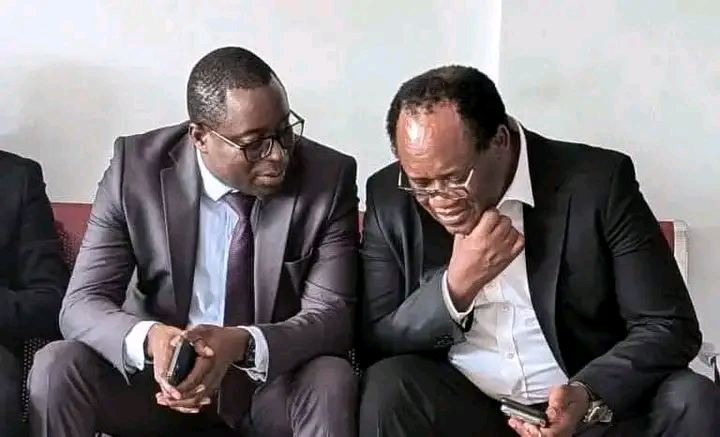
Mwamba accuses UN of “Failing Zambia” in Mundubile, Makebi case as envoy leave without deal

Breaking News Zambia
News12 Views Former diplomat, Emmanuel Mwamba has accused the United Nations of letting down Zambia, saying the world body’s failure to broker an agreement in the standoff over opposition leaders has left the country’s democracy more vulnerable. “The United Nations envoy’s departure without an agreement highlights an impasse that risks further destabilizing the nation’s fragile […]
12 ViewsFormer diplomat, Emmanuel Mwamba has accused the United Nations of letting down Zambia, saying the world body’s failure to broker an agreement in the standoff over opposition leaders has left the country’s democracy more vulnerable.
“The United Nations envoy’s departure without an agreement highlights an impasse that risks further destabilizing the nation’s fragile democratic fabric,” Mwamba said in a statement on Friday.
His comments came hours after the representative of UN Secretary-General António Guterres ended a high-level mediation mission in Lusaka that ended with opposition leader Brian Mundubile and his running mate in the just ended general election Makebi Zulu being handed over to the police.
After hours of interrogations, police issued Mundubile and Zulu with a warn and caution statement on treason charges and the two were detained at Lusaka Central Police Station.
The envoy had been in the capital to mediate a tense standoff involving Mundubile, Zambia’s main opposition leader and the government.
The crisis was triggered last week by a violent military raid on Mundubile’s residence, and during the operation, former Minister of Transport and Communications, Mutotwe Kafwaya, was killed.
In the aftermath, Mundubile and Zulu, sought refuge inside the United Nations compound in Lusaka, citing fears for their safety amid accusations of treason and incitement to insurrection.
For days, the UN envoy conducted shuttle diplomacy between the UN compound and State House. Proposals put forward included transferring the two men to a neutral third party or granting them safe passage out of Zambia.
However, President Hakainde Hichilema reportedly rejected both options, insisting that Mundubile and Zulu must face legal proceedings in Zambian courts.
Mwamba said the collapse of talks underscores a deepening political divide. He argued that by leaving without a deal, the UN had missed an opportunity to de-escalate tensions at a critical moment.
Apparently, the question lingering in some Zambians’ is What happens when someone knocks on the UN’s door seeking refugee?
There is no clause in the United Nations Charter that says, “If you are in danger, run to a UN building.” The Charter, written in 1945 in the aftermath of war, speaks in broad strokes about peace, human rights and cooperation between nations. It does not mention asylum, refugees, or people seeking shelter inside UN offices.
So why do people still seek refuge at UN compounds, as we’ve just seen in Lusaka with Mundubile and Zulu?
The answer lies not in the Charter itself, but in two agreements that grew from it. The first is the 1946 Convention on Privileges and Immunities. It declared UN premises “inviolable.” In plain language, that means police and soldiers from the host country cannot walk into a UN office or compound without permission. For a person fearing arrest, that wall of inviolability can mean the difference between life and detention.
The second is the Host Country Agreement. Every UN office signs one. The host government agrees to respect the UN’s space, and the UN agrees to respect the host’s laws. It’s a careful balance. The UN is not a country. It cannot grant legal asylum or issue passports. It can only offer temporary physical protection.
When someone enters a UN compound seeking safety, UN security’s first job is to protect life. After that, the politics begins.
UN officials will talk to the host government. Sometimes they negotiate safe passage to another country. Sometimes they arrange for the person to face local courts with guarantees. Sometimes the standoff drags on for weeks.
The UN Charter gave the organization its mandate to protect human rights, but it left the messy details to later treaties and diplomacy. That is why a UN gate can feel like both a sanctuary and a negotiating table. It can shield you for a night, but it cannot decide your future alone. That decision still rests with nations, laws, and the talks that happen after the door closes.

Community Feedback