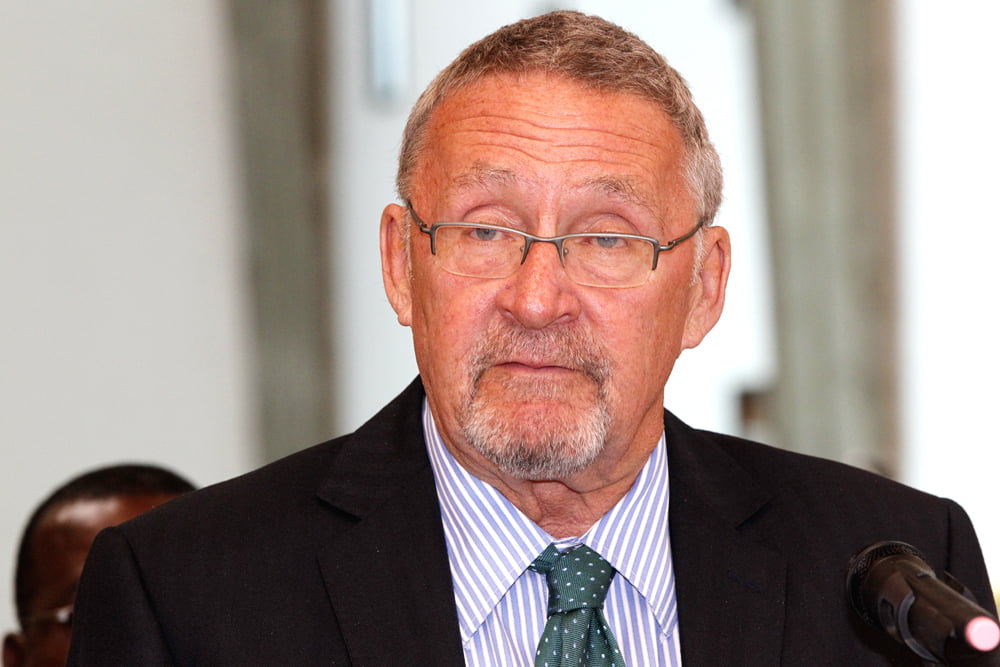
Guy Scott: the most patriotic, intelligent “muzungu opusa”

Breaking News Zambia
NewsZAMBIA has lost one of the most unusual, courageous and intellectually honest political figures to have served this Republic. Dr Guy Scott was never a conventional politician. He was too blunt for comfort, too sarcastic for diplomacy and too intelligent for ordinary politics. But beneath that difficult exterior was a man who believed in Zambia […]
ZAMBIA has lost one of the most unusual, courageous and intellectually honest political figures to have served this Republic. Dr Guy Scott was never a conventional politician. He was too blunt for comfort, too sarcastic for diplomacy and too intelligent for ordinary politics. But beneath that difficult exterior was a man who believed in Zambia and served Zambia. At a defining moment in our history, he held Zambia together when weaker men would have surrendered the Republic to factional confusion.
The world will remember him as the white Zambian who briefly became acting President after the death of president Michael Sata in 2014, making history as Africa’s first white Head of State in decades. But Zambia must remember him for more than that historical curiosity. Guy Scott’s colour was always the least important thing about him, even though politics never allowed him to escape it. His true significance lies in the statesmanship he demonstrated when the nation was vulnerable, when the ruling Patriotic Front was divided, and when power-hungry factions were prepared to pull the country into a constitutional storm.
After president Sata died, Dr Scott fought a tough battle against a vicious PF faction before stepping in as acting President for the constitutionally required transition period. That moment demanded calm judgment, institutional discipline and personal courage. Inside the PF, the succession battle was brutal. The Edgar Lungu camp did not merely oppose him politically; it resisted him with hostility, suspicion and open contempt. There were those who believed he was an inconvenience standing between them and power. They said he was not Zambian enough to be a transition head of state and they said he did not qualify to rule the country, purely because of his skin pigmentation. There were those who thought he should be pushed aside, ignored or humiliated. But Dr Scott stood firm. He took the hits from all directions and refused to let the PF’s internal disorder become Zambia’s national crisis.
Dr Scott did not command a tribal constituency. He did not have the advantage of being adored by the party machinery that was reorganising itself around Mr Lungu. What he had was the Constitution, the office he occupied, a sharp attorney general in the name of Musa Mwenye and a stubborn commitment to procedure. In that short period, he protected the transition from degenerating into an open power grab. That was statesmanship. That was Guy Scott at his finest.
This is the man whose story is captured in his memoir, Adventures in Zambian Politics: A Story in Black and White. The memoir tells a uniquely Zambian story: the rise of two improbable political allies, Michael Sata and Guy Scott, and the strange, chaotic, humorous but deeply consequential journey that brought them to power. The title was apt. His life in politics was indeed a story in black and white, but not merely in the racial sense. It was also a story about constitutional clarity and political darkness, loyalty and betrayal, principle and ambition.
We have always believed that the spirit of Michael Sata truly lived in this white man. Scott understood Sata’s political instinct, his impatience with pretence, his disdain for polished hypocrisy and his love for directness. Like Sata, Scott could be rough. Like Sata, he could offend. Like Sata, he could say things that made even his friends uncomfortable. But also like Sata, he had authenticity. He was not manufactured. He was not scripted. He was Guy Scott.
And let it also be remembered that Guy Scott was not just a passenger in the PF story. He was one of its sharpest strategists. He is credited with having intelligently coined the “Don’t Kubeba” phrase in 2011, that devastatingly effective political message which encouraged voters to take money, food and campaign materials from the MMD, but keep their true voting intentions secret and vote them out. It was simple, witty, dangerous and brilliant. It captured the mood of a people who felt pressured by the advantages of incumbency but were determined to punish the ruling party quietly in the ballot booth. That phrase became a political weapon. It helped citizens understand that the secrecy of the vote was theirs to use. In that phrase, Scott’s mind was fully visible: mischievous, strategic, sharp and brutally effective.
He was also a man who endured racial insults from all sides. When he fought the UPND, the current President infamously called him “muzungu opusa”, a stupid white man. That comment attracted serious backlash from citizens and civil society organisations because it was beneath the standard expected of national leaders. Yet Dr Scott did not allow such attacks to define him. He had heard worse. He had lived long enough in Zambian politics to know that people who lack arguments often reach for identity.
It is to President Hichilema’s credit that government has accorded Dr Scott a state funeral. In death, as in life, Guy Scott belongs to the country, not to one party. He served in Parliament, served as agriculture minister, served as vice-president, and served briefly as acting President. His contribution to public life deserves national honour.
But the greater tribute is not the funeral. The greater tribute is the lesson. Guy Scott taught us that institutions matter when emotions are high. He taught us that transitions must be protected even when party factions are fighting. He taught us that loyalty to the Constitution is more important than loyalty to ambitious individuals. He taught us that one can be unpopular and still be right.
That is why Zambia must mourn him with gratitude. In a country where many politicians want power at any cost, Guy Scott’s finest hour came when he held power temporarily and understood that his duty was to hand it over through a lawful process. That is rare. That is honourable. That is statesmanship.
Farewell, Dr Guy Scott. Our white man. Our Most intelligent “muzungu opusa”.





Community Feedback