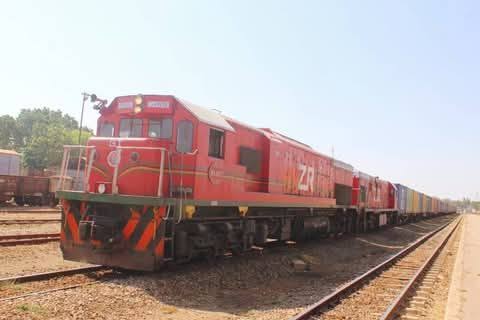
Did you know that rail is mandated to carry 30% of bulk cargo?

Breaking News Zambia
NewsZambia Railways Limited (ZRL) Managing Director Eng. […]
Zambia Railways Limited (ZRL) Managing Director Eng. Cuthbert Malindi has outlined measures being undertaken by the company to improve rail transport capacity and increase the volume of freight moved by rail. The remarks follow recent data highlighting the continued dominance of road transport in Zambia’s import and export logistics.
According to figures published by the Zambia Statistics Agency (ZamStats), road transport accounts for the largest share of goods transported by value, while rail transport accounts for a significantly smaller proportion. Commenting on the statistics, Eng. Malindi noted that transport data should be interpreted within the broader context of infrastructure capacity, operational constraints, and market dynamics.
“It is often difficult to refer to one particular statistic without understanding how the statistic was arrived at. There are several reports that have been produced, including those by the Zambia Statistics Agency, and we do not dispute the published statistics. However, road transportation remains the dominant mode for bulk cargo movement in Zambia, while rail’s share remains considerably lower,” he said.
Eng. Malindi explained that rail freight operations in Zambia involve both Zambia Railways Limited and private rail operators, with private sector players contributing to the movement of cargo by rail. He further highlighted that, under Statutory Instrument No. 98 of 2020, the policy objective is for 30% of bulk cargo to be transported by rail.
However, Zambia’s rail freight volumes remain below this target due to a number of operational and infrastructure challenges. “We are not yet close to achieving the 30% target stipulated under Statutory Instrument No. 98. The reasons are well understood and largely relate to infrastructure limitations, particularly the condition of the permanent way (rail track) and associated facilities,” Eng. Malindi said.
He noted that Zambia Railways’ infrastructure has been in existence for over a century, and while various interventions have been made to rehabilitate the track over the years, further investment is required to achieve the reliability and capacity needed to attract more freight onto rail. Eng. Malindi also identified the condition and availability of rolling stock as another key factor affecting rail freight capacity.
“We have locomotives and wagons that are over 50 years old, alongside ageing infrastructure and operational facilities. These factors directly influence the amount of cargo that Zambia Railways can move, whether for exports or imports,” he said. He explained that most export commodities, particularly copper and other minerals, originate from the private mining sector, which determines the preferred mode of transport based on reliability, efficiency, and commercial considerations. “Most exports come from the private sector, with copper being the dominant commodity. These companies assess the available transport options and naturally select the mode that provides the required reliability and service levels,” Eng. Malindi said.
To improve rail freight capacity, Eng. Malindi said ZRL has been implementing a hybrid locomotive fleet strategy that combines the use of its own fleet with private sector participation. Under this approach, ZRL works with private sector players to access additional locomotive capacity through lease arrangements, where payments are linked to the revenue generated from the use of the equipment. In addition, private operators operate on the ZRL line through a limited open-access model.
“We follow a hybrid model where we utilise both Zambia Railways-owned locomotives and locomotives sourced through private sector partnerships. This approach allows us to expand capacity while managing funding requirements,” he explained. He added that ZRL is also undertaking a locomotive remanufacturing programme aimed at restoring locomotives to operational service.
“Within our existing fleet, we have identified 12 locomotives that can be rehabilitated through remanufacturing. We are currently implementing a programme to remanufacture six GT locomotives, with the first two expected to be completed between August and September 2026,” he said. Eng. Malindi said improving infrastructure, increasing locomotive availability, and strengthening partnerships with the private sector will be critical to enabling Zambia Railways to increase its contribution to freight transportation and support the country’s economic development objectives.
Article by Justine Phiri



Community Feedback