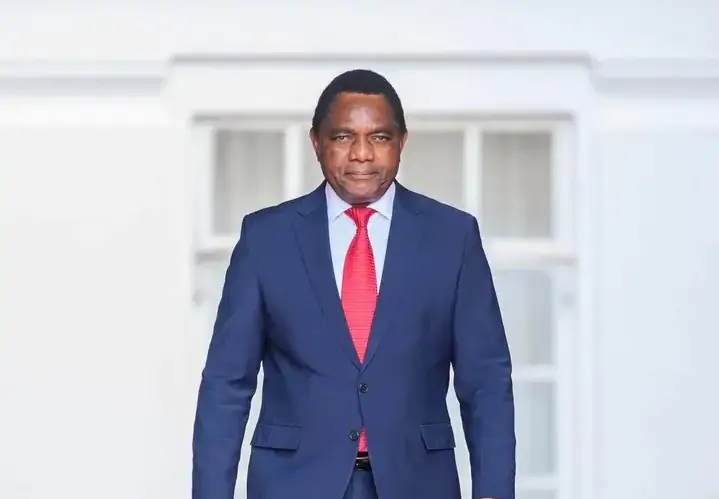
HH’S RE-ENGINEERED SQUAD…as citizens await new Cabinet tasked to triple economy under ‘Grow Zambia’ agenda

Breaking News Zambia
NewsHH’S RE-ENGINEERED SQUAD…as citizens await new Cabinet tasked to triple economy under ‘Grow Zambia’ agendaBy DAVID KANDUZAFRESH from securing a definitive 60.5 per cent second-term mandate, President Hakainde Hichilema...
HH’S RE-ENGINEERED SQUAD
…as citizens await new Cabinet tasked to triple economy under ‘Grow Zambia’ agenda
By DAVID KANDUZA
FRESH from securing a definitive 60.5 per cent second-term mandate, President Hakainde Hichilema is meticulously configuring a high-octane new ‘Growth Cabinet’ which will be tasked with transforming Zambia’s hard-won macroeconomic stability into hard cash and food security for ordinary households.
Following the formal dissolution of his first Cabinet before the August 13 polls, public anticipation has reached a fever pitch.
President Hichilema tasks is to structure a new Cabinet following his victory in the August 13, 2026, general election.
With a perceived delay in the full announcement of the executive team since his inauguration on September 1, 2026, this delay is widely attributed to the complex political balancing act required to fulfill promises of an unprecedented, inclusive Government.
The selection of the new Cabinet hinges on several critical factors such as, the legal framework and expansion of Parliament
Under the Zambian Constitution, the President must appoint Cabinet Ministers from among Members of Parliament (MPs).
Following legislative changes and the push under Constitution Amendment Bill No. 7, the dynamics of the National Assembly have shifted.
The number of elected parliamentary seats has increased to more than 220, giving the President a wider pool of elected MPs—predominantly from the ruling UPND —from which to choose.
Additionally, the President retains the constitutional power to nominate un-elected MPs to Parliament, allowing him to pull highly qualified technocrats or marginalised representatives directly into the executive fold.
Secondly, high expectations for marginalised groups, where the core of the political tension rests on Article 259 of the Constitution of Zambia, which mandates that presidential appointments should ensure equitable representation of gender, youth and persons with disabilities.
Advocacy groups, including the Zambia Federation of Disability Organisation (ZAFOD) and various women’s coalitions, have argued that previous administrations disproportionately favoured traditional political elites over youth, women and the disabled.
With the 2026 election results yielding a Parliament where only about 14 per cent of elected seats are held by women 32 out of 224 determined seats, observers note that President Hichilema must rely heavily on his presidential nomination slots to bridge the massive gender and representation gap.
The Cabinet is further complicated by political realities:The Coalition and Party Dynamics: where the President must reward party loyalists and balance regional representation to maintain national unity.
The ‘Grow Zambia Agenda’ President Hichilema’s second-term mandate centres heavily on aggressive economic growth and job creation where he is meticulously vetting individuals who possess strict technical qualifications rather than just political alignment, adding to the time taken to finalise the list
The upcoming Cabinet announcement will serve as a litmus test for whether the administration will break historical precedents by directly appointing youth and persons with disabilities to full Cabinet portfolios, or continue relying on traditional demographics.
State House insiders and political analysts confirm that the President’s upcoming executive roster will completely move away from the cautious, repair-focused ‘New Dawn’ posture to spearhead the newly launched, hyper-ambitious ‘Grow Zambia’ Agenda.
The 10-10-5-3-3-1-1-1 amplified during the recent inauguration at National Heroes Stadium, lays down the benchmark for any incoming minister.
The targets are aggressive, aiming to hit: 10 million tonnes of maize, 10,000 megawatts of electricity, 5 million tourist arrivals and 3 million tonnes of copper and soya beans respectively
Others were 1 million tonnes each of wheat and sugar, plus US$1 billion in annual beef export earnings
With such pledges Zambia’s macroeconomic gains will now directly transform household livelihoods through jobs, business opportunities and enhanced food security
Mr Hichelema has been sending a direct message of relief to the Zambian people: “We have heard your cries.”
The President has acknowledged the economic hardships ordinary households are faced with and declared that the hard-won fiscal adjustments of his first term would now aggressively translate into tangible prosperity at the grassroots level.
The formulation of this historic Cabinet represents a pivotal moment for Zambia’s democratic journey.
President Hichilema’s meticulous selection process reflects the high stakes of balancing constitutional mandates for gender, youth and disability inclusion against the urgent demand for a highly competent, technocratic executive team.
Whether this administration successfully breaks historical precedents or falls back on traditional political structures remains to be seen.
However, the final composition of the new Cabinet as Zambians wait for the selection will ultimately signal whether the Government intends to match its progressive rhetoric with tangible inclusive governance.


Community Feedback