
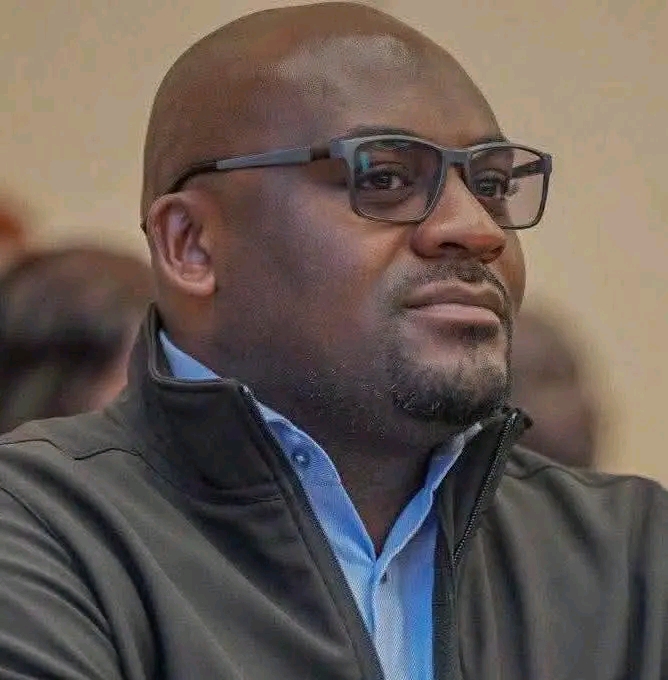
Celestine Mukandila responds to the revoking of his Citizenship

Breaking News Zambia
News0 ViewsMY POSITION ON MY ZAMBIAN CITIZENSHIP, NATIONAL REGISTRATION AND THE RULE OF LAW I wish to put the facts concerning my nationality and the circumstances surrounding the cancellation of my National Registration Card and Passport on record. I was born in 1990 in Lubumbashi, in the Democratic Republic of Congo. My mother was a […]
0 ViewsCelestine Mukandila
MY POSITION ON MY ZAMBIAN CITIZENSHIP, NATIONAL REGISTRATION AND THE RULE OF LAW
I wish to put the facts concerning my nationality and the circumstances surrounding the cancellation of my National Registration Card and Passport on record.
I was born in 1990 in Lubumbashi, in the Democratic Republic of Congo. My mother was a Zambian citizen at the time of my birth. My father was a Congolese citizen.
My mother is Ushi by origin, from Matanda Village in Mansa. My maternal family has deep roots in Luapula Province, with my family lineage extending through Matanda and Mununga.
The fact that I was born outside Zambia does not, in itself, make me a foreigner. Zambia’s constitutional framework expressly recognises citizenship by descent. Article 36 of the Constitution provides that a person born outside Zambia is a citizen by descent if, at the date of that person’s birth, at least one parent was or was a citizen by birth or descent.
My position is therefore straightforward: I acquired Zambian citizenship by descent at birth through my Zambian mother. I did not apply to become Zambian as an adult, nor did I obtain my citizenship through naturalisation.
This distinction is fundamental.
It is therefore deeply troubling that an attempt is now apparently being made to question my nationality by attacking the circumstances under which I obtained my National Registration Card when I was a minor.
I was approximately 16 years old when I became eligible for national registration. I was a child. I did not independently create my family history, determine my nationality, or manufacture the circumstances of my birth. The State’s own national registration system was responsible for determining the requirements applicable to a person of that age.
If the State alleges that fraud was committed in the acquisition of my NRC, then it must identify the alleged fraudulent representation, identify who made it, establish who had the legal responsibility for making the relevant declarations at the time, and demonstrate the lawful basis upon which I, as a minor, can now be personally accused of fraud in circumstances where my nationality was derived from my Zambian parent.
My family returned to Zambia in 1999. My mother nevertheless continued to spend periods in the Democratic Republic of Congo because of her employment, while remaining a Zambian citizen. The fact that a Zambian citizen worked or lived outside Zambia cannot, without more, transform that citizen into a foreign national.
What makes the present situation even more difficult to understand is that I have previously served as a Civil Servant of the Republic of Zambia. In that capacity, I was subjected to the vetting and verification processes applicable to persons entering the public service. My nationality was not treated as an obstacle to my employment by the State.
The National Registration authorities themselves have previously recognised me and issued me with national documentation.
One must therefore ask a very simple question:
If there was genuinely a fundamental defect in my nationality or national registration, why was this not raised during the various occasions when the Zambian State had the opportunity and responsibility to verify my status?
And why is this question arising now?
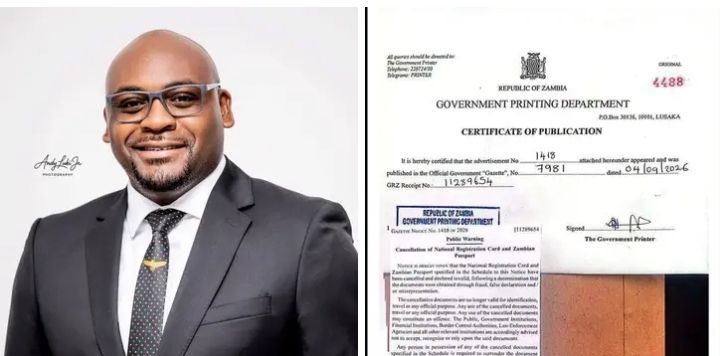
I am particularly concerned by the apparent involvement of a Permanent Secretary in the process of issuing or causing the issuance of a Gazette notice affecting my national documents.
Public officers exercise statutory powers; they do not exercise personal powers. Every decision affecting a citizen must have a clear legal foundation, must be taken by the person or institution legally authorised to take it, and must comply with the requirements of procedural fairness and due process.
A Gazette notice cannot itself become a substitute for the law.
If the State believes that I ceased to be a Zambian citizen, it must identify the constitutional and statutory provision under which that occurred. If it alleges that I fraudulently acquired citizenship, it must identify the alleged fraud and follow the procedure prescribed by law. If it merely disputes the validity of my NRC or Passport, that is a separate question from whether I am constitutionally a Zambian citizen.
These distinctions matter because a National Registration Card is evidence of identity and registration; it is not what created my citizenship by descent.
I therefore call upon the relevant authorities to place the legal basis for these actions on record and to make clear:
1. What constitutional or statutory provision is being relied upon to challenge my citizenship;
2. What specific fraud is alleged to have been committed;
3. Who is alleged to have committed that fraud;
4. What evidence supports that allegation;
5. Which authority made the decision affecting my NRC and Passport;
6. What statutory power that authority relied upon;
7. What notice and opportunity to be heard were afforded to me; and
8. What procedure was followed before the decision was made and published.
This is bigger than one individual.
The rule of law requires that government authorities exercise power according to law and not according to political convenience. Citizenship cannot become a political weapon against citizens because they hold views that are unpopular with those in power.
I have participated in public affairs and expressed political views that are different from those of the Government. I believe that disagreement, criticism and political opposition are legitimate components of a constitutional democracy. They should not expose a citizen to arbitrary treatment by the State.
If there are genuine questions concerning my nationality, I am prepared to have those questions determined through the proper legal and judicial processes.
What I cannot accept is a situation in which my nationality is effectively determined administratively, without transparent due process, and where official documents that I have held for years are suddenly treated as though they were obtained through fraud merely because I was born outside Zambia.
I remain confident that the Constitution and the courts of Zambia will ultimately protect the principle that no public authority is above the law and no citizen should be deprived of rights without lawful authority and due process.
The issue is therefore not whether I demand special treatment.
I demand only what every citizen is entitled to demand:
Let the law be followed. Let the evidence be produced. Let due process be respected. And let the rule of law prevail over political expediency.
Celestin Mambula Mukandila_Esq
Community Feedback