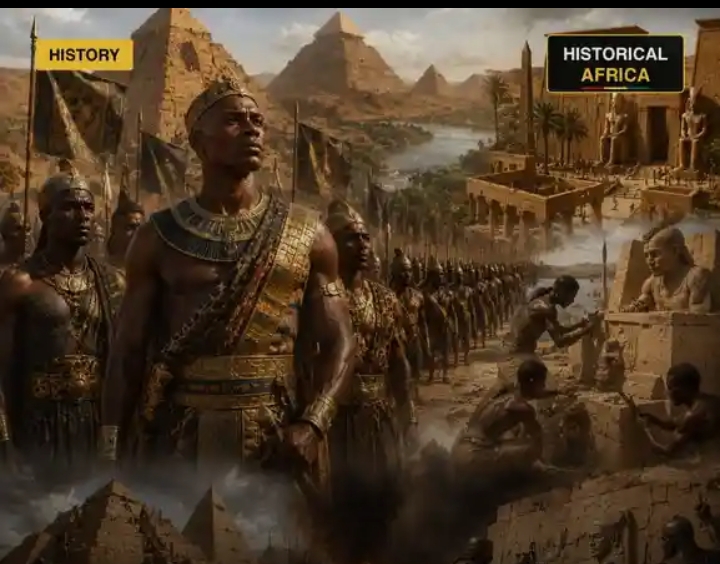
Black African kings once ruled all of Egypt, and history was rewritten to hide it

Breaking News Zambia
NewsBlack African kings once ruled all of Egypt, and history was rewritten to hide it For thousands of years, Egypt looked down on the land to its south. Nubia, the kingdom on the Nile in what is now Sudan, was treated by the pharaohs as a colonial backwater, a place to mine for gold and […]
Black African kings once ruled all of Egypt, and history was rewritten to hide it
For thousands of years, Egypt looked down on the land to its south. Nubia, the kingdom on the Nile in what is now Sudan, was treated by the pharaohs as a colonial backwater, a place to mine for gold and raid for men. Then, around 730 years before the birth of Christ, the story turned completely upside down.
A Nubian king named Piye looked north at an Egypt that had fallen into weakness and division, and he decided he was the rightful heir to its ancient glory. He marched his army out of the Kingdom of Kush and swept through the whole of Egypt, city by city, until he had conquered all of it. The land that once ruled Nubia was now ruled by a Nubian. Piye and the kings who followed him, Shabaka, Shebitku and Taharqa, became the pharaohs of Egypt’s 25th Dynasty. History remembers them as the Black Pharaohs.
They were not foreign destroyers. This is the part that matters. They did not come to loot Egypt and burn it. They came to restore it. They saw themselves as the true guardians of a civilisation the Egyptians themselves had let decay. They revived the ancient custom of building pyramids, which Egypt’s own rulers had abandoned some 800 years earlier. They restored the great temples. Piye rebuilt and honoured the temple of Amun. Taharqa raised monuments and colonnades across both Egypt and Nubia that still stand today. Under these African kings, for the first time in centuries, one ruler controlled the entire Nile Valley, from deep in Sudan all the way to the Mediterranean Sea. It was a golden age.
And when their rule finally ended, it did not end with honour. Around 660 years before Christ, the Assyrian Empire invaded Egypt with iron weapons and drove the Kushites back south. But the conquerors did something colder than mere defeat. They set about erasing the Black Pharaohs from memory. They struck their names off the monuments. They smashed their statues. They chiselled these African kings out of the record on purpose, so that those who came later would not know they had ever ruled at all.
Sit with that, because it is the oldest version of a lie we still live with today. The idea that African hands could not have built or ruled a great civilisation is not an accident. Someone worked to make you believe it. They took a hammer to the truth thousands of years ago, and later empires simply continued the same work with textbooks instead of chisels.
But they did not finish the job. The Nubians retreated home and built a kingdom at Meroë that thrived for another thousand years. And Sudan today holds around 200 pyramids, more than exist in all of Egypt, silent stone witnesses standing in the desert, refusing to let the Black Pharaohs be forgotten.
They tried to erase these kings from history. The pyramids they left behind made sure it was impossible.





Community Feedback