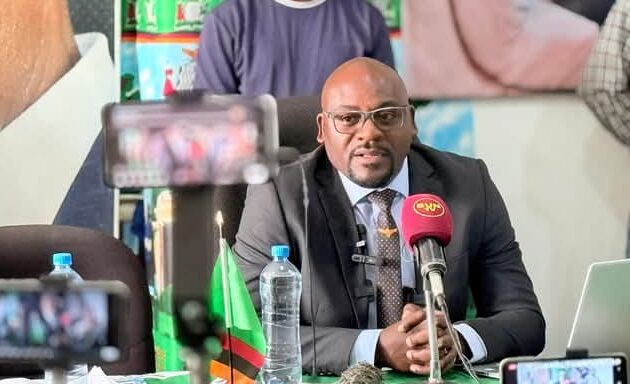
Zambia : Mukandila Challenges Cancellation Of NRC, Passport As M'membe Condemns Move

Breaking News Zambia
NewsLusaka - Zambia: Opposition politician and lawyer Celestine Mukandila has challenged the cancellation of his National Registration Card and passport,
Headlines 6 min.Read Mukandila challenges cancellation of NRC, passport as M’membe condemns move By editor September 7, 2026 FacebookTwitterPinterestWhatsAppOpposition politician and lawyer Celestine Mukandila has challenged the cancellation of his National Registration Card and passport, maintaining that he is a Zambian citizen by descent and calling on authorities to disclose the legal and evidentiary basis for invalidating his national documents.
Mukandila said in a statement that he was born in 1990 in Lubumbashi, Democratic Republic of Congo, to a Zambian mother and a Congolese father. He said his mother is Ushi, from Matanda Village in Mansa, and that his maternal family has roots in Luapula Province.
His statement followed what opposition leader Fred M’membe described as a Government Gazette notice issued by the Ministry of Home Affairs and Internal Security invalidating Mukandila’s NRC and passport on grounds that the documents had been obtained through “fraud, false declaration, and misrepresentation.”
Mukandila rejected any suggestion that being born outside Zambia made him a foreign national.
He said his claim to Zambian nationality was based on citizenship by descent through his mother and cited Article 36 of the Constitution, which he said provides for citizenship by descent for a person born outside Zambia when at least one parent was a citizen by birth or descent at the time of the person’s birth.
“My position is therefore straightforward: I acquired Zambian citizenship by descent at birth through my Zambian mother,” Mukandila said.
He said he had neither applied for Zambian citizenship as an adult nor obtained it through naturalization.
Mukandila also questioned allegations surrounding the circumstances under which he obtained his NRC, saying he was about 16 years old when he became eligible for national registration.
He argued that if authorities allege fraud in the acquisition of the NRC, they should identify the alleged false representation, establish who made it and explain the legal basis for holding him responsible for events that occurred while he was a minor.
“I was a child,” Mukandila said. “I did not independently create my family history, determine my nationality, or manufacture the circumstances of my birth.”
Mukandila said his family returned to Zambia in 1999, although his mother continued spending periods in the Democratic Republic of Congo because of her employment.
He said his mother’s residence or employment outside Zambia did not change her Zambian citizenship.
Mukandila also pointed to his previous service in Zambia’s civil service, saying he underwent vetting and verification processes before entering public service and that his nationality had not previously prevented the state from employing him.
He said national registration authorities had also previously recognized him and issued him national documents.
Mukandila questioned why concerns about his status were being raised now if authorities believed there had always been a fundamental problem with his nationality or national registration.
“If there was genuinely a fundamental defect in my nationality or national registration, why was this not raised during the various occasions when the Zambian State had the opportunity and responsibility to verify my status?” he said.
Mukandila expressed particular concern about what he described as the apparent involvement of a permanent secretary in the process that resulted in the Gazette notice.
He argued that public officials could exercise only powers granted to them by law and that decisions affecting citizenship or national documents had to comply with procedural fairness and due process.
“A Gazette notice cannot itself become a substitute for the law,” he said.
Mukandila drew a distinction between citizenship and possession of an NRC or passport, arguing that cancellation of national identification documents would not by itself determine whether he remained a citizen under the Constitution.
He said an NRC served as evidence of identity and registration but was not the source of his citizenship by descent.
Mukandila called on authorities to explain which constitutional or statutory provision was being used to challenge his citizenship, what specific fraud was alleged, who was accused of committing it and what evidence supported the allegation.
He also demanded disclosure of which authority made the decision concerning his NRC and passport, the statutory power relied upon, whether he had been given notice and an opportunity to respond, and what procedure had been followed before the decision was published.
Mukandila linked the dispute to his political activities, saying he had participated in public affairs and expressed views different from those of the government.
He said political disagreement and criticism were legitimate elements of constitutional democracy and should not result in arbitrary treatment by the state.
“Citizenship cannot become a political weapon against citizens because they hold views that are unpopular with those in power,” Mukandila said.
He said he was prepared to have any genuine dispute over his nationality determined through legal and judicial processes.
“What I cannot accept is a situation in which my nationality is effectively determined administratively, without transparent due process,” he said.
Mukandila said he remained confident that Zambia’s Constitution and courts would uphold the principle that public authorities were subject to the law.
“Let the law be followed. Let the evidence be produced. Let due process be respected. And let the rule of law prevail over political expediency,” he said.
M’membe, meanwhile, condemned the cancellation of Mukandila’s documents and described the action as the “foreignising of political opponents.”
“From whatever angle one looks at it, this is unacceptable,” M’membe said. “The foreignising of political opponents must stop.”
M’membe compared Mukandila’s situation with the cases of John Chinula and William Banda in the 1990s after the United National Independence Party lost power to President Frederick Chiluba and the Movement for Multiparty Democracy.
According to M’membe, Chinula and Banda were deported to Malawi. He said he and others supported the two financially and in other ways, and that Chinula later died in Malawi.
M’membe said they subsequently persuaded President Levy Mwanawasa to allow Banda to return to Zambia.
He also placed the dispute within what he described as a broader African pattern in which citizenship cancellation has sometimes been used for political exclusion, national security enforcement or in response to alleged fraudulent documentation.
M’membe said arbitrary deprivation of nationality was prohibited under international human rights principles and frameworks such as the African Charter on Human and Peoples’ Rights.
He cited examples from elsewhere on the continent, including a claim that Chadian President Mahamat Idriss Déby revoked the nationality of two France-based activists in late 2025 after accusing them of conduct incompatible with citizenship because of their criticism of the government.
M’membe also referred to historical controversies involving Zambia’s founding president, Kenneth Kaunda, under Chiluba’s government and former Ivorian Prime Minister Alassane Ouattara in Côte d’Ivoire.
At the same time, M’membe acknowledged that governments can cancel national registration documents or passports where authorities determine they were acquired through false declarations, misrepresentation or administrative corruption.
But he rejected such treatment in Mukandila’s case.
“Mukandila doesn’t deserve this unfair, unjust, and inhuman treatment,” M’membe said.
Mukandila’s statement did not deny that authorities have powers to investigate allegations concerning national documentation. His central argument was that any such action must distinguish between citizenship itself and the validity of particular documents and must be carried out under clearly identified legal authority and through due process.
The two statements frame the dispute as extending beyond the status of one politician, with Mukandila casting it as a test of administrative legality and constitutional citizenship protections and M’membe portraying it as part of a wider concern about the use of nationality disputes against political opponents.
Loading read count...LEAVE A REPLY Cancel reply
Hot this week
Feature PoliticsKabimba is on point, President Hichilema must appoint Action-Oriented Cabinet! September 6, 2026 4 Economic Front President Wynter Kabimba has appealed to President... Headlines
SADC Troika Considers Zambia’s Post-Electoral Crisis September 6, 2026 13 SADC Troika Considers Zambia's Post-Electoral Crisis The Southern African Development... General News
From Civil Servant to Stateless: Mukandila’s Citizenship Ordeal September 6, 2026 5 A man does not need to lose his freedom... Headlines
UPND Alliance Spars UN Human Rights Report September 6, 2026 4 A government publicly disputing the findings of a United... Columns
Death of Constitutionalism — How August 13 Marked a Turning Point for Zambia’s Democracy September 6, 2026 5 Death of Constitutionalism — How August 13 Marked a...
Topics
Feature PoliticsKabimba is on point, President Hichilema must appoint Action-Oriented Cabinet! 4 Economic Front President Wynter Kabimba has appealed to President... Headlines
SADC Troika Considers Zambia’s Post-Electoral Crisis 13 SADC Troika Considers Zambia's Post-Electoral Crisis The Southern African Development... General News
From Civil Servant to Stateless: Mukandila’s Citizenship Ordeal 5 A man does not need to lose his freedom... Headlines
UPND Alliance Spars UN Human Rights Report 4 A government publicly disputing the findings of a United... Columns
Death of Constitutionalism — How August 13 Marked a Turning Point for Zambia’s Democracy 5 Death of Constitutionalism — How August 13 Marked a... Headlines
Mundubile, Makebi on Hunger Strike? 12 Uncertainty over what is happening inside Mukobeko Maximum Correctional... Headlines
Release Mundubile, Makebi, Demands Kalaba 4 A widening rift between political rhetoric and judicial practice... Sports
Power lose Champions League opener 0 Zambian champions Power Dynamos have launched their CAF Champions...
Related Articles
SADC Troika Considers Zambia’s Post-Electoral Crisis
Headlines September 6, 2026UPND Alliance Spars UN Human Rights Report Headlines September 6, 2026
Mundubile, Makebi on Hunger Strike?
Headlines September 6, 2026Release Mundubile, Makebi, Demands Kalaba
Headlines September 6, 2026US Congressman Demands Release Of Zambia Poll Results
Headlines September 5, 2026Popular Categories
HeadlinesGeneral NewsSportsEconomyRural NewsColumnsFeature Politics Previous articleKabimba is on point, President Hichilema must appoint Action-Oriented Cabinet!


Community Feedback