VOTE ANALYSIS | Projection at 161: Hichilema Poised to Retain State House

Breaking News Zambia
NewsVOTE ANALYSIS | Projection at 161: Hichilema Poised to Retain State House The presidential count has reached a point where the remaining paths are no longer equally difficult. At 161 of 226 constituencies, Hakainde Hichilema has 2,057,986 votes against Brian Mundubile’s 1,190,920, giving the incumbent an 867,066-vote advantage with 65 constituencies remaining. Of the 3,394,098 […]
VOTE ANALYSIS | Projection at 161: Hichilema Poised to Retain State House
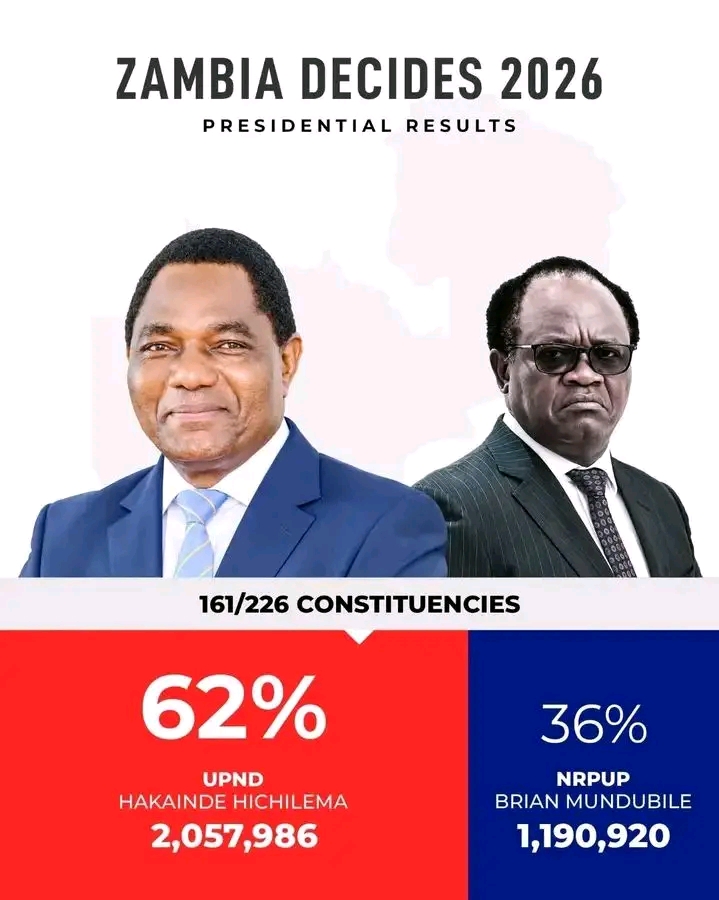
The presidential count has reached a point where the remaining paths are no longer equally difficult. At 161 of 226 constituencies, Hakainde Hichilema has 2,057,986 votes against Brian Mundubile’s 1,190,920, giving the incumbent an 867,066-vote advantage with 65 constituencies remaining. Of the 3,394,098 valid votes reported from these constituencies, Hichilema holds about 60.6%, Mundubile 35.1%, while the remaining candidates share roughly 4.3%.
The speed at which the gap has expanded is more revealing than the lead itself. At 135 constituencies, Hichilema stood at 1,544,140 against Mundubile’s 1,030,662, a difference of 513,478. Mundubile then needed to recover roughly 5,600 net votes per outstanding constituency. Twenty-six declarations later, Hichilema has added 513,846 votes against Mundubile’s 160,258. The incumbent therefore gained another 353,588 votes of net advantage from this batch alone.
That means Hichilema has just averaged a net advantage of approximately 13,600 votes per constituency across the latest 26 declarations. Mundubile must now produce almost the same average, but in reverse, across all 65 remaining constituencies merely to draw level. His required recovery rate has therefore risen from about 5,600 net votes per constituency at 135 declarations to approximately 13,340 now.
The distinction between votes received and net margin is important. If one remaining constituency gives Mundubile 25,000 votes and Hichilema 15,000, Mundubile has recovered only 10,000 votes from the deficit. Even repeating such a performance across all 65 constituencies would recover 650,000, still leaving him more than 217,000 votes behind before accounting for other candidates. He needs victories considerably larger than this on average.
The remaining geography makes the task harder. Our current provincial reconciliation leaves approximately 18 constituencies on the Copperbelt, 11 in Western, seven each in Northern and Lusaka, five each in Eastern, Luapula and North-Western, four in Central, and two each in Muchinga and Southern. There remains a one-constituency discrepancy between the provincial declaration labels and the consolidated national count, which we will reconcile as further ECZ declarations come through. The broad geographical picture, however, is already useful.
Mundubile’s largest remaining opportunity is clearly the Copperbelt. But winning Copperbelt constituencies will not be sufficient. He needs to dominate them. Kalulushi, for example, gave Mundubile 16,112 against Hichilema’s 11,129, producing a net gain of only 4,983. At that rate, Mundubile would need about 174 Kalulushi-sized margins to eliminate the current national deficit. Only 65 constituencies remain.
The problem becomes clearer when compared with Hichilema’s strongest results. Solwezi Central gave Hichilema a 52,129-vote margin, Mongu Central 46,062, Choma Central 28,086, Nangoma 21,542 and Mwinilunga West 20,268. Those five constituencies alone generated a combined net advantage of approximately 168,087 votes for Hichilema. One large Western or North-Western declaration can therefore erase several moderate Mundubile victories elsewhere.
Mundubile is also running out of his strongest geographical reserve. Much of Eastern, Luapula and Muchinga has already entered the count. These are areas where his campaign has demonstrated considerable strength and where much of the former PF presidential vote appears to have consolidated behind him. Western still has a substantial number of constituencies outstanding, while North-Western retains additional returns. Those provinces have so far produced some of Hichilema’s largest percentage and numerical margins.
Copperbelt consequently becomes the critical test. If Mundubile begins producing repeated margins of 15,000, 20,000 or more from its remaining constituencies, the deficit can narrow. But mixed results make a wholesale recovery less straightforward. Kalulushi favoured Mundubile by 4,983, while Luanshya favoured Hichilema by 14,040. Kabwata in Lusaka also went 37,573 to 33,289 for Hichilema. Chimbamilonga in Northern was separated by only 657 votes. Close contests now favour the candidate already leading nationally because every near-even constituency removes another opportunity for Mundubile to recover the deficit.
The remaining electorate provides another useful test. The 161 declared constituencies account for approximately 5.87 million registered voters, leaving roughly 2.91 million registered voters across the outstanding constituencies. Valid presidential votes in declared areas are running at approximately 58% of registered voters. If something close to this rate holds across the remaining electorate, roughly 1.68 million additional valid votes could enter the national tally.
This produces the strongest numerical indication of where the race stands. Ignoring votes going to the other 12 candidates for illustration, Mundubile would need approximately 1.27 million of those hypothetical 1.68 million remaining votes, while Hichilema receives only about 407,000, merely to erase the current 867,066 deficit. That translates to roughly a 75% to 25% split in Mundubile’s favour among the two frontrunners across the outstanding vote. If other candidates continue taking part of the vote, the precise requirement changes slightly, but the central conclusion does not.
Such a reversal is not impossible mathematically. It is, however, far removed from the pattern established across the first 161 constituencies. Hichilema currently holds approximately 60.6% of all valid votes already declared. For Mundubile to recover, the remaining electorate would effectively have to reverse the national pattern and do so overwhelmingly, despite Western and North-Western constituencies still being part of the outstanding map.
This also explains why maps showing constituencies or provinces won can create a distorted impression. Mundubile may finish with substantial geographical representation and could conceivably carry several provinces. But Zambia’s presidential contest ultimately turns on accumulated votes. Winning 10 constituencies by 5,000 votes each creates a 50,000-vote advantage. Losing one constituency by 50,000 removes the entire gain.
The pattern we identified earlier has therefore strengthened rather than weakened: Mundubile has demonstrated considerable geographical reach, while Hichilema has demonstrated greater vote efficiency. Hichilema is winning exceptionally big in his strongest territory and, critically, continuing to collect meaningful numbers in areas he loses. Mundubile has frequently dominated his own strongholds, but not consistently by margins large enough to neutralise Hichilema’s western and southern surpluses.
Our projection can therefore become firmer. Based on the 161 constituencies announced and the geographical composition of the outstanding vote, The People’s Brief projects Hakainde Hichilema as being on course to retain the presidency, barring a substantial reversal across the final 65 constituencies. This is an electoral projection, not a declaration of a winner. ECZ remains responsible for completing the count and announcing the official outcome.
For Mundubile, the route remains mathematically open but politically narrow. He now requires three things to happen simultaneously: very large margins from the remaining Copperbelt and opposition-friendly constituencies, substantially stronger vote efficiency than he has recorded so far, and significantly weaker Hichilema margins from the outstanding Western, North-Western, Central and other competitive constituencies.
At 135 constituencies, Mundubile needed approximately 5,600 net votes per remaining constituency to catch Hichilema. At 161, he needs 13,340. The required recovery rate is rising, not falling.
This is perhaps the clearest indicator in the count.
Hichilema needs the established pattern to continue. Mundubile needs the remaining 65 constituencies to change it.
Projection note: This assessment is based on the consolidated figures and constituency results available at 161 of 226 constituencies. It is not an official declaration of the presidential result.
© The People’s Brief |Ollus R. Ndomu




Community Feedback