
THE ZULU-MUNDUBILE ALLIANCE SENDS PALPABLE TREMORS THROUGH THE UPND

Breaking News Zambia
Local NewsBy Given Mutinta THE ZULU-MUNDUBILE ALLIANCE SENDS PALPABLE TREMORS THROUGH THE UPND The political arena, yesterday, experienced a significant transformation, marked by a potent alliance between Honourable Makebi Zulu, President of the Pamodzi Alliance, and Honourable Brian Mundubile, President of the Tonse Alliance. This strategic pact has sent palpable tremors in the ruling party, the […]
By Given Mutinta
THE ZULU-MUNDUBILE ALLIANCE SENDS PALPABLE TREMORS THROUGH THE UPND
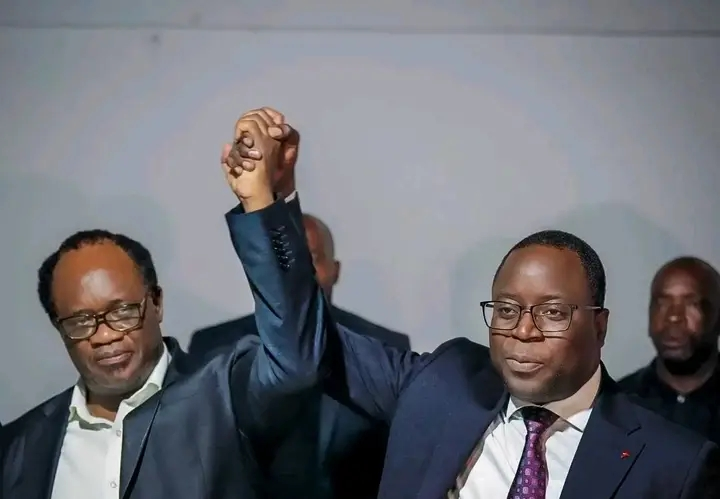
The political arena, yesterday, experienced a significant transformation, marked by a potent alliance between Honourable Makebi Zulu, President of the Pamodzi Alliance, and Honourable Brian Mundubile, President of the Tonse Alliance.
This strategic pact has sent palpable tremors in the ruling party, the United Party for National Development (UPND), which wanted to maintain divisions between Zulu and Mundubile, fundamentally altering the electoral calculus for the upcoming general elections.
The union of Honourable Makebi Zulu and Honourable Brian Mundubile is more than a mere political handshake; it is a strategic amalgamation of deeply rooted support bases.
The confluence of these two formidable political forces, representing significant regional strongholds, has created a formidable electoral bloc that strategically secures votes across the Eastern, Luapula, Northern, Muchinga, Copperbelt, and to a certain extent Lusaka, and Central provinces.
This combined strength creates an almost insurmountable barrier for any political party attempting to gain a foothold in these key regions.
The alliance effectively consolidates a vast swathe of the country, leaving the ruling party strategically disadvantaged.
The unity between Zulu and Mundubile is perceived by many voters as a credible alternative to the incumbent government, especially if Fred M’membe and Harry Kalaba also come on board, tapping into existing sentiments of dissatisfaction and a desire for change.
This strategic alignment allows for the efficient mobilization of resources, coordinated campaign efforts, and a unified message that resonates across diverse provincial demographics.
The alliance’s ability to present a united front, transcending previous party divisions, is a powerful signal to the electorate that a viable and cohesive opposition exists.
The ramifications of the Zulu-Mundubile alliance are starkly evident in the ruling party’s precarious electoral position.
By securing the votes in the Eastern, Luapula, Northern, Muchinga, Copperbelt, and some big chunks in urban Lusaka, and urban Central provinces, the alliance will effectively confine the ruling party’s potential electoral gains to a limited number of regions.
The incumbent government, which was counting on oppositions dividing votes to its advantage, now faces a daunting challenge, with a primary focus on maintaining support in the North-Western, Southern, and Western provinces.
The ruling party now faces the arduous task of overcoming established loyalties and addressing deep-seated grievances in the very regions where the opposition alliance has strongholds.
Any attempt to counter this dominance would require a radical shift in strategy, potentially involving unprecedented “imingalato”, which may not be feasible or electorally beneficial.
The perception of a united and formidable opposition further erodes the ruling party’s narrative that there is no opposition and of invincibility.
Many Zambians, disillusioned by what they perceive as bad governance of the UPND, are actively seeking an alternative, and the Zulu-Mundubile alliance presents itself as that compelling alternative.
The current political climate suggests a strong undercurrent of public desire for change, making the ruling party’s task of maintaining power exceptionally difficult.
The rise of the Zulu-Mundubile alliance is not merely a consequence of strategic political maneuvering; it is also deeply intertwined with the prevailing public sentiment. A significant portion of the electorate cried for this alliance and is resolute in their desire for a change in government, citing concerns related to bad governance encompassing issues such as corruption, oppressive laws, abrogation of the constitution, high cost of living, unfulfilled promises, tribalism, selective justice, occultism, and a lack of responsiveness to the needs of the populace.
The alliance, therefore, acts as a conduit for this widespread desire for change.
By presenting a united front, Zulu and Mundubile are perceived as capable leaders who can usher in a new era of governance.
Their ability to capture the attention and trust of voters in the strategically vital provinces underscores the depth of dissatisfaction with the current leadership.
The challenge for the ruling party is not just to appeal to its traditional base but to persuade a populace that is actively looking for a new direction, especially away from dictatorship.
The alliance, in this context, becomes a symbol of hope and a potential catalyst for the real transformative change many Zambians seek, not rhetoric of the incumbent.



Community Feedback