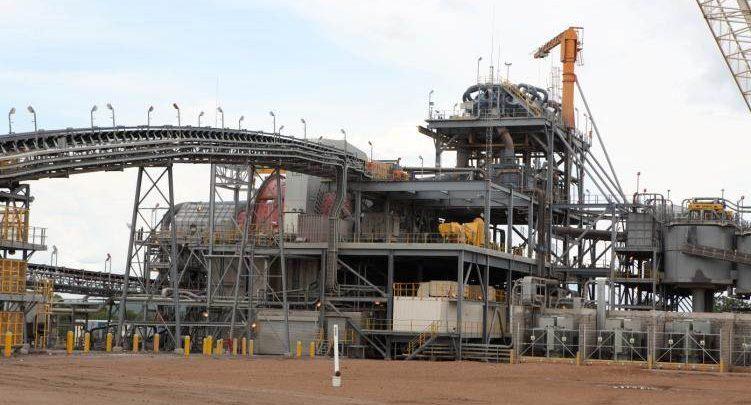
Barrick Lumwana mine urged to be transparent on gold, uranium & cobalt deposits

Breaking News Zambia
NewsThe ongoing $2 billion Lumwana Expansion Project, […]
The ongoing $2 billion Lumwana Expansion Project, led by Canadian mining giant Barrick Gold Corporation, has come under scrutiny for its focus on copper mining, despite holding licenses for multiple minerals including gold, uranium, and cobalt Fresh data obtained by the Zambian Business Times (ZBT) reveal that Barrick Gold, operating Lumwana mine in Zambia’s North Western Province, holds nearly six mining licenses, some with high-grade deposits of minerals aside from copper.
The Expansion Project, located in the same province, is estimated to require a capital expenditure (CAPEX) of approximately USD $2 billion. Official data seen by ZBT, however, confirms that the expansion area contains measurable quantities of gold, cobalt, and uranium alongside copper. According to the official data, the original Lumwana mining license (LML-49), covering roughly 1,355 km², was granted in 2004 for 25 years under the Mines and Minerals Act of 1995.
Following a bankable feasibility study and environmental and social assessments, the license was split into six in 2012 to comply with revised mining regulations. These include licenses 8089-HQ-LML, 9000-HQ-LML, 9001-HQ-LML, and 9003-HQ-LML, among others.
Economist and researcher Salwindi Notulu told ZBT that while mining firms often focus on minerals with the highest commercial volumes, it is vital for both regulators and the public to have transparent data on all minerals available on site, not just copper.
Notulu explained, that although, “Mining companies typically prioritize minerals with the largest volumes, but there is a need for greater accountability on the quantities of gold, uranium, and cobalt present.” He added that uranium, due to its sensitive nature, often has less transparent data disclosures.
“The real question is whether national regulators are equipped to accurately track and verify the volumes of these other minerals. Projected copper outputs are often publicized, but similar data on gold, cobalt, and uranium are rarely made available,” Notulu noted.
Notulu also highlighted a broader pattern in Zambia’s natural resource management, where attention and policy are disproportionately focused on copper at the expense of other valuable minerals. “It’s a similar trend to agriculture, where maize receives more attention than other crops despite their importance,” she said.
According to Notulu, for every mineral, the nation should receive full disclosure of volumes. He emphasized that political will and regulatory enforcement are necessary for such transparency. “Survey reports are shared with authorities, but unless there’s pressure to make this information public, companies may only disclose what is convenient for them,” He concluded.
The call for broader mineral disclosure comes as Zambia aims to ramp up its copper output to 3 million metric tons by 2031. However, industry observers and stakeholders argue that transparency on all resources is crucial for maximizing national benefit and ensuring responsible resource management.
Article by Tyndale Muchiya





Community Feedback